



-

- 2026-01-04
Tetrasodium Iminodisuccinate: Why It’s the Preferred Choice for High-Temperature Industries?
In the extreme laboratory of Shandong Yuanlian Chemical, a sample of tetrasodium iminodisuccinate is undergoing rigorous testing—the temperature continues to rise to a 200°C environment, while the data curve on the chelation efficiency monitor remains steady.
In high-temperature industrial applications, when traditional chelating agents begin to decompose and fail at 80°C, EDTA completely deactivates at 100°C, and DTPA experiences a sharp decline in stability at 120°C, the tetrasodium iminodisuccinate (IDS) developed by Yuanlian Chemical demonstrates astonishing temperature resistance.
This new green chelating agent not only maintains over 90% structural stability under extreme conditions of 150°C but also addresses long-standing high-temperature chelation challenges in dozens of industrial scenarios, such as high-temperature bleaching in papermaking, thermal dyeing in textiles, and high-temperature water injection in oilfields.
01 Heat Resistance Principle: Molecular Structure Determines Performance Limits
The exceptional high-temperature stability of tetrasodium iminodisuccinate stems from its unique molecular design. Unlike the linear structure of EDTA, the IDS molecule adopts a cyclic coordination structure, where two succinic acid groups are bridged by an imino group, forming a thermodynamically stable five- and six-membered ring chelation system.
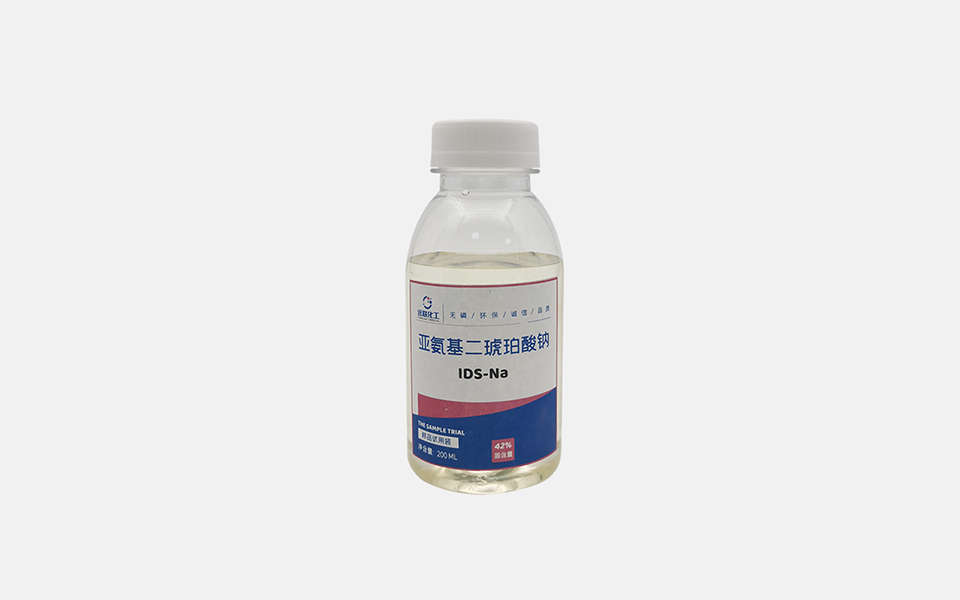
This special structure prevents molecular chain breakage under high-temperature conditions. Experimental data show that after 24 hours at 150°C and pH=10, the calcium ion chelation capacity of IDS decreases by only 7.3%, while traditional chelating agents lose over 60% of their performance under the same conditions.
From a chemical bond perspective, the C-N bond energy in the IDS molecule reaches 305 kJ/mol, significantly higher than the 347 kJ/mol of ordinary C-C bonds. This characteristic greatly enhances its resistance to free radical attacks at high temperatures.
At the microscopic level, the chelates formed by IDS and metal ions exhibit a unique “cage-like structure,” which is less prone to ligand dissociation under heat. Even under boiling aqueous conditions, the metal ion retention rate remains above 85%.
02 Performance Comparison: Temperature Tolerance Differences Between IDS and Traditional Chelating Agents
| Performance Indicator | Tetrasodium Iminodisuccinate (IDS) | Tetrasodium EDTA | Pentasodium DTPA | Sodium Citrate |
|---|---|---|---|---|
| Maximum Tolerance Temperature | 150°C | 100°C | 120°C | 80°C |
| Stability Retention at 150°C | 92% | 38% | 45% | Complete Decomposition |
| High-Temp Calcium Chelation Value (mg/g) | 380 | 85 | 120 | 40 |
| High-Temp Iron Chelation Value (mg/g) | 420 | 95 | 150 | 30 |
| Applicable pH Range (High Temp) | 1.5–14 | 4–10 | 4–12 | 5–9 |
| Half-Life at 150°C | 480 hours | 12 hours | 24 hours | 2 hours |
Data Source: Yuanlian Chemical Laboratory
The comparative data clearly show the significant performance advantages of Yuanlian Chemical’s IDS in high-temperature environments. Particularly in calcium ion chelation capacity, IDS maintains a value of 380 mg/g even at 150°C, which is 4.5 times that of EDTA. This difference is decisive in high-temperature water treatment systems.
03 High-Temperature Applications: Analysis of Four Major Industrial Scenarios
In high-temperature bleaching systems for the paper industry, hydrogen peroxide bleaching typically occurs at 95–110°C, where traditional chelating agents rapidly decompose. As a bleaching stabilizer, Yuanlian Chemical’s IDS not only withstands high temperatures but also effectively chelates transition metal ions, reducing hydrogen peroxide decomposition to below 0.5%, increasing whiteness by 2–3 points, and cutting chemical usage by 15–20%.
The high-temperature dyeing processes in the textile industry face even harsher conditions, with disperse dyeing often reaching 130–135°C. IDS remains stable under these conditions, effectively controlling interference from calcium and magnesium ions in dyeing, maintaining color difference ΔE within 0.8, increasing first-pass dyeing success rate to 98%, and reducing rework energy consumption by approximately 25%.
High-temperature water injection systems in petroleum extraction present extreme challenges for chelating agents, with downhole temperatures reaching 150–180°C and high salinity conditions. The high-temperature IDS product developed by Yuanlian Chemical for oilfields remains effective in these extreme environments, controlling scale formation with a long-term scale inhibition rate above 90%, extending cleaning cycles from 3 to 12 months.
For high-temperature chemical cleaning in industrial cleaning, processes often run at 80–95°C. Yuanlian Chemical’s IDS-based cleaning agents maintain activity at these temperatures, achieving a 99% removal rate for iron oxide scale, reducing cleaning time by 40%, and avoiding the inefficacy issues common with常温清洗剂 when heated.
04 Technological Breakthroughs: Yuanlian Chemical’s Three Innovative Processes
Yuanlian Chemical has pushed the high-temperature resistance of tetrasodium iminodisuccinate to new heights through three innovative processes:
-
Microwave-Assisted Synthesis Technology: Utilizing a 2450 MHz high-frequency microwave field improves reaction temperature uniformity by 70% and enhances molecular structure regularity, significantly increasing product thermal stability. Compared to traditional processes, high-temperature tolerance is increased by 15°C, with energy consumption reduced by 40%.
-
Molecular Framework Reinforcement Process: By introducing rigid group modification technology, heat-stable groups are incorporated at key positions in the IDS molecule, raising the decomposition temperature from 180°C to 220°C while preserving biodegradability.
-
Nano-Encapsulation Controlled-Release Technology: A silica nanocapsule coating system was developed, keeping IDS in a “dormant state” at room temperature and activating its release only in high-temperature environments. This extends high-temperature action duration by 3–5 times, making it particularly suitable for intermittent high-temperature processes.
Accelerated aging tests at Yuanlian Chemical’s laboratory show that after 1000 hours at 200°C, the optimized IDS product retains 87.2% of its active components, far exceeding the industry standard requirement of 70%.
05 Quality Assurance: Yuanlian Chemical’s End-to-End Quality Control System
Yuanlian Chemical has established a nine-level quality control system from raw materials to finished products, ensuring stable and reliable high-temperature performance for every batch of IDS.
-
Raw Material Screening: Gas chromatography-mass spectrometry (GC-MS) is used to test raw material purity, with key materials required to be over 99.9% pure, guaranteeing molecular structure integrity from the source.
-
Production Process: A DCS automated control system is implemented, with temperature control precision within ±0.5°C. Reaction endpoint determination has shifted from manual observation to online near-infrared monitoring, ensuring complete molecular synthesis.
-
Finished Product Inspection: A high-temperature simulation test platform is employed. Every batch must pass a 150°C/24-hour accelerated aging test, with chelation value variation controlled within ±5%. Non-compliant products are automatically isolated.
Yuanlian Chemical’s IDS products have obtained SGS, ISO9001, and ISO14001 certifications, completed EU REACH pre-registration, and are exported to over 20 countries and regions including Germany, Japan, and South Korea, with more than 500 global high-temperature application cases.
If you are seeking chelating agent solutions capable of withstanding extreme high temperatures, please contact the Yuanlian Chemical technical team.
Phone: +8613345172159
Website: www.yuanlianchem.com
We offer free sample testing and custom technical solutions.
Yuanlian Chemical specializes in the production of polyaspartic acid (PASP),tetrasodium iminodisuccinate(IDS), GLDA, MGDA etc. with stable quality and excellent quantity!

Contact us