

-

- 2026-04-09
Bulk MGDA-Na3 40% Liquid vs. Powder: Which Form is Most Cost-Effective for Your Production?
As the global demand for phosphate-free and readily biodegradable chelants accelerates, MGDA-Na3 has become the gold standard for high-performance automatic dishwashing (ADW) and industrial degreasing. However, a critical decision remains for the 2026 formulator: Sourcing the 40% Liquid or the 92%+ Powder?
While price-per-kilogram is the starting point, the true "cost-effective" choice depends on your facility's infrastructure, logistics, and end-product requirements.
1. The Logistics & Storage Equation
The most immediate difference lies in transport and warehouse footprint.
-
The Powder Advantage: With an active content of ≥92%, MGDA powder is the most efficient for long-distance international shipping. You are not paying to transport water. For manufacturers in regions with high logistics costs, powder significantly reduces the carbon footprint per active ton.
-
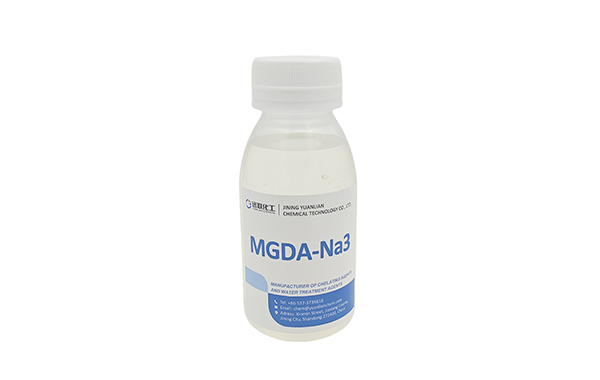
The Liquid Reality: The 40% Liquid contains 60% water. However, for domestic sourcing or proximity to a manufacturer (such as the Yuanlian Chemical cluster in Shandong), the liquid form eliminates the energy-intensive spray-drying cost, often resulting in a lower unit price per active matter.
2. Processing and Manufacturing Efficiency
Operational costs inside the factory often outweigh the initial purchase price.
-
Liquid (Plug-and-Play): MGDA 40% Liquid is ideal for automated continuous production lines. It can be metered directly into mixing vats via high-precision pumps, reducing labor costs and eliminating the risk of "dusting" in the workplace.
-
Powder (The Dissolution Step): Using powder requires a dissolution stage. This involves industrial agitators, energy for heating (to speed up solubility), and the potential for "caking" if storage conditions are not humidity-controlled. However, if you are producing dry-mix detergents or tablets, powder is the only viable technical choice.
3. Performance and Formulation Stability
From a chemical standpoint, both forms provide the same powerful chelation (approximately 150–160 mg /g for the 40% liquid).
-
Stability: MGDA-Na3 40% Liquid is engineered for stability. With a density of 1.28–1.33 g/cm³, it remains a clear, homogenous solution that is easy to incorporate into liquid laundry detergents or high-alkaline CIP (Clean-in-Place) cleaners.
-
Purity: MGDA Powder is often perceived as "purer," but in 2026, high-tier liquid production ensures NTA levels remain <0.1%, meeting all REACH and safety benchmarks.
4. Total Cost of Ownership (TCO) Comparison
5. Strategic Sourcing in 2026
For the 2026 procurement cycle, the most cost-effective strategy is often a Hybrid Approach:
-
Direct Sourcing: By sourcing directly from an upstream manufacturer like Yuanlian Chemical, you minimize the "middleman" markup on both forms.
-
Infrastructure Alignment: If your plant is equipped with bulk liquid storage, the 40% liquid typically offers the best ROI due to reduced processing time and lower energy consumption.
-
Export Strategy: For regional hubs far from the production source, the 92% powder serves as the "concentrate" that is reconstituted locally to save on global freight.
Conclusion: Which is Right for You?
There is no universal winner; only the right fit for your specific "Formulation-to-Market" path. If your priority is operational speed and local sourcing, the 40% Liquid is the clear victor. If your focus is global distribution and dry-mix stability, the 92% Powder remains the industry essential.
Yuanlian Chemical specializes in the production of polyaspartic acid (PASP),tetrasodium iminodisuccinate(IDS), GLDA, MGDA etc. with stable quality and excellent quantity!

Contact us