


-

- 2026-05-06
Comparing Chelating Strength: EDDS-Na3 vs. EDTA in Laundry Detergents and Personal Care Formulations
In the 2026 consumer goods landscape, the transition from "functional" to "responsible" chemistry is complete. For formulators of laundry detergents and personal care products, the choice of chelating agent (sequestering agent) is a critical decision that impacts product stability, cleaning efficacy, and environmental labeling.
While EDTA (Ethylenediaminetetraacetic acid) has been the historical benchmark for chelating strength, EDDS-Na3 (Trisodium Ethylenediamine Disuccinate) has emerged as the premier biodegradable rival. This article provides a deep-dive comparison of their stability constants, performance in hard water, and suitability for modern "Green" formulations.
1. The Core Comparison: Chelating Strength and Stability
The effectiveness of a chelant is measured by its Stability Constant ($Log K$). This value represents the strength of the bond between the "claw" (the chelant) and the metal ion ($Ca^{2+}, Mg^{2+}, Cu^{2+}, Fe^{3+}$).
EDTA: The Strongest Synthetic Link
EDTA is known for its exceptionally high stability constants across almost all metal ions. It forms a hexadentate complex that is nearly impossible to break, making it ideal for removing stubborn mineral scales and preventing oxidation.
EDDS-Na3: The Precision Performer
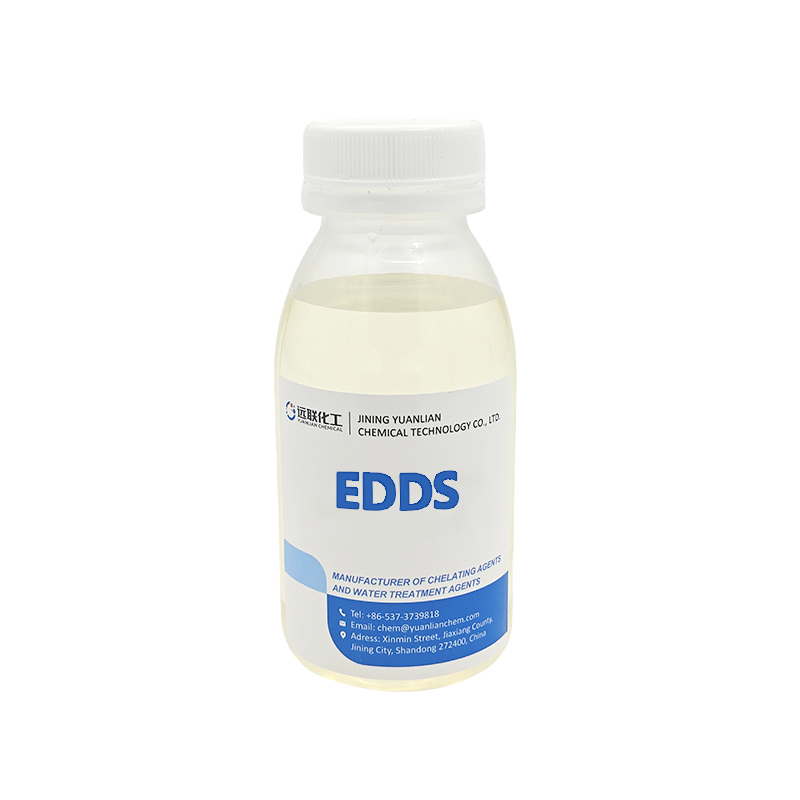
EDDS-Na3, particularly the [S,S]-isomer produced by Yuanlian Chemical, offers a stability profile that is strategically optimized for HPC applications.
-
Transition Metal Affinity: EDDS has a higher specific affinity for Copper ($Cu^{2+}$) and Zinc ($Zn^{2+}$) than EDTA. In hair care, this is crucial for preventing copper-induced oxidative damage during coloring or UV exposure.
-
Hard Water Management: While EDTA is slightly stronger on Calcium, EDDS-Na3 is more than sufficient for managing water hardness in standard laundry cycles and shower environments.
2. Performance in Laundry Detergents
In laundry formulations, the primary role of a chelant is to prevent "graying" of clothes and to protect enzymes from heavy metal interference.
-
Stain Removal: EDDS-Na3 excels in removing transition-metal-containing stains (like tea, coffee, or wine) by sequestering the metal "bridge" that binds the stain to the fabric.
-
Bleach Stabilization: EDDS-Na3 is highly effective at stabilizing peroxide-based bleaches. By "locking up" trace iron and manganese, it prevents the premature decomposition of the bleach, ensuring it activates on the fabric rather than in the bottle.
-
Formula Transparency: EDDS-Na3 is highly soluble and remains stable in concentrated liquid detergents, ensuring the product stays clear and shelf-stable in 2026's "ultra-compact" formats.
3. Personal Care and Cosmetics: The Safety Edge
In shampoos, body washes, and skincare, EDDS-Na3 is rapidly replacing EDTA due to its superior safety and environmental profile.
-
Preservative Booster: Like EDTA, EDDS-Na3 acts as a potent synergistic agent for preservatives. It weakens the cell walls of bacteria by removing essential minerals, allowing for lower (and safer) concentrations of active preservatives.
-
Antioxidant Protection: In skincare, EDDS-Na3 prevents the catalytic oxidation of oils and fragrances caused by trace metals, significantly extending the product's shelf life and maintaining its sensory profile.
-
Non-Irritating: EDDS-Na3 is recognized for its gentle profile on the skin and eyes, making it the preferred choice for "Sensitive Skin" and "Baby Care" lines.
4. The 2026 Environmental Mandate: Biodegradability
The most significant divergence between these two molecules is their environmental fate.
| Environmental Metric | Traditional EDTA | Green EDDS-Na3 |
| Origin | Petrochemical / Formaldehyde | Biomimetic / Amino Acid Derived |
| Biodegradability | Persistent (Fails OECD 301) | Ready Biodegradable (>80% in 28 days) |
| Metal Remobilization | High Risk (Leaches metals in rivers) | Zero (Breaks down before leaching) |
| Regulatory Status | Restricted (EU Ecolabel / REACH) | Preferred (Eco-Label Friendly) |
EDDS-Na3 is the only strong chelant that is Readily Biodegradable according to OECD 301B standards. It breaks down into harmless nitrogen and carbon components, ensuring it does not accumulate in the ecosystem—a non-negotiable requirement for 2026's "Blue Beauty" and "Eco-Laundry" trends.
5. Strategic Sourcing: Why Yuanlian Chemical?
Transitioning from EDTA to EDDS-Na3 requires a partner that ensures isomeric purity. Only the [S,S]-isomer of EDDS is truly biodegradable. Yuanlian Chemical provides high-purity [S,S]-EDDS-Na3 specifically engineered for the HPC sector, offering:
-
Enhanced Solubility: Optimized for liquid concentrates.
-
Low Color/Odor Profile: Ensuring zero impact on your formulation's aesthetics.
-
Technical Support: Assisting your R&D team in re-balancing stability for "drop-in" replacements.
Conclusion: The New Standard for 2026
While EDTA remains a powerful tool, the technical and environmental advantages of EDDS-Na3 make it the superior choice for modern laundry and personal care formulations. By choosing EDDS-Na3, you aren't just selecting a chelant; you are future-proofing your brand against regulatory shifts and aligning with the 2026 consumer's demand for high-performance, planet-safe products.
Yuanlian Chemical specializes in the production of polyaspartic acid (PASP),tetrasodium iminodisuccinate(IDS), GLDA, MGDA etc. with stable quality and excellent quantity!

Contact us