


-

- 2026-05-25
Optimising Peroxide Bleach Stability in Concentrated Liquid Detergents: The Role of Tetrasodium Iminodisuccinate
In the formulation of premium concentrated liquid detergents, achieving a long shelf-life while ensuring powerful stain removal remains a significant challenge. Hydrogen peroxide and other peroxygen bleaches are highly valued for their ability to eliminate tough organic stains like tea, coffee, wine, and juice. However, these bleaching agents are inherently unstable in liquid matrices. They are prone to rapid decomposition, which leads to diminished washing performance, container bloating, and product degradation.
The primary catalysts for this breakdown are trace heavy metal ions—such as Iron Fe3+, Copper Cu2+, and Manganese Mn2+—introduced through raw materials or process water. To mitigate this flaw without resorting to persistent synthetic chemicals, modern formulation design relies on Tetrasodium Iminodisuccinate (IDS) as an environmentally responsible, high-efficiency peroxide stabilizer.
1. The Chemistry of Instability: How Trace Metals Ruin Liquid Bleach
Hydrogen peroxide (H2O2) is a sensitive molecule. In an ideal environment, it remains intact until triggered during the wash cycle. However, when trace heavy metal contaminants are present in a liquid detergent, they initiate a catalytic chain reaction known as Haber-Weiss and Fenton-like pathways.
Even at concentrations as low as a few parts per billion (ppb), these transition metals continuously break down hydrogen peroxide into water and oxygen gas. The consequences for liquid detergent formulations are severe:
Loss of Efficacy: The bleach decomposes prematurely inside the bottle, leaving little to no active oxygen available to remove stains when the consumer does the laundry. Package Deformation (Bloating): The continuous generation of oxygen gas creates severe internal pressure, causing plastic bottles to bloat, distort, or even leak during transit and shelf display. Viscosity and Surfactant Degradation: The free radicals generated during metal-catalyzed decomposition attack the carbon chains of adjacent surfactants and polymer thickeners, causing the liquid detergent to thin out, separate, or discolor.
2. Deactivating the Catalysts: How Tetrasodium Iminodisuccinate (IDS) Works
Traditional chelates like EDTA and Phosphonates (ATMP/DTPMP) are strong metal binders, but their poor environmental profiles make them increasingly unviable. Tetrasodium Iminodisuccinate (IDS) offers an elegant green alternative that provides precise peroxide protection through advanced chelation kinetics:
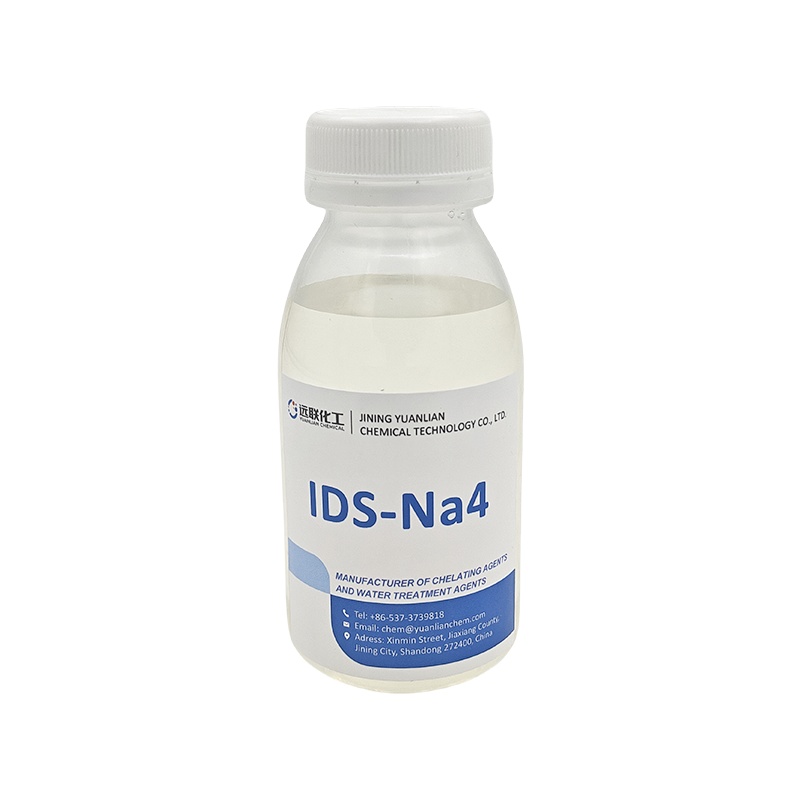
Multi-Dentate Heavy Metal Sequestration: The molecular structure of IDS features a central imino group combined with multiple carboxyl groups. This configuration allows it to form highly stable, water-soluble octahedron complexes with transition metal ions like Fe3+, Cu2+, and Mn2+. By completely enveloping these ions, IDS deactivates their catalytic surfaces, putting a stop to peroxide breakdown. Excellent Alkaline Synergy: Peroxide-based liquid bleaches require a slightly alkaline to neutral pH to optimize shelf stability while maintaining high performance. IDS maintains robust chelation capacity and exceptional structural integrity across these targeted pH ranges, avoiding the premature hydrolysis that plagues weaker organic salts. Prevention of Radical Runaway: By securely locking away transition metals, IDS eliminates the root cause of radical generation, preserving both the active oxygen content and the physical structural viscosity of the concentrated liquid matrix.
3. Aligning with Green Chemistry: Environmental Advantages of IDS
Beyond its technical merits as a bleach stabilizer, Tetrasodium Iminodisuccinate is a model compound for modern green chemistry. It resolves the long-standing conflict between high performance and ecological safety:
Ultimate Biodegradability: Unlike persistent phosphonates and EDTA, IDS passes the standard OECD 301E and OECD 302B tests with ease. It degrades quickly into non-toxic, natural components, preventing heavy metal accumulation and mobilization in aquatic ecosystems. Favorable Toxicological Profile: IDS is completely non-toxic to aquatic life, phosphorus-free, and skin-friendly, making it an excellent structural component for detergents striving for EU Ecolabel, Nordic Swan, or Safer Choice certifications.
Conclusion: Future-Proofing Premium Bleach Liquids
Optimizing peroxide stability no longer requires sacrificing your green credentials. By integrating Tetrasodium Iminodisuccinate into concentrated liquid detergents, manufacturers can completely prevent bottle bloating, preserve bleaching power over extended shelf-lives, and deliver a high-performance product that meets the strictest environmental mandates.
Secure Your Liquid Bleach Formulations
Are you experiencing package bloating, active oxygen loss, or viscosity drops in your concentrated peroxide formulas? Contact our upstream chemical engineering team today to receive specialized stability data, dosage optimization models, and high-purity Tetrasodium Iminodisuccinate (IDS) samples for your laboratory verification.
Request IDS Technical Samples & Data Sheets
Yuanlian Chemical specializes in the production of polyaspartic acid (PASP),tetrasodium iminodisuccinate(IDS), GLDA, MGDA etc. with stable quality and excellent quantity!

Contact us