



-

- 2026-06-04
Biodegradability and Ecotoxicity Profile of Tetrasodium Aspartate Diacetate (ASDA)
For years, the word “biodegradable” has been thrown around rather loosely in the chemical industry. But European regulators—and increasingly, formulators themselves—are demanding more than claims. They want data. They want proof. And they want products that break down completely, not just partially, leaving no persistent residues behind.
Tetrasodium Aspartate Diacetate (ASDA) belongs to a new generation of chelating agents designed specifically to meet these exacting standards. Built on an aspartic acid backbone, it promises both high performance and genuine environmental compatibility. But what does the science actually say? Let's look at the numbers—the biodegradation rates, the ecotoxicity data, and how ASDA compares to the persistent chelators it is designed to replace.
What Is ASDA? A Quick Chemical Overview
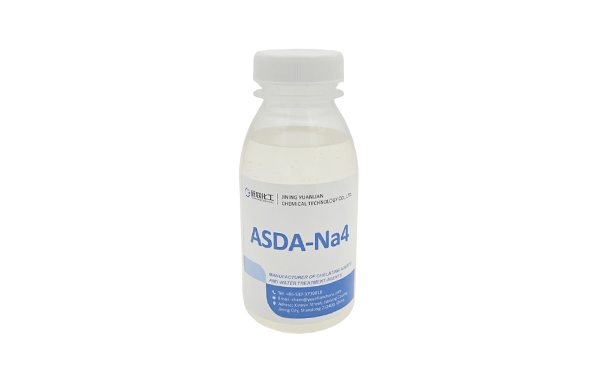
ASDA (tetrasodium aspartate diacetate, CAS 34612-80-1) is an aminopolycarboxylic acid chelator derived from L-aspartic acid—a naturally occurring amino acid. Its molecular formula is C₈H₇NNa₄O₈, and its structure features a central nitrogen atom with multiple carboxylate “arms” that bind tightly to metal ions like calcium, magnesium, iron, and copper.
As a pentadentate ligand (meaning it can form five coordinate bonds with a central metal ion), ASDA offers strong chelation performance across a broad pH range, typically from 2 to 14. It is supplied as a clear, light-yellow liquid with a solid content of at least 55% and a density above 1.20 g/cm³. Importantly, it contains no phosphorus—already a major advantage for anyone trying to avoid eutrophication risks in surface waters.
But the real story lies in how it behaves once it has done its job.
Biodegradability: Breaking Down, Not Building Up
The OECD Test Results
The gold standard for assessing ready biodegradability in Europe is the OECD test series. For ASDA, the data is impressive. According to testing based on OECD 302A (modified SCAS method), ASDA achieves a biodegradation rate of over 90%. Other sources cite figures exceeding 90% under OECD 301B conditions as well.
To put that in perspective: the EU Detergents Regulation (EC No 648/2004) requires a “readily biodegradable” classification for any chelator used in a detergent formulation. The pass mark is 60% degradation within 28 days. ASDA not only passes—it significantly exceeds the threshold.
Why This Matters for European Compliance
Traditional chelators like EDTA and DTPA stubbornly resist biological breakdown. They persist in rivers, lakes, and soils for weeks or even months. This persistence has made them a target for regulators across the EU. Some countries have already restricted or banned their use in certain applications.
ASDA, by contrast, is part of a new wave of “readily biodegradable” aminopolycarboxylic acids developed specifically to address these concerns. It breaks down into harmless natural components—aspartic acid and acetate—under aerobic conditions. No accumulation. No lingering liability.
What About Marine Biodegradability?
This is where ASDA offers a genuine point of difference. Many biodegradable chelators break down well in freshwater but struggle in colder, saltier marine environments. ASDA, however, has been shown to exhibit no bioaccumulation potential. It does not hang around in sediments or build up in aquatic food chains.
For brands selling into Scandinavian markets or pursuing Nordic Swan Ecolabel certification, this is a serious advantage.
Ecotoxicity: Is ASDA Harmful to Aquatic Life?
Biodegradability is only half the equation. A chemical can break down quickly but still be acutely toxic to fish, algae, or daphnia while it is present. So how does ASDA perform?
Acute Toxicity to Fish
According to available data, the 48-hour LC50 for ASDA in killifish (medaka, a standard test species) is 750 mg/L. That figure is comfortably above the 100 mg/L threshold typically used to classify a substance as “harmful to aquatic life.”
In plain terms: ASDA is not acutely toxic to fish at anything approaching realistic environmental concentrations.
Overall Safety Profile
Beyond aquatic toxicity, ASDA has been evaluated for mammalian safety as well. The acute oral LD50 (rats) is >2000 mg/kg, placing it in the low-toxicity category. It is non-mutagenic (Ames test negative), shows no chromosomal aberrations, and is neither a skin irritant nor a skin sensitiser. The No-Observed-Adverse-Effect Level (NOAEL) is consistent with other next-generation chelators.
For formulators of household products, personal care items, or food-contact cleaners, this safety profile is reassuring.
How ASDA Compares to Traditional and Alternative Chelators
Here is a side-by-side look at how ASDA stacks up against both the old guard and other biodegradable options.
| Chelator | Ready Biodegradability (28d OECD) | Marine Biodegradability | Acute Fish Toxicity (LC50) | Regulatory Status in EU |
|---|---|---|---|---|
| EDTA | <20% (non) | Poor | ~500 mg/L | Increasingly restricted |
| DTPA | <20% (non) | Poor | ~400 mg/L | Restricted |
| NTA | <30% (slow) | Unknown | ~200 mg/L | Carcinogen concern, restricted |
| MGDA | >80% | Moderate | >100 mg/L | Preferred chelator |
| GLDA | >90% | Good | >100 mg/L | Preferred chelator |
| ASDA | >90% | Good (no bioaccumulation) | 750 mg/L | Eligible for ecolabels |
What becomes clear is that ASDA performs at the same level as GLDA and MGDA—the current market leaders in biodegradable chelators—while offering a distinct ecotoxicity advantage in the fish toxicity data.
What the Scientific Literature Says
The research community has taken notice of ASDA. A comprehensive 2022 review published in RSC Advances (a peer-reviewed journal from the Royal Society of Chemistry) specifically identified ASDA as one of the “new generation, pentadentate chemicals developed in response to a growing need for biodegradable chelating agents to replace non-biodegradable ones such as EDTA and DTPA”.
The same review notes that ASDA has been proposed as a viable substitute for EDTA in environmental remediation applications—specifically, cleaning soils contaminated with heavy metals like copper(II) and lead(II) ions. This speaks to both its chelation strength (it can mobilise bound metals) and its environmental acceptability (it does not linger afterwards).
In the oil and gas sector, ASDA has been evaluated alongside GLDA and MGDA for downhole applications. While one SPE paper concluded that GLDA is the most versatile option for that specific industry, ASDA was still described as a “readily biodegradable” candidate with genuine potential for replacing traditional chelators.
Regulatory Status in Europe
REACH and CLP
ASDA is fully REACH registered. Importantly, it is not classified as hazardous under the CLP Regulation (EC 1272/2008) for any endpoint—no acute toxicity, no skin corrosion, no eye damage, no sensitisation, no mutagenicity, no reproductive toxicity. This simplifies Safety Data Sheet preparation and downstream compliance.
EU Ecolabel and Other Certifications
Because of its biodegradability and low ecotoxicity, ASDA is eligible for use in EU Ecolabel products. It contains no phosphorus, so it does not contribute to eutrophication. For formulators pursuing Nordic Swan, Blue Angel, or ZDHC (Zero Discharge of Hazardous Chemicals) compliance, ASDA is a safe choice.
Practical Implications for Formulators
So what does all this mean if you are actually trying to replace EDTA in a commercial formulation?
First, the biodegradability data gives you a defensible marketing claim. You are not just saying “eco-friendly” without evidence. You can cite OECD test results.
Second, the low ecotoxicity means you are unlikely to face surprises in wastewater treatment or regulatory audits. ASDA will not harm the bacteria in your effluent plant, and it will not accumulate in receiving waters.
Third, because ASDA is already listed as a preferred chelator in several ecolabel frameworks, switching to it can help you qualify for certifications that might have been out of reach when you were using EDTA or phosphonates.
For brands like Yuanlian Chemical that manufacture high-purity ASDA meeting European specifications, the value proposition is straightforward: performance without persistence. The chelation numbers are good. The environmental profile is excellent. And the regulatory pathway is already mapped out.
Conclusion: ASDA as the Evidence-Based Choice
European formulators are under more pressure than ever to justify every ingredient in their products. “Because it works” is no longer enough. Regulators want to see biodegradation curves. Consumers want to see ecolabel logos. And compliance officers want to see REACH dossiers.
Tetrasodium Aspartate Diacetate (ASDA) delivers on all three fronts. It chelates effectively, breaks down completely (>90% in 28 days), and shows low toxicity to aquatic life (LC50 > 750 mg/L). It is not a niche “green” ingredient—it is a legitimate, data-backed alternative to the persistent chelators that Europe is steadily leaving behind.
If you are currently reformulating to meet EU Ecolabel, Nordic Swan, or simply your own sustainability targets, ASDA deserves a place on your shortlist.
Yuanlian Chemical specializes in the production of polyaspartic acid (PASP),tetrasodium iminodisuccinate(IDS), GLDA, MGDA etc. with stable quality and excellent quantity!

Contact us