



-

- 2026-06-08
Hydrogen Peroxide Stabilization: Utilizing Biodegradable IDS to Inhibit Heavy Metal Catalyzed Decomposition
Anyone who has worked with hydrogen peroxide in an industrial setting knows the frustration. You prepare a bleaching bath or a cleaning solution with exactly the right concentration. Within hours, maybe less, the active oxygen content drops. Bubbles appear where they should not. And your process results become inconsistent.
The culprit is almost always metal ions. Iron, copper, manganese – even at parts per million levels – catalyse the decomposition of hydrogen peroxide into water and oxygen. The reaction generates heat, which accelerates further decomposition. In closed systems, pressure builds. In open systems, you lose bleaching power and gain nothing but wasted chemical and rejected product.
Traditional stabilisers exist, of course. Sodium silicate works but leaves deposits. Phosphonates are effective but raise environmental concerns. EDTA stabilises well but does not biodegrade, and European regulators are watching it closely.
This is where tetrasodium iminodisuccinate, or IDS, enters the conversation.
What Makes IDS Different from Traditional Stabilisers
IDS is a chelating agent, which means it binds metal ions and removes them from solution. When metal ions are bound, they cannot catalyse the decomposition of hydrogen peroxide. The principle is straightforward. The execution is where IDS distinguishes itself.
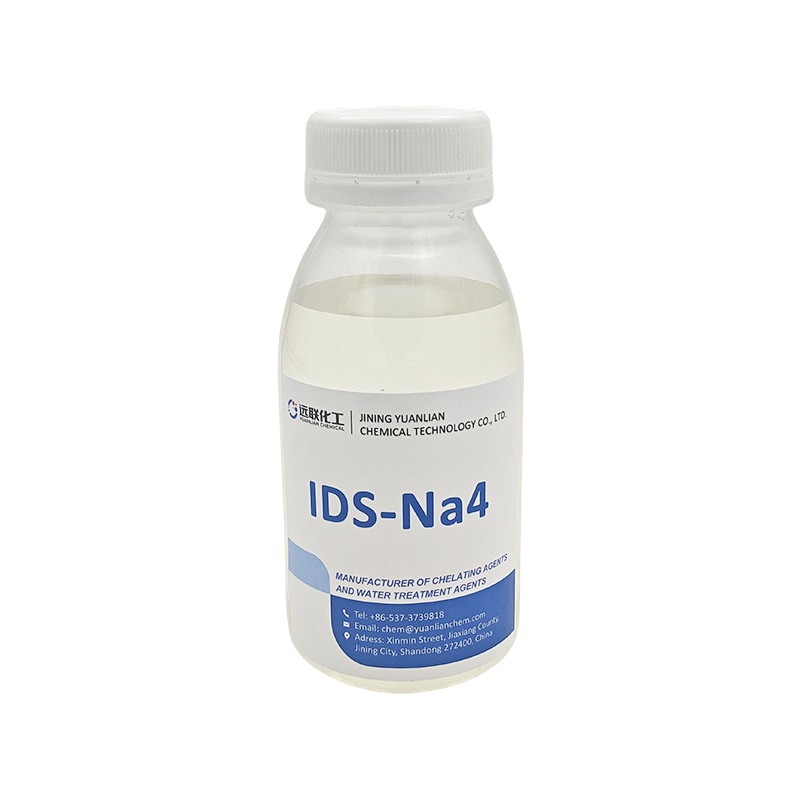
Unlike EDTA, IDS is readily biodegradable. OECD 301 tests show degradation above sixty percent within twenty-eight days. Unlike phosphonates, IDS contains no phosphorus, so it does not contribute to eutrophication in receiving waters. Unlike silicate, IDS leaves no residue on equipment or fabrics.
The molecular structure of IDS is designed around iminodisuccinate, which forms stable complexes with iron, copper, manganese, and other transition metals. The stability constants are high enough to compete with the metal ions' affinity for hydrogen peroxide, but not so high that the chelates persist in the environment after treatment.
For European manufacturers facing pressure to reduce their environmental footprint while maintaining process reliability, this combination of performance and biodegradability is increasingly attractive.
How IDS Performs in Real Industrial Conditions
Laboratory data is useful, but what matters is how IDS works on your production floor.
In textile bleaching, where hydrogen peroxide is used to whiten natural and synthetic fibres, IDS has been tested against conventional stabilisers across multiple trials. The results consistently show decomposition rates reduced by fifty to seventy percent compared to unstabilised controls, and performance comparable to EDTA at equivalent molar dosages.
The mechanism is straightforward. IDS chelates iron and copper ions before they can initiate the free radical chain reaction that breaks down hydrogen peroxide. With the metal ions sequestered, the peroxide remains available for the intended oxidation reaction rather than decomposing prematurely.
Temperature matters. IDS remains effective at typical bleaching temperatures ranging from sixty to ninety-five degrees Celsius. Some stabilisers lose efficiency at higher temperatures as their metal complexes become less stable. IDS maintains its performance across this range.
pH also matters. IDS works across a broad pH spectrum from mildly acidic to strongly alkaline. For hydrogen peroxide applications, which often run at alkaline pH to activate the bleaching chemistry, this compatibility is essential.
Comparing IDS to Other Chelating Stabilisers
| Stabiliser | Biodegradability | Thermal Stability | Scale Risk | Regulatory Status in Europe |
|---|---|---|---|---|
| IDS | Rapid (OECD 301) | Good to 95°C | None | REACH compliant, no restrictions |
| EDTA | Very slow / none | Good to 95°C | None | Under review, environmental concerns |
| DTPA | Very slow | Excellent to 120°C | None | Similar concerns as EDTA |
| Phosphonates | Poor to moderate | Good to 90°C | Can form calcium phosphonate scale | Restricted in some EU detergents |
| Silicate | N/A (inorganic) | Excellent | Forms silicate scale | No restrictions, but scaling issues |
For most European industrial users, the choice comes down to a trade-off between performance and environmental acceptability. IDS offers a way to avoid that trade-off.
Practical Guidelines for Using IDS in Hydrogen Peroxide Stabilisation
If you are considering switching to IDS, here is what you need to know.
Dosage depends on the metal ion concentration in your process water and feedstock. A typical starting point is a one-to-one molar ratio of IDS to total transition metals, measured as iron equivalent. For most applications, this translates to between fifty and two hundred grams of IDS active per cubic metre of solution.
Add IDS to the water before adding hydrogen peroxide. This allows the chelator to bind metal ions before they encounter the peroxide. If you add IDS afterward, some decomposition may have already occurred.
The order of addition matters for other components too. If your formulation includes surfactants or other auxiliaries, add IDS early in the mixing sequence.
Testing is essential when switching from any existing stabiliser. Conduct small-scale trials measuring hydrogen peroxide concentration over time under your actual process conditions. Compare decomposition rates, final product quality, and any effects on other performance parameters.
Why European Buyers Are Moving to IDS Now
The regulatory environment for chelating agents in Europe is shifting. EDTA has been on the radar of environmental agencies for years due to its persistence. Several EU member states have signalled interest in tighter restrictions. Meanwhile, consumer brands are pushing their suppliers toward more sustainable chemistries.
IDS is already approved for use under EU Ecolabel criteria for detergents and cleaning products. It is listed by Nordic Swan and Blue Angel. It appears on the ECOCERT positive list for natural cosmetics. For manufacturers seeking these certifications, switching to IDS simplifies the process.
Beyond compliance, there is the question of supply chain resilience. Manufacturers who rely on EDTA may find their options narrowing as the regulatory pressure increases. Those who qualify IDS now, while both options are available, will be better positioned when the transition becomes necessary.
Final Thoughts
Hydrogen peroxide stabilisation does not have to be a choice between performance and environmental responsibility. IDS provides effective metal chelation, consistent decomposition inhibition, and a clean environmental profile all in one product.
For European industrial formulators, that combination is increasingly difficult to ignore. The technology is proven. The regulatory path is clear. And the cost, while slightly above conventional options on a pure price basis, is competitive when evaluated on total cost of ownership including compliance, waste handling, and customer requirements.
At Yuanlian Chemical, we supply tetrasodium iminodisuccinate for hydrogen peroxide stabilisation across textile, paper, and industrial cleaning applications. Our IDS is REACH-registered and supported by full documentation for European buyers.
Contact our technical team to discuss your hydrogen peroxide stabilisation requirements or request samples for testing.
Yuanlian Chemical specializes in the production of polyaspartic acid (PASP),tetrasodium iminodisuccinate(IDS), GLDA, MGDA etc. with stable quality and excellent quantity!

Contact us