


-

- 2026-06-26
GLDA in Laundry Detergents and Dishwasher Tablets: Hard Water Sequestration and Preservative Boosting
Why Traditional Chelates Are Being Replaced
If you formulate laundry detergents or dishwasher tablets for the European market, you have probably noticed the shift. EDTA and phosphonates have been the standard for decades. They soften water, chelate metals, and improve cleaning. But they come with regulatory baggage that is becoming harder to ignore.
The EU Detergent Regulation restricts phosphates. REACH is tightening scrutiny on persistent chelates. And eco-label schemes like EU Ecolabel and Nordic Swan explicitly favour readily biodegradable alternatives.
GLDA (tetrasodium glutamate diacetate) has emerged as the most practical replacement. It is derived from L-glutamic acid, a naturally occurring amino acid, and it chelates hard water ions as effectively as EDTA. More importantly, it biodegrades completely and boosts preservative efficacy in liquid formulations .
Hard Water Sequestration: How GLDA Performs
In laundry and dishwashing, hard water ions—calcium and magnesium—are the enemy. They react with anionic surfactants, forming insoluble precipitates that reduce foam, increase scale, and leave residues on fabrics and glassware.
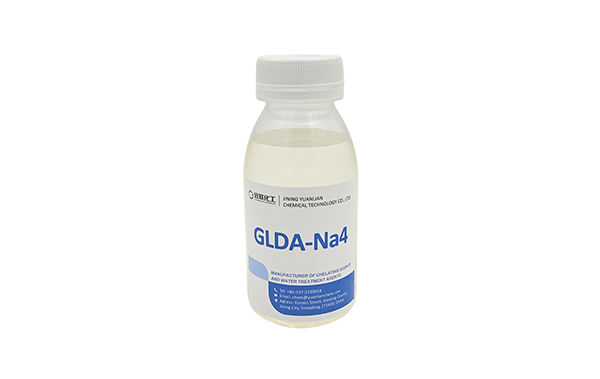
GLDA forms stable, water-soluble complexes with calcium and magnesium, preventing these reactions . Its sequestering value for calcium is approximately 65 mg metal per gram of active product, comparable to EDTA across the pH range relevant to most detergent applications .
What this means in practice:
-
Better cleaning in hard water. GLDA keeps surfactants active, even in water with high calcium and magnesium content .
-
Prevents scale deposition. On dishes, glassware, and fabrics, GLDA stops calcium carbonate and soap scum from forming .
-
Works across a broad pH range. GLDA remains soluble and effective from pH 2 to 14, making it suitable for acidic and alkaline formulations .
-
Performs at elevated temperatures. In automatic dishwashing cycles that run hot, GLDA retains its chelating power .
Preservative Boosting: A Hidden Advantage
This is where GLDA shows a measurable advantage over EDTA. In liquid laundry detergents, microbial contamination is a constant risk. Traditional preservatives work, but they often need boosters to reach full efficacy.
GLDA is not a preservative itself . What it does is chelate the metal ions that microorganisms need for essential functions—enzyme activity, membrane stability, nutrient transport. This weakens microbial cells and makes them more vulnerable to preservatives .
Practical implications:
-
Reduced preservative load. In liquid formulations, just 0.2–0.3% GLDA can boost preservative efficacy, allowing formulators to reduce preservative concentrations .
-
Better shelf life. GLDA also chelates transition metals like iron and copper, preventing oxidative breakdown of oils, perfumes, and surfactants .
-
Colour and clarity stability. By binding metal ions that would otherwise catalyse colour changes, GLDA keeps liquid products clear and stable over time .
A Replacement That Matches Performance
GLDA can replace EDTA in a 1:1 active ratio in most detergent and dishwashing applications . The performance is virtually identical—the environmental profile is not.
Key differentiators:
| Property | GLDA | EDTA |
|---|---|---|
| Readily biodegradable (OECD 301) | Yes | No |
| EU Ecolabel eligible | Yes | No |
| NTA-free | Yes | Yes |
| Skin sensitisation risk | Low | Low |
| Calcium chelation | Strong | Strong |
| Preservative boosting | Enhanced | Moderate |
Practical Formulation Considerations
Typical use levels in detergents:
-
Liquid laundry detergents: 0.2–5% active, depending on formulation. At low levels (0.2–0.3%), GLDA serves as a preservative booster and stabiliser. At higher levels (3–5%), it enhances stain removal in hard water .
-
Automatic dishwashing tablets/powders: 2–8% active, often combined with MGDA, polymers, and enzymes .
-
Hard surface cleaners: 1–3% active.
Compatibility: GLDA works with all common anionic, non-ionic, and amphoteric surfactants. It is compatible with enzymes, preservatives, fragrances, and optical brighteners .
pH range: GLDA is effective from pH 2 to 14, offering flexibility across acidic and alkaline formulations .
Regulatory Alignment
European regulators are moving toward tighter restrictions on persistent chelates. GLDA is readily biodegradable under OECD 301 tests (>60% degradation within 28 days). EDTA is not. For formulators targeting EU Ecolabel, Nordic Swan, or meeting retailer sustainability requirements, this difference is decisive.
The Bottom Line
GLDA is not a compromise. It is a genuinely better choice for laundry and dishwashing formulations—strong calcium sequestration, preservative boosting, broad pH tolerance, and ready biodegradability. For European formulators facing regulatory pressure and consumer demand for sustainable products, GLDA is the practical, proven alternative to EDTA.
Yuanlian Chemical specializes in the production of polyaspartic acid (PASP),tetrasodium iminodisuccinate(IDS), GLDA, MGDA etc. with stable quality and excellent quantity!

Contact us