




European regulators have steadily tightened the framework around persistent chelating agents. The EU Ecolabel for detergents explicitly prohibits EDTA and NTA in certified products, and REACH authorisation processes continue evaluating persistent substances for potential restriction. For formulators across home care, personal care, and industrial processing, the challenge is specific: maintain metal sequestration performance while transitioning to readily biodegradable alternatives that meet environmental compliance.
Tetrasodium aspartate diacetate (ASDA-Na4)—derived from L-aspartic acid—offers a technical path through this transition. Its molecular architecture provides effective chelation for calcium, magnesium, iron, and copper across a wide pH range, while its biodegradability profile (OECD 301B >60% in 28 days) distinguishes it from legacy chelates that persist in aquatic environments.
1. Regulatory Trajectories Shaping European Chemical Synthesis
The regulatory pressure on persistent chelating agents is not hypothetical. The EU Chemicals Strategy for Sustainability, part of the broader Green Deal, explicitly targets persistent substances for restriction. ECHA's ongoing reviews of EDTA and NTA have accelerated substitution across multiple sectors.
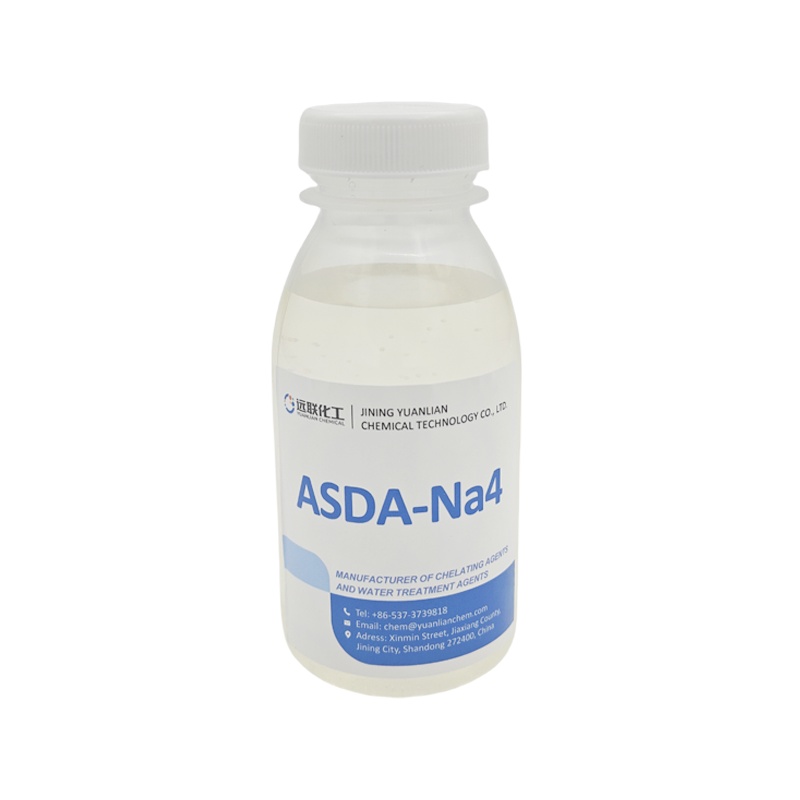
Key constraints affecting chelate selection:
-
EU Detergents Regulation (EC 648/2004) —phosphorus limits; persistent chelates face substitution pressure
-
EU Ecolabel criteria —explicitly prohibit EDTA and NTA in certified products
-
REACH authorisation and restriction processes —ongoing assessments of EDTA and NTA under SVHC pathways
-
Retailer procurement policies —major European supermarket chains increasingly require "EDTA-free" and "readily biodegradable" claims on product packaging
-
Circular Economy Action Plan —the "zero pollution" ambition drives demand for raw materials that do not accumulate in water systems
The shift toward readily biodegradable pathways is not merely regulatory—it reflects a broader industrial realignment toward biomimetic design principles. ASDA-Na4, synthesised from plant-derived L-aspartic acid, sits at the intersection of both trends.
2. Coordination Chemistry and Stability Constants of ASDA-Na4
Core Parameters
| Parameter | Specification |
|---|---|
| CAS number | 34612-80-1 |
| Molecular formula | C₈H₇NNa₄O₈ |
| Molecular weight | 309.1 g/mol |
| Active content (liquid grade) | ≥55% solid content |
| Appearance | Light yellow clear liquid |
| pH (1% solution) | ≥7.0 |
| Density (20°C) | ≥1.20 g/cm³ |
Chelation Mechanism
The chemical skeleton of ASDA-Na4 features four carboxylate groups and a tertiary amine nitrogen—a configuration that facilitates the formation of stable, water-soluble complexes with divalent and trivalent metal ions. As a multidentate ligand, it coordinates with metal centres through the nitrogen and carboxylate oxygen atoms, forming chelate rings that prevent precipitation of insoluble salts .
Chelation performance:
-
Effectively binds Ca²⁺, Mg²⁺, Fe²⁺/³⁺
-
Calcium binding capacity: approximately 550 mg CaCO₃/g active
-
Stability constants (log K): Ca²⁺ 5.81, Mg²⁺ 5.92
pH and Thermal Stability
ASDA-Na4 maintains chelation performance across a broad pH range (2–14) , distinguishing it from citrate which loses efficacy above pH 8. The chelate remains stable at process temperatures up to 100°C , supporting applications in automatic dishwashing and industrial cleaning where elevated temperatures are routine.
The compound exhibits excellent solubility in high-concentration alkaline solutions—a critical property for formulators working on concentrated detergent systems and CIP cleaning formulations .
3. Cross-Industry Performance Matrices
A. Sustainable Home Care and Ecolabeled Detergents
In automatic dishwashing and hard surface cleaning, calcium and magnesium ions cause spotting, filming, and scale deposition. ASDA-Na4 prevents these effects by sequestering hardness ions throughout the wash and rinse cycles.
Key characteristics for detergent formulations:
-
Phosphorus-free—addresses discharge restrictions
-
Readily biodegradable—supports EU Ecolabel compliance
-
Effective calcium binding at typical use levels
-
Compatible with surfactants and enzymes common in European detergent formulations
The compound is used in cleaning products, detergents, and rinse aid formulations as an environmentally friendly alternative to traditional phosphonates and EDTA .
B. Personal Care and Cosmetic Preservation Synergy
In shampoos, body washes, and liquid soaps, ASDA-Na4 functions as a metal ion stabiliser and preservative booster. By sequestering trace metals that microorganisms require for cellular function, it contributes to preservative efficacy.
Relevant for mild formulations:
-
Non-toxic profile—LD50 >2000 mg/kg (rat)
-
Non-irritating to skin and eyes
-
No sensitisation observed
-
Phosphorus-free and biodegradable
The INCI-compatible profile makes it suitable for personal care products targeting sensitive-skin claims .
C. Advanced Textile Auxiliaries and Pulp Bleaching
In textile processing and pulp bleaching, trace transition metals (iron, manganese, copper) catalyse hydrogen peroxide decomposition, reducing bleaching efficiency and damaging fibre strength. ASDA-Na4 stabilises peroxide systems by sequestering these catalytic metals .
The compound is used in pulp and paper additives and textile auxiliaries for this purpose . Its thermal stability supports the elevated temperatures encountered in bleaching operations.
4. Comparative Evaluation: ASDA-Na4 vs. Legacy Complexes
| Performance Parameter | ASDA-Na4 | EDTA-Na4 | GLDA-Na4 |
|---|---|---|---|
| Origin / Synthesis Precursor | L-Aspartic Acid (plant-derived) | Petrochemical / Formaldehyde | L-Glutamic Acid (plant-derived) |
| Ultimate Biodegradability (OECD 301B) | Readily biodegradable (>60% in 28 days) | Persistent (<10% degradation) | Readily biodegradable (>60%) |
| Calcium Binding Capacity | High (~550 mg CaCO₃/g) | Very High (~260 mg/g) | High (~210–230 mg/g) |
| pH Stability Range | 2–14 | 4–10 | 2–13 |
| Thermal Stability | Up to 100°C stable operation | High stability | No decomposition at 170°C |
| Ecotoxicological Hazards (GHS) | Non-hazardous / Safe | Category 2 Carcinogen Suspect | Non-sensitising / Safe |
| EU Ecolabel Compliance | Yes | No | Yes |
What the comparison demonstrates: EDTA works. The environmental persistence that makes it problematic also makes it effective. ASDA-Na4 matches or exceeds the chelation performance of legacy chelates—particularly for calcium binding—while eliminating the accumulation risk and regulatory liability .
5. Aligning Global Supply Chains
For formulators making the transition from EDTA to ASDA-based chelates, supply chain consistency is a practical concern. Batch-to-batch variation in active content, free impurities, or colour clarity can disrupt formulation performance.
Quality parameters to verify:
| Parameter | Specification |
|---|---|
| Appearance | Light yellow clear liquid |
| Active content | ≥55% solids |
| pH | ≥7.0 (1% solution) |
| Density (20°C) | ≥1.20 g/cm³ |
| Heavy metals | Within specification limits |
Supply chain considerations:
-
The liquid grade is suitable for large-scale liquid formulations, as it can be dosed directly without pre-dissolution
-
The product can be manufactured via a one-step synthesis from L-aspartic acid and chloroacetic acid, with yields above 95%
-
The synthesis route avoids cyanide or 2-chloroacetonitrile as alkylation reagents, eliminating toxic by-products
-
Full REACH registration and OECD biodegradability documentation are baseline requirements for European procurement
6. Collaborative Engineering Support and Product Verification
ASDA-Na4 offers formulators a pathway to biodegradable, phosphorus-free chelation without the performance compromises associated with weaker alternatives. It achieves effective metal sequestration across moderate-to-high pH and temperature conditions, meets OECD readily biodegradable criteria, and maintains good compatibility with surfactants, peroxides, and enzymes.
The technical case for ASDA-Na4:
-
Readily biodegradable under OECD 301B—supports EU Ecolabel compliance
-
Effective chelation for calcium, magnesium, iron, and copper
-
Thermal stability to 100°C
-
No phosphorus content—addresses discharge restrictions
-
Derived from plant-based L-aspartic acid
-
Non-hazardous human health profile—non-irritating, non-sensitising
To confirm the specific coordination kinetics or synergistic thresholds of ASDA-Na4 within your custom systems, standard evaluation samples, comprehensive Technical Data Sheets (TDS), and Safety Data Sheets (SDS) are accessible through our application engineering group. The technical team provides compatibility assessments tailored to specific surfactant systems, water chemistry profiles, and application conditions.

Contact us