


-

- 2026-07-27
Tetrasodium Glutamate Diacetate (GLDA-Na₄): Properties, Applications and Formulation Considerations
Environmental regulations, such as the EU REACH framework and eco-label schemes like Ecolabel and Nordic Swan, have accelerated the phase-out of poorly degradable aminopolycarboxylic acids (APCAs) like EDTA and NTA. Product developers across industrial cleaning, cosmetics, and agriculture are actively replacing persistent sequestrants with readily biodegradable alternatives.
Tetrasodium Glutamate Diacetate (GLDA-Na₄) is a green chelating agent derived from L-glutamic acid, an renewable amino acid precursor. It combines strong sequestration capacity for hard water cations and transition metals with a favorable environmental profile, making it a viable replacement for traditional chelates in diverse formulations.
Chemical Structure and Physical Properties
Molecular Characteristics and Product Forms
GLDA-Na₄ (CAS No. 51981-21-6) is a tetrasodium salt of N,N-bis(carboxymethyl)-L-glutamic acid. Its molecular structure features four carboxylic acid groups and a tertiary amine nitrogen, providing multiple electron-donor sites for coordinate bonding.
            O                   O
            ||                  ||
   NaO-C-CH2\                  /CH2-C-ONa
             N - CH - CH2 - CH2
   NaO-C-CH2/    |             \
            ||   C=O            C=O
            O    |              ||
                ONa             O
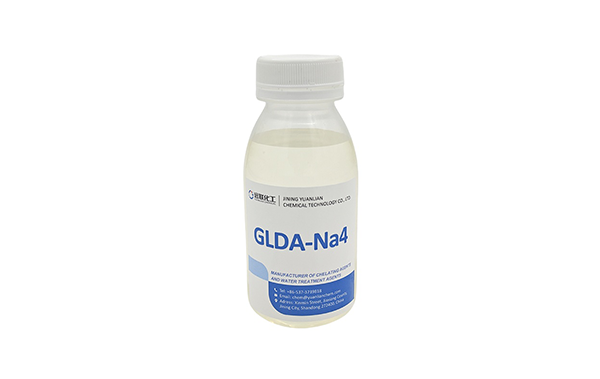
In industrial supply chains, GLDA-Na₄ is primarily distributed as an aqueous liquid solution with a typical active concentration of ~47%. The liquid form exhibits high consistency, immediate miscible properties in water-based media, and eliminates dust-handling risks during manufacturing.
- Chemical Formula: C9H9NO8Na4
- Molecular Weight: 351.1 g/mol (active acid basis: 263.2 g/mol)
- Appearance: Clear, light yellow to pale amber liquid
- Density (20°C): ≈ 1.30 - 1.45 g/cm³
Solubility and Stability Profile
The aqueous liquid solution of GLDA-Na₄ is miscible with water in all proportions and exhibits high solubility across a broad temperature spectrum (0°C to >100°C).
- pH Range Stability: GLDA-Na₄ remains active across a broad pH window (pH 2 to 13.5). Unlike EDTA, which can precipitate as free acid under strongly acidic conditions (pH < 1.5), GLDA maintains functional solubility in acidic cleaners down to pH 1–2.
- Thermal Stability: Thermal gravimetric profiles indicate resistance to decomposition up to 170°C in aqueous processing, allowing it to withstand high-temperature pasteurisation, industrial bottle washing, and spray-drying processes.
- Electrolyte Tolerance: Demonstrates compatibility with concentrated builder salts, non-ionic surfactants, and caustic soda solutions up to 10–15% active NaOH.
Chelation Mechanism and Metal Ion Affinity
Coordination Chemistry and Binding Selectivity
GLDA-Na₄ acts as a pentadentate or hexadentate ligand. The four carboxylate groups and the nitrogen atom coordinate with central metal cations to form stable, water-soluble ring structures (chelate complexes).
This sequestration mechanism prevents metal ions from participating in undesirable side reactions, such as:
- Precipitation of insoluble calcium and magnesium carbonates/soaps in hard water.
- Catalytic decomposition of active oxygen species (percarbonates, hydrogen peroxide) by trace iron or copper.
- Oxidation of sensitive active ingredients, fragrances, and unsaturated lipids in cosmetic emulsions.
       O = C ------ O           O ------ C = O
           |         \         /         |
          CH2         \       /         CH2
           |           \     /           |
           N ---------- Me(II) ---------- N
           |           /     \           |
          CH2         /       \         CH2
           |         /         \         |
       O = C ------ O           O ------ C = O
Stability Constants for Key Metal Ions
The affinity of a chelating agent for specific metal ions is expressed by the conditional or logarithmic stability constant (log K). Higher log K values indicate stronger complex formation.
| Metal Ion | Target Complex | log K (GLDA-Na₄, 25°C, I=0.1) | Industrial Significance |
|---|---|---|---|
| Fe³⁺ | Iron (III) | 11.7 | Disruption of iron-catalyzed oxidation; soil washing |
| Cu²⁺ | Copper (II) | 13.1 | Preservation of lipids/fragrances; textile processing |
| Zn²⁺ | Zinc (II) | 10.0 | Micronutrient delivery; industrial water treatment |
| Ca²⁺ | Calcium (II) | 5.2 | Water softening; limescale prevention |
| Mg²⁺ | Magnesium (II) | 3.5 | Soap scum prevention; builder synergy |
Although GLDA exhibits lower absolute log K values for calcium compared to EDTA (log K ≈ 10.7), its functional performance in cleaning formulations is compensated by its higher solubility, alkaline stability, and rapid binding kinetics.
Environmental Profile and Biodegradability
OECD Biodegradation Test Results
The environmental persistence of traditional chelates has led to strict monitoring of industrial effluents. GLDA-Na₄ addresses these concerns through rapid microbial breakdown.
- Ready Biodegradability (OECD 301D / OECD 301B): Achieves > 60% theoretical oxygen demand (ThOD) or CO₂ evolution within the 28-day window, satisfying the criteria for "Readily Biodegradable."
- Inherent Biodegradability (OECD 302B / Zahn-Wellens Test): Demonstrates > 90% dissolved organic carbon (DOC) removal within 14 days under standard municipal wastewater treatment simulation.
- Ecotoxicity Profile:
- Aquatic Toxicity (Fish, LC50): > 100 mg/L (96h, Oncorhynchus mykiss)
- Daphnia Toxicity (EC50): > 100 mg/L (48h, Daphnia magna)
- Algal Growth Inhibition (EC50): > 100 mg/L (72h, Pseudokirchneriella subcapitata)
Regulatory Recognition and Eco-Certifications
Because GLDA contains no alkylphenol ethoxylates, phosphorus, or persistent aminopolycarboxylates, it complies with standard European green chemistry frameworks:
- EU Ecolabel (2021/1870/EU): Approved as an environmentally acceptable complexing agent with minimal Detergent Ingredient Database (DID) list impact.
- Nordic Swan Ecolabel: Recognized as a compliant raw material for consumer and institutional sanitary products.
- REACH Registration: Fully registered under Regulation (EC) No 1907/2006 for high-tonnage industrial use in the European Economic Area (EEA).
Primary Industrial Applications
Detergents and Cleaning Formulations
Hard water cations (Ca²⁺, Mg²⁺) reduce the efficacy of anionic surfactants by forming insoluble precipitates. GLDA-Na₄ acts as a builder and water softener in dishwashing liquids, laundry detergents, and surface cleaners.
[Hard Water Cations (Ca²⁺/Mg²⁺)] + [Insoluble Soaps / Scale]
                       │
                       ▼ + GLDA-Na₄
[Soluble GLDA-Metal Complex] + [Restored Anionic Surfactant Efficacy]
- Automatic Dishwashing (ADW): Replaces phosphates and NTA to prevent filming and spotting on glassware without causing stress cracking on polycarbonate materials.
- Institutional & Industrial (I&I) Cleaners: Enhances the removal of stubborn inorganic soils, milkstone in dairy lines, and beerstone in brewing operations under high-caustic conditions.
Personal Care and Cosmetics
In leave-on and rinse-off formulations, trace metal ions accelerate the autoxidation of unsaturated fatty acids, causing rancidity, discolouration, and loss of fragrance integrity.
- Preservative Booster: GLDA-Na₄ weakens the outer cell membranes of Gram-negative bacteria (e.g., Pseudomonas aeruginosa) by chelating structural divalent cations, increasing membrane permeability to organic preservatives like phenoxyethanol, benzyl alcohol, and benzoic acid.
- INCI Name: Tetrasodium Glutamate Diacetate
- Rinse-Off Products (Shampoos, Body Washes): Maintains clarity in transparent formulations and ensures lathering performance in hard water.
Agriculture and Micronutrient Chelation
In high-pH or calcareous soils, micronutrients such as iron, zinc, and manganese precipitate as insoluble hydroxides, rendering them unavailable to plant roots. GLDA-Na₄ serves as an organic ligand for soluble micronutrient fertilizers.
- Foliar and Soil Delivery: Forms stable, plant-absorbable complexes that remain soluble across soil pH ranges from 4.0 to 9.0.
- Environmental Safety: Unlike synthetic complexes based on EDTA, GLDA-chelated micronutrients breakdown naturally in soil matrices, eliminating heavy metal accumulation risks in groundwater.
Soil Remediation and Heavy Metal Extraction
GLDA-Na₄ is used in eco-friendly soil-washing technologies to extract cadmium (Cd), lead (Pb), and copper (Cu) from contaminated industrial sites. Its low phytotoxicity allows post-washing biological restoration of the soil microbiome.
Textile Processing and Pulp & Paper
- Textile Bleaching: In hydrogen peroxide (H₂O₂) bleaching processes, free iron (Fe³⁺) and manganese (Mn²⁺) ions cause catalytic decomposition of peroxide, resulting in fabric pinholing. GLDA-Na₄ sequesters these ions, stabilising the bleach bath and protecting cellulose fibers.
- Pulp Processing: Used during the EOP (Extra-Oxygen-Peroxide) bleaching stage to prevent brightness scaling without contributing to non-biodegradable COD in wastewater discharge.
Formulation Considerations
Recommended Dosage Ranges by Application
Dosage levels vary depending on water hardness, metal ion concentration, and target shelf-life requirements. The figures below refer to active GLDA-Na₄ (38–47% aqueous solution basis):
| Application Sector | Dosage Range (% w/w as supplied) |
|---|---|
| Household Liquid Laundry | 0.5% – 2.0% |
| Automatic Dishwash (Liquid/Gel) | 1.5% – 5.0% |
| Industrial Caustic Cleaners (CIP) | 2.0% – 8.0% |
| Personal Care (Rinse-off/Leave-on) | 0.1% – 0.5% |
| Agricultural Micronutrient Concentrates | 5.0% – 15.0% |
Compatibility with Surfactants, Enzymes and Preservatives
- Surfactant Systems: Fully compatible with anionic (LAS, SLES, ALES), non-ionic (alcohol ethoxylates, APGs), and amphoteric (CAPB) surfactants.
- Enzyme Stability: Unlike strong inorganic sequestrants that strip essential structural calcium from proteases and amylases, GLDA at recommended levels (<2.0%) maintains enzyme structural stability while preventing hard water interference.
- Bleach Systems: Stable in the presence of sodium percarbonate, hydrogen peroxide, and sodium hypochlorite under controlled conditions.
Storage and Handling Guidelines
- Materials of Construction: Store liquid GLDA-Na₄ in high-density polyethylene (HDPE), polypropylene (PP), stainless steel (316L), or rubber-lined steel tanks. Avoid prolonged contact with carbon steel, aluminum, or copper alloys due to potential mild surface oxidation over extended periods.
- Storage Conditions: Maintain storage temperatures between -10°C and 40°C. If exposed to sub-zero temperatures, crystallization or increased viscosity may occur; heating gently to 20°C with mild agitation restores uniform liquid properties without altering product quality.
Technical Comparison: GLDA vs. EDTA and Other Chelating Agents
Selecting the appropriate chelating agent requires balancing sequestration power, environmental impact, and regulatory compliance.
| Parameter | GLDA-Na₄ | EDTA-Na₄ | MGDA-Na₃ | Citric Acid / Citrate |
|---|---|---|---|---|
| Origin / Feedstock | Bio-based (L-Glutamic acid) | Synthetic (Petrochemical) | Bio-based / Synthetic mix | Bio-based (Fermentation) |
| OECD 301 Biodegradability | Readily Biodegradable | Non-biodegradable (Persistent) | Readily Biodegradable | Readily Biodegradable |
| Phosphorus Content | 0% (P-free) | 0% (P-free) | 0% (P-free) | 0% (P-free) |
| pH Stability Window | 2.0 – 13.5 | 1.5 – 12.0 | 2.0 – 13.5 | 3.0 – 8.5 |
| High Alkaline Stability | Excellent | Good | Excellent | Poor (degrades/precipitates) |
| Preservative Synergy | High | High | Moderate | Low |
| Primary Product Form | ~47% Liquid Solution | Powder / Solution | Liquid / Granule | Powder / Solution |
Frequently Asked Questions
Is GLDA fully biodegradable?
Yes. GLDA-Na₄ is classified as "readily biodegradable" according to OECD 301D/B criteria. It undergoes rapid mineralization by domestic wastewater microorganisms into carbon dioxide, water, and inorganic nitrogen species, leaving no persistent residues in aquatic environments.
Can GLDA replace EDTA directly in existing formulations?
In most water-treatment, cleaning, and cosmetic formulations, GLDA-Na₄ replaces EDTA at a 1:1 to 1:1.2 weight ratio (adjusted for active ingredient content). Because GLDA is supplied primarily as a liquid solution, formulators should adjust the water balance in the batch sheet accordingly.
What is the pH stability range of GLDA?
GLDA-Na₄ maintains structural integrity and metal-binding capacity across a pH spectrum from 2.0 to 13.5. This makes it suitable for both acidic descalers and heavy-duty alkaline industrial degreasers.
Is GLDA suitable for use in leave-on personal care products?
Yes. Tetrasodium Glutamate Diacetate has a favorable toxicological profile with low dermal and ocular irritation potential. It is listed on the EU CosIng database and widely utilized in leave-on creams, serums, and facial lotions as a booster for mild preservative systems.
Conclusion and Technical Support
Tetrasodium Glutamate Diacetate (GLDA-Na₄) represents a reliable, high-performance alternative to traditional persistent chelating agents. Its combination of high solubility, broad pH stability, enzyme compatibility, and rapid environmental degradation allows industrial manufacturers to meet environmental standards without sacrificing technical performance.
For comprehensive technical data sheets (TDS), safety documentation (MSDS), or formulation advice tailored to your specific application, contact our technical service department. Our laboratory team is available to assist with stability testing, dosage optimization, and raw material replacement trials.
Yuanlian Chemical specializes in the production of polyaspartic acid (PASP),tetrasodium iminodisuccinate(IDS), GLDA, MGDA etc. with stable quality and excellent quantity!

Contact us