


-

- 2026-07-29
Trisodium Methylglycine Diacetate (MGDA-3Na) in the European Market: From Regulation-Driven to Value-Driven Transition in Green Chelating Agents
For global chemical procurement managers and detergent formulators, Europe is far more than just another regional market—it is the global bellwether for green chemistry and sustainable industrial practices. Currently, Europe accounts for approximately 50% of the global market share for Trisodium Methylglycine Diacetate (MGDA-3Na).
However, a persistent question arises during daily sourcing inquiries: The per-kilogram price of MGDA is noticeably higher than traditional chelating agents like EDTA and NTA. Why, then, does its market penetration rate in Europe continue to accelerate?
The answer lies in a fundamental shift in purchasing logic among European consumer brands and industrial cleaning leaders. Sourcing decisions are no longer guided solely by raw material sticker price. Instead, decisions are evaluated through Total Cost of Ownership (TCO), regulatory risk mitigation, and overall formulation performance.
1. Regulatory Tightening: The "Compliance Wall" Facing Traditional Chelates
European environmental and chemical safety regulations are notoriously stringent. Legacy chelating agents that dominated the market for decades are now facing accelerated phase-outs.
REACH Regulation and Persistence Risks
EDTA (and EDTA-4Na) suffers from poor biodegradability, causing it to persist in European waterways and wastewater treatment systems while potentially remobilizing heavy metals. Under strict EU REACH scrutiny, formulations relying on EDTA encounter escalating environmental compliance and audit costs.
CMR Classification Pressure on NTA
While NTA (Nitrilotriacetic acid) biodegrades faster than EDTA, it is classified as a Category 2B suspected carcinogen and listed as a Substance of Very High Concern (SVHC). Under the EU CLP Regulation, products containing NTA above regulatory thresholds require hazardous warning labels—a serious drawback for consumer and industrial brands prioritizing safety and sustainability.
Ecolabel and Nordic Swan Standards
Both the official EU Ecolabel and the Nordic Swan Ecolabel enforce strict caps on toxicity and mandate high biodegradability for organic ingredients. Continuing to formulate with traditional chelating agents directly disqualifies products from securing these recognized green certifications.
2. Performance Advantage: Superior Efficiency in Hard Water and High pH
Beyond regulatory push factors, MGDA-3Na offers compelling performance advantages that actively pull formulators toward adoption.
High Calcium Chelation Value
Under hard water conditions, a chelate's primary benchmark is its capacity to bind calcium and magnesium ions:
-
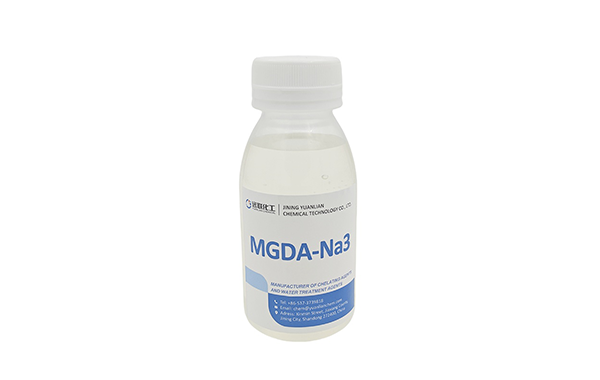
MGDA-3Na achieves a calcium chelation value of approximately 310–406 mg CaCO3/g (depending on active concentration).
-
By contrast, standard EDTA-4Na typically reaches around 274 mg CaCO3/g.
This higher efficiency means formulators can achieve equivalent or superior builder and anti-encrustation performance using lower dosage levels of MGDA compared to legacy alternatives.
Stability in Alkaline and Oxygen-Bleach Systems
MGDA maintains high conditional stability constants across a broad pH range (pH 2–13; lg K (Ca2+) 7.0). It remains stable in high-alkaline industrial and institutional (I&I) cleaners as well as automatic dishwashing detergents (ADWD). Furthermore, MGDA exhibits excellent compatibility with oxygen bleaching agents like sodium percarbonate, preventing premature hydrogen peroxide decomposition.
Formulation Value Realization: Lower active dosage + extended shelf-life stability + reduced secondary builder requirements = lower overall total formulation cost.
3. Green Chemistry in Action: Biodegradability and Toxicological Safety
MGDA-3Na stands out as a rare amino acid-based chelating agent that combines powerful complexing ability with rapid environmental degradation.
-
OECD 301B Ready Biodegradability: MGDA exceeds 80% biodegradation within 28 days under OECD 301B tests, breaking down rapidly into harmless small molecules without bioaccumulating.
-
Favorable Toxicological Profile: With an acute oral toxicity $LD_{50} > 2000 \text{ mg/kg}$ and non-irritating properties toward skin and eyes, pure MGDA-3Na solutions do not require GHS severe hazard warning labels under EU regulations.
This allows detergent manufacturers to seamlessly pass EU Ecolabel audits while marketing products with clear "green, non-toxic, and eco-friendly" claims.
4. European Procurement Practice: Identifying High-Standard MGDA
As global production capacity expands, the supply of MGDA-3Na from international markets has grown substantially. However, penetrating the European market demands rigorous quality control and technical compliance.
Testing Standard Alignment (ISO 16588:2002)
High-spec MGDA-3Na must be quantified using recognized analytical methodologies, such as ISO 16588:2002 via High-Performance Liquid Chromatography (HPLC), ensuring accurate verification of active content and impurity profiles.
Key Impurity Control (The "Deal-Breaker" Criteria)
When reviewing Certificates of Analysis (CoA), European buyers scrutinize specific byproduct limits alongside active concentration (typically 40% liquid or solid powder/granules):
-
Free Amino Acid Residue: Should be controlled to 0.5% to prevent negative impacts on formulation stability and color over time.
-
NTA Impurity Levels: NTA residue is a critical compliance threshold for European imports. Standard technical grades keep NTA below 0.1%, but premium European buyers often mandate < 0.05\% (500 ppm) or lower.
As an upstream manufacturer specializing in sustainable chelation technology, YuanlianChemical optimizes synthesis and purification processes to strictly control NTA residues and free impurities in its MGDA-3Na line, meeting EU REACH mandates and EU Ecolabel standards for global partners.
5. Conclusion: From Eco-Friendly Alternative to Industry Standard
In the European market, MGDA-3Na has completed its transition from an "expensive EDTA substitute" to an essential baseline component for high-performance green formulations.
For detergent manufacturers and chemical buyers looking to upgrade formulations for global compliance, adopting MGDA-3Na is not merely an added environmental cost—it represents a strategic investment in mitigating regulatory risk, enhancing cleaning performance, and capturing premium market share. As manufacturing scale expands and production technologies mature, MGDA-3Na will continue to set the new benchmark across detergent, water treatment, and industrial processing industries globally.
Yuanlian Chemical specializes in the production of polyaspartic acid (PASP),tetrasodium iminodisuccinate(IDS), GLDA, MGDA etc. with stable quality and excellent quantity!

Contact us