



-

- 2026-08-06
Biodegradable Chelating Agents: A Practical Selection Guide for Formulators
Biodegradable chelating agents have moved from a niche choice to a mainstream requirement across detergents, water treatment, and personal care. These compounds bind metal ions such as calcium, magnesium, iron, and copper, yet break down in the environment after use instead of persisting like EDTA. This guide explains what they are, why formulators adopt them, and how to pick the right one for your application.
If you are replacing a traditional chelator, the good news is that amino-acid-derived options now cover most of the performance range that EDTA once held. The task is matching chemistry to condition rather than accepting a performance drop.
What Are Biodegradable Chelating Agents
A chelating agent grips a metal ion with two or more donor atoms, locking it in a ring structure so it cannot interfere with a formulation. A biodegradable version does this job and then degrades through natural microbial action, leaving no persistent residue in water or soil.
Most modern green chelators are built from amino acids: glutamic acid, glycine, or aspartic acid. Their natural origin supports both biodegradability and lower aquatic toxicity, which is why they appear on clean-label and restricted-substance approved lists more readily than petrochemical alternatives.
The relevant test method is OECD 301B, which measures ultimate aerobic biodegradation. Products that pass this threshold give formulators a defensible environmental claim backed by a recognised protocol. Biodegradability matters because it removes the trade-off between performance and persistence that older chelators forced on formulators.
Why Formulators Replace EDTA with Biodegradable Chelating Agents
EDTA is effective and cheap, but it resists degradation and can mobilise heavy metals in wastewater. Phosphates, used as builders in detergents, drive eutrophication in rivers and lakes, which led to phosphate bans in several regions.
Retailers and regulators now push the opposite direction. Many brand owners publish restricted substance lists that name EDTA. Municipal discharge limits cap phosphorus. Several large retailers already list EDTA as a substance to phase out, which accelerates the move. Buyers therefore ask for materials that perform and then disappear, which is exactly the gap these agents fill.
The Main Types of Biodegradable Chelating Agents
Each amino-acid-derived chelator has a distinct stability profile. Understanding those differences prevents misapplication.
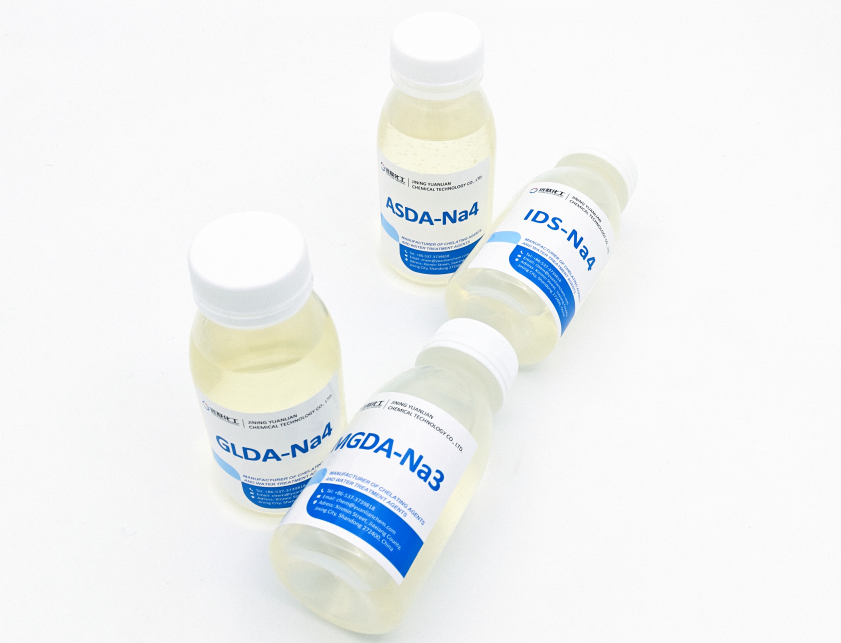
GLDA-Na4 (Tetrasodium Glutamate Diacetate)
Derived from glutamic acid, GLDA-Na4 binds calcium strongly across a wide pH window. It suits alkaline cleaners, personal care, and industrial degreasing where hard-water control is critical.
MGDA-Na3 (Trisodium Methylglycine Diacetate)
From glycine, MGDA-Na3 excels at magnesium chelation and stays stable at high pH. It is the standard choice for phosphate-free automatic dishwashing and heavy-duty laundry.
PASP-Na (Sodium Polyaspartate)
A polymeric chelant and dispersant, PASP-Na inhibits scale in cooling water and boilers and improves fertiliser efficiency in agriculture. It adds no phosphorus to effluent.
IDS-Na4 (Tetrasodium Iminodisuccinate)
Also aspartic-acid-based, IDS-Na4 shows useful iron and copper selectivity and stabilises hydrogen peroxide. It fits textile bleaching and metal-sensitive processes.
ASDA-Na4 (Tetrasodium Aspartate Diacetate)
ASDA-Na4 offers a balanced calcium and magnesium profile for general-purpose use in water treatment, cleaning, textile, and concrete retarding.
[Image: Chelation mechanism diagram showing metal ion binding]
How to Choose the Right Biodegradable Chelating Agents
Selection starts with three questions: which metal ion causes the problem, what pH does your process run at, and what regulation applies to your effluent.
|
Chelator |
Strongest against |
Effective pH |
Typical use |
|
GLDA-Na4 |
Calcium |
Broad (alkaline to neutral) |
Cleaners, personal care |
|
MGDA-Na3 |
Magnesium |
Broad, stable at high pH |
Dishwashing, laundry |
|
PASP-Na |
Scale cations |
Neutral to alkaline |
Water treatment, agriculture |
|
IDS-Na4 |
Iron, copper |
Broad |
Bleaching, textiles |
|
ASDA-Na4 |
Calcium, magnesium (balanced) |
Broad |
General-purpose, construction |
When in doubt, run a bench test at your actual water chemistry and temperature. Substitution ratios vary, and a small pilot prevents a costly full-scale error. Keep a record of dose, pH, and cleaning or stabilisation result so you can repeat the outcome at plant scale.
Industry Applications of Biodegradable Chelating Agents
- Home and industrial cleaning: hard-water softening, anti-redeposition, peroxide stabilisation.
- Water treatment: scale and corrosion control without phosphorus discharge.
- Personal care: protection of oils and fragrances from metal-catalysed oxidation.
- Textile and pulp: dye consistency, peroxide bleaching stabilisation.
- Agriculture: fertiliser anti-scaling and nutrient availability.
- Construction: controlled concrete setting through calcium chelation.
Each application sets its own priority. Cleaning favours hard-water performance, while water treatment favours low phosphorus and scale control. Matching the chelator to that priority avoids both over- and under-dosing.
Regulatory Drivers for Biodegradable Chelating Agents
European rules lead the change. REACH restricts and monitors substances of concern, while the Carbon Border Adjustment Mechanism (CBAM) raises the cost profile of carbon-intensive inputs. Phosphate bans in washing products already exist across parts of the EU and US, and similar measures appear in other markets.
Similar restrictions are under discussion in parts of Asia and South America, so early adoption protects export plans. For buyers, this means green chelators are not a marketing extra but part of staying compliant. Sourcing from a supplier who can document biodegradability and provide regulatory files reduces your own audit risk.
[Image: Application testing of chelating agents in industrial cleaning]
Where to Get Full Technical Data
This guide covers selection logic, but formulation work needs hard numbers: active content, stability constants, pH, density, and certificates. The manufacturer's product pages carry the full technical data sheets, safety data sheets, and sample request options.
For specifications, certificates, and free samples of GLDA-Na4, MGDA-Na3, PASP-Na, IDS-Na4, and ASDA-Na4, visit the **Yuanlian Chemical product centre** and request a sample for your bench trial.
Frequently Asked Questions
Are these agents as strong as EDTA?
For many applications they match or exceed EDTA, particularly at the metal ions and pH ranges where each is designed to work. The key is correct selection rather than a like-for-like swap.
Do they cost more than traditional chelators?
Unit cost is often higher, but total formulation cost stays competitive once you account for regulatory risk, retailer approval, and avoided phosphate surcharges.
Can I blend two green chelators?
Yes. Blends of GLDA and MGDA, or IDS with PASP, are common where a broad metal-ion spectrum is needed.
How do I prove biodegradability to a customer?
Use OECD 301B test data from your supplier. A recognised method carries far more weight than a generic green claim.
For the underlying chemistry, see this Wikipedia overview of chelation.
Yuanlian Chemical specializes in the production of polyaspartic acid (PASP),tetrasodium iminodisuccinate(IDS), GLDA, MGDA etc. with stable quality and excellent quantity!

Contact us