



-

- 2026-08-28
GLDA-Na4 Product Profile: Chemistry, Specification and Performance Data
Every raw material in a cleaning or care formula carries two documents: the specification sheet and the safety data sheet. Between the two lies the information a formulator actually works with, spread across product bulletins, test reports and supplier correspondence. This article assembles the GLDA-Na4 technical profile in one place, from the chemistry and the physical properties to the chelation data, the grades on offer and the regulatory position, so a reader new to the product can evaluate it without chasing documents across three folders.
The Molecule in Brief
GLDA-Na4 is the tetrasodium salt of glutamic acid diacetic acid, CAS 51981-21-6, INCI name Tetrasodium Glutamate Diacetate. The molecule is built from L-glutamic acid, an amino acid produced by fermentation of plant-derived sugars, which gives it a natural-origin index of 0.56 under ISO 16128. It belongs to the aminopolycarboxylate family: two acetate arms and the parent amino acid wrap around a metal ion and hold it in solution, which is the mechanism behind every application it serves.
Physical and Chemical Properties
|
Property |
Typical Value |
|
INCI name |
Tetrasodium Glutamate Diacetate |
|
CAS number |
51981-21-6 |
|
Appearance |
Clear, light yellow liquid |
|
Active content |
38–47% (grade dependent) |
|
pH (as supplied) |
10–12 |
|
Density |
~1.25 g/cm³ |
|
Water solubility |
Exceptionally high, above 500 g/L |
|
pH stability range |
2–13 |
|
Thermal stability |
Stable to 170 °C |
|
Biodegradation |
OECD 301, readily biodegradable |
|
Natural-origin index |
0.56 (ISO 16128) |
The combination of a wide pH window and high thermal stability is unusual among chelating agents. Most alternatives work well in one part of the range; GLDA-Na4 carries its calcium binding from acidic descalers through to caustic industrial cleaners, and survives hot-fill lines that would stress a less stable molecule.
Chelation Performance
The number a formulator checks first is the calcium chelation capacity. GLDA-Na4 binds approximately 550 mg of CaCO₃ per gram of active material, above the typical figure for EDTA. Because the binding works by weight of active chelator, a lower dose of GLDA-Na4 achieves the same hardness control in many formulations.
Two properties separate it from the older molecule. The first is the pH range: GLDA-Na4 holds calcium effectively from pH 2 to 13, while EDTA loses performance in strongly alkaline wash conditions. The second is biodegradability, which does not affect the wash cycle but decides the environmental file. Neither property requires a trade-off; both come with the same molecule.
Grades and Forms
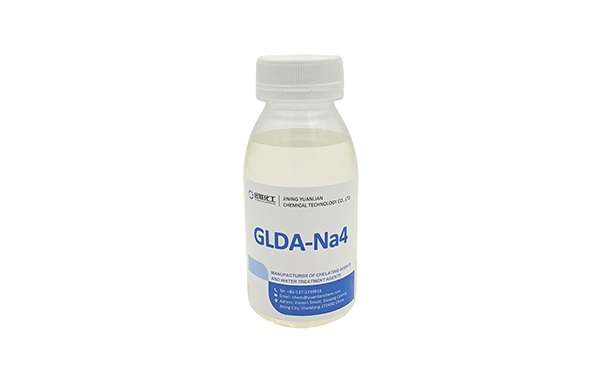
GLDA-Na4 is supplied as a clear, light yellow aqueous solution. The 47 per cent active grade is the standard offering for detergents and cleaning products. The 38 per cent grade suits buyers who prefer a lower active content for handling, dosing or regulatory reasons. Both ship in drums or IBCs, and the exact values for each batch are recorded on the Certificate of Analysis, so the numbers on the specification match the numbers in the tank.
Biodegradation and Ecotoxicology
GLDA-Na4 meets the ready-biodegradability threshold under OECD 301 testing, typically mineralising well within 28 days to carbon dioxide, water and inorganic nitrogen. It contains no phosphorus and no NTA-type chelators, which keeps the nutrient load of the discharge neutral. Aquatic toxicity testing reports low acute values, and the molecule shows no tendency to bioaccumulate. For formulators replacing EDTA, this is the difference that answers the retailer questionnaire.
Regulatory Status and Compliance
Under REACH (EC) No 1907/2006, GLDA-Na4 is registered for the relevant tonnage bands, and the registration status is confirmed at the order review. Under CLP (EC) No 1272/2008, it is commonly not classified as hazardous for aquatic or human health, which keeps the safety data sheet and the transport classification simple. In detergents, use of the molecule aligns with the Detergents Regulation (EC) No 648/2004, and its biodegradable profile sits comfortably with the direction of EU Ecolabel criteria, which restrict EDTA and reward readily biodegradable chelators.
Handling and Storage
Store GLDA-Na4 in sealed original containers, away from direct sunlight, at roughly 5 to 40 °C. The solution is stable under those conditions, and liquid grades generally keep for 12 months or longer under sealed packaging, with the recommended shelf life stated on the specification sheet. Section 14 of the safety data sheet confirms the transport classification, and the full handling guidance is in sections 7 and 8.
FAQ
What is GLDA-Na4?
GLDA-Na4 is the tetrasodium salt of glutamic acid diacetic acid (CAS 51981-21-6), a biodegradable aminopolycarboxylate chelating agent used across detergents, cleaning and personal care.
How much calcium does GLDA-Na4 bind?
Approximately 550 mg of CaCO₃ per gram of active material, which exceeds the typical figure for EDTA and usually allows a lower dose for the same hardness control.
What pH range does GLDA-Na4 work in?
Calcium binding stays effective from about pH 2 to 13, covering acidic descalers through to strongly alkaline industrial cleaners.
Is GLDA-Na4 biodegradable?
Yes. It meets ready-biodegradability under OECD 301 testing, typically mineralising within 28 days to carbon dioxide, water and inorganic nitrogen.
Which grade should I order?
The 47 per cent liquid grade is the standard for most formulations. The 38 per cent grade is available where a lower active content is preferred for handling or regulatory reasons.
What documentation do you provide?
A Certificate of Analysis per batch, a current safety data sheet in the required language, the OECD 301 report and REACH registration status for the relevant tonnage band.
Building the Technical File
The GLDA-Na4 profile stands on test results that can be requested and filed: the OECD 301 report, the Certificate of Analysis and the safety data sheet. For the specification sheet, the technical data pack and a sample for bench trials, contact [email protected] or call +86-537-3739818. Full product details are available at the company website: https://www.yuanlianchem.com
Yuanlian Chemical specializes in the production of polyaspartic acid (PASP),tetrasodium iminodisuccinate(IDS), GLDA, MGDA etc. with stable quality and excellent quantity!

Contact us