



-

- 2026-09-18
PASP-Na Purchase Specification and Acceptance Checklist
Most buyers treat sodium polyaspartate like any other chelant on the quote sheet. That is a mistake, and it usually shows up six months later as a scale programme that suddenly stops holding. PASP-Na is not a strong chelant at all — it is a dispersant and threshold agent, and the property that decides whether it works in your system is not the active percentage on the drum. It is the molecular-weight distribution, a number most suppliers would rather leave vague. This note is for the procurement and quality people at European formulators and water-treatment sites who actually sign off incoming PASP-Na.
First, what you are actually buying
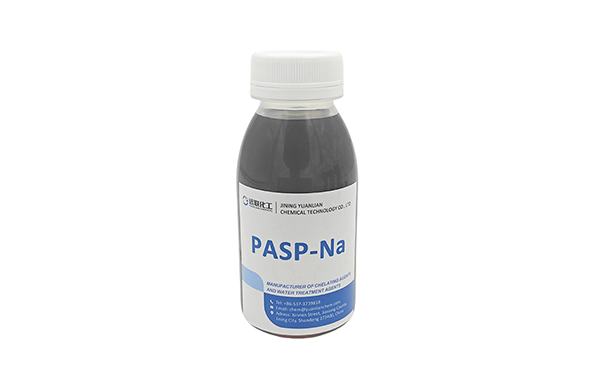
PASP-Na is the sodium salt of polyaspartic acid, made by hydrolysing polysuccinimide. The chain length is not fixed. A drum sold as "PASP-Na 40%" can contain a mix skewed short, skewed long, or somewhere in between, and those three drums will not behave the same in a cooling tower, a detergent, or a fertiliser suspension.
The catch is simple: short chains disperse calcium carbonate well but do little for crystal distortion at scale; long chains do the opposite and can even thicken a liquid. If your specification only says "active content" and "pH", you have specified a molecule whose most important variable you never controlled.
The lines that decide whether it works
|
Parameter |
What to request |
Why it matters |
|
Identity |
CAS for sodium polyaspartate / PSI route |
Stops a different polymer slipping through |
|
Active content |
Typical 35 to 45% as supplied; also per g |
Drives dose and cost |
|
Molecular-weight distribution |
Mn and Mw by named method, with Mw/Mn |
This is the property that matters |
|
Residual monomer |
Free aspartic acid limit by named method |
High monomer means weak, unstable product |
|
Appearance |
Clear to pale liquid or free-flowing solid |
First sign of degradation |
|
pH (as supplied) |
Within a stated band |
Affects tank and seal choice |
|
Iron and heavy metals |
Low ppm limit |
Catalyst residues that hurt stability |
|
Biodegradability |
OECD 301 result or equivalent |
Required for Ecolabel and green-claim support |
Set the band, not just the typical. A supplier can hit a typical figure while drifting across the tolerance every other batch; the band is what protects your line.
Molecular-weight distribution is the line suppliers skip
This is the one. PASP-Na performance tracks the chain-length spread far more than the headline active figure, yet a large share of quotes arrive with nothing on it — or with a single viscosity number presented as if that were enough. Viscosity is related to molecular weight, but it is not the distribution, and it will not tell you whether your drum is skewed short or long.
Name the method and the targets. "Molecular weight: typical" is not a specification; "number-average Mn 2,000–4,000 Da, weight-average Mw by [named method], Mw/Mn not above X" is. Ask which method the supplier uses — GPC against what standard? — and whether the distribution is measured on every batch or only on a development sample. A distribution that is never measured is a distribution you cannot defend when a tower scales up.
Residual monomer is the quiet failure
Polysuccinimide hydrolysis leaves free aspartic acid. Some is normal; a lot means the reaction ran short and the product is both weaker and less stable. High monomer also shifts the dose you calculated, because you paid for polymer and got amino acid.
Put a limit in the specification by named method, and ask whether it is a per-batch test. A limit printed on a data sheet that no one measures is a line on paper.
What the certificate of analysis should prove
A CoA is only as good as the methods behind it. Before you approve a supplier, read it against these points:
- Methods are named, not implied. A value with no method cannot be audited and cannot be repeated when a batch misbehaves.
- The distribution is reported, not a single viscosity. If the CoA shows one number where a spread belongs, send it back.
- Residual monomer is on the sheet, with a limit and a method. This is the quiet failure mode; treat it as a primary line.
- The biodegradability claim has a test, not a slogan. OECD 301 (or an accepted equivalent) with a pass level is evidence; "readily biodegradable" on a cover sheet is marketing.
- The batch number ties to a retained sample. If a drum fails six months later, you need to trace it to the same lot the CoA describes.
Keep one approved CoA per grade as your reference, and treat any change in method, target distribution or supplier site as a re-approval trigger.
Five traps in a PASP-Na quote
- As-supplied versus per-active confusion. Same issue as every other chelant; it is the most common way a cheap quote becomes an expensive one once you work it through to cost per kilogramme of active.
- No molecular-weight data. A quote that arrives with only active content and pH has left out the one number that decides performance. Treat the omission as a red flag, not a detail.
- Viscosity used as a proxy for distribution. It is related, not equivalent. Ask for Mn and Mw by named method before you compare two offers.
- Undisclosed blend. A product labelled PASP-Na that carries citrate or a small chelant to hit a price is still sold under the PASP name. Require the identity line and a heavy-metal profile that would expose a blend.
- No retest date. Without one you cannot plan incoming inspection, and a drum at the back of the warehouse becomes an unknown.
How to check a delivery in five steps
A receiving check need not be slow to be useful. The steps below catch most of the failures that matter:
- Match the documents. Batch number, CoA, and SDS agree, and the CAS on the CoA is the one in your specification.
- Look at it. Colour, clarity and any sediment against the agreed appearance. A drawn sample in a clear jar beats a glance at the drum.
- Check pH and density against the band, at the temperature stated on the CoA.
- Run one confirmation test you trust — active content, monomer, or a molecular-weight check by your own or a contract lab — on the first lot from any new supplier, then on a frequency you set.
- Quarantine until cleared. Do not release to production on the lorry's paperwork alone. A short hold costs less than a line stoppage.
Questions to put to a supplier before you commit
- Which hydrolysis route is used, and what distribution does it deliver as standard?
- Is the molecular-weight distribution measured on every batch, and against what standard?
- What is the residual monomer typical and limit, and by which method?
- What is the retest period, and what storage temperature keeps the product inside it?
- Can the supplier hold a second site or a documented backup, so a single plant stoppage does not stop your line?
- What is the standard lead time to a named European port, and what packaging is available?
A second source is not only a commercial hedge. A second molecule that covers the same failure mode — say MGDA where hard-water chelation is the job, PASP where dispersion is — is a stronger hedge, because it protects against a raw-material shortage rather than only a supplier's calendar.
Frequently asked questions
Is PASP-Na a strong chelant like EDTA? No. It is a dispersant and threshold agent with weak calcium binding. It controls scale and suspends solids; it does not strip hardness the way EDTA does. Specify it for the job it does, not the one EDTA used to do.
Why does molecular weight appear in a purchase spec? Because the chain-length spread decides where the product works. A short-chain drum and a long-chain drum with the same active percentage will not perform the same. The distribution is the property you are actually buying.
What active-content basis should I quote against? Per gram of active, because that is what your dose maths uses. Keep the as-supplied figure for logistics and the per-active figure for formulation and cost.
How do I confirm biodegradability for a customer claim? Ask for the OECD 301 test report with the pass level and the exact test variant. A summary sentence on a data sheet is not enough when a retailer or a regulator asks.
What is the single most useful line to add to my spec? The identity CAS and the molecular-weight distribution by named method. Those two stop substitution and the failure mode suppliers are most likely to leave vague.
Sodium polyaspartate is bought on the distribution, not the headline. A short, well-chosen list of parameters — identity, active basis, molecular-weight spread, residual monomer, biodegradability — protects your line and gives your supplier a clear target. For the application side, including scale inhibition, agriculture and cleaning, see the technical notes on Yuanlian's chelation site, and contact Yuanlian Chemical for a current specification and sample.
Yuanlian Chemical specializes in the production of polyaspartic acid (PASP),tetrasodium iminodisuccinate(IDS), GLDA, MGDA etc. with stable quality and excellent quantity!

Contact us