


-

- 2026-09-20
Chelating Agents for Metal Finishing and Electronics
A plating line passes a zinc die-cast part through acid activation and the bath turns cloudy by the afternoon. The deposit comes out rough, and a week later there is copper in a barrel that never saw a copper part. The activator did its job — it dissolved the oxide — and then left the metal floating, where it found its way into every subsequent load. A chelating agent in that activator would have held the dissolved ions until the rinse carried them off. The plant was saving pennies on the additive and spending them on rejects.
Metal finishing and electronics are unforgiving about free metal. The tolerances are tighter than in cleaning or textiles, and the cost of a contaminated bath is a line stoppage, not a faded colour. This is a buyer's view of what to specify and what to reject.
What the chelant is actually doing
In both sectors the job is the same in principle: tie up metal ions so they cannot redeposit, catalyse, or contaminate. The difference is the consequences.
- In plating, stray iron, copper, nickel and zinc in the pre-treatment liquor end up in the plating bath. There they cause rough deposits, burning at edges, and replacement (cement) copper on active surfaces. The fault shows up three batches later, which is why it is hard to trace.
- In electronics, a printed-circuit microetch releases copper that, if not held, redeposits in via holes and on pads. In ultrapure-water loops, a few parts per billion of metal in the wrong place shifts device yield. The chelant is part of keeping the loop quiet.
A chelating agent does not purify the stream. It silences the metal until mechanical removal — rinse, filter, ion exchange — takes it away. Specify it as a holding step, not a cleaning step.
Plating pre-treatment
Most faults enter at activation and pickling. After the oxide comes off, the metal is in solution and aggressive. Holding it there with a chelant through the rinse means it leaves with the water, not on the next part.
The move away from cyanide accelerators has made this more, not less, important. Cyanide complexes metal by its own chemistry; cyanide-free lines rely on the auxiliary package — including the chelant — to do that work. A line converted to non-cyanide without re-specifying the chelant often sees exactly the copper creep described above. The chelant was never the weak point until the chemistry around it changed.
Electronics and PCB
Here the chelant works in tighter company. After a microetch, copper concentration climbs fast; a selective copper chelant keeps it soluble and off the surface until the rinse. In alkaline and acidic etchants, the chelant stabilises the bath against metal-catalysed decomposition.
One honest constraint: the common amino-acid chelants are supplied as sodium salts. Some semiconductor and wafer steps are sodium-sensitive, and a sodium-bearing auxiliary is the wrong choice there. For those processes, ask the supplier about a lower-sodium grade or accept that a different chemistry fits. Stating the limit up front avoids specifying a product that fails the customer's own incoming spec — which is the sort of surprise that ends a supply relationship.
Choosing the molecule
- GLDA-Na4 and MGDA-Na3 suit the alkaline and neutral ranges that dominate plating pre-treatment and many electronics cleans. Both hold calcium, magnesium, iron and copper across a useful pH band and both biodegrade, which helps with discharge consent.
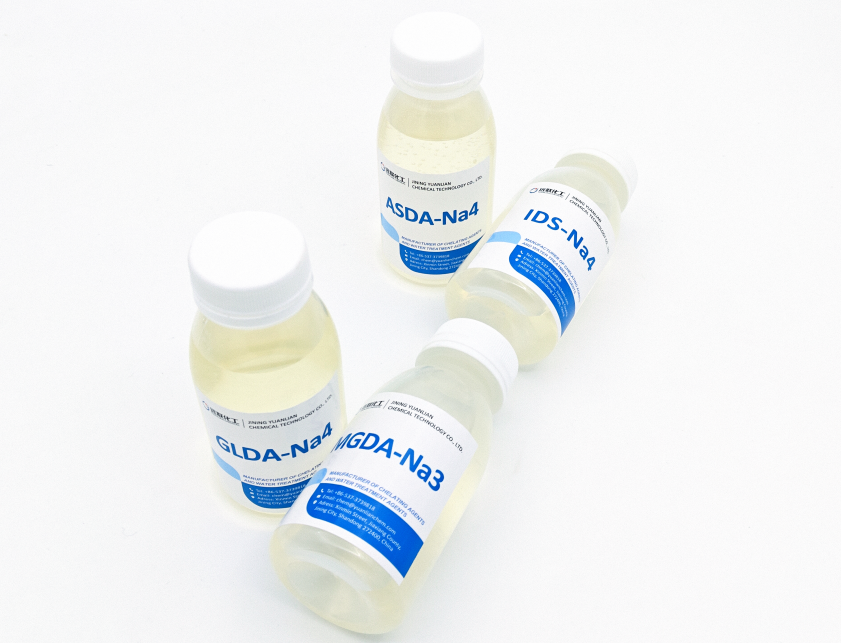
- IDS-Na4 is the one to reach for when copper selectivity matters — PCB lines where copper load drives the fault, or plating where stray copper is the recurring problem. It is not a general hardness builder, so do not price it as one.
- The choice between them is a function of which metal you are fighting and at what pH, not of which data sheet looks strongest. A half-day bench screen at your bath conditions beats a supplier's ranking every time.
Compatibility you have to check
Chelants sit in busy liquors: surfactants, acids, alkalis, brighteners, suppressors. The interactions are system-specific. Before a line trial, screen the candidate in the actual bath at working temperature and confirm it does not drop the brightener window or load the filter. A product that is excellent in a jar can spoil a deposit in a barrel, and the only way to know is to run it where it will live.
Purity is the product
For electronics, the chelant grade is defined by what is not in it. Trace iron, copper, sodium and chloride at the parts-per-million or parts-per-billion level decide whether a grade is "industrial" or "electronics-capable." The certificate of analysis should report those limits by a named method, with a retest date, not a blanket "high purity." If the supplier cannot tell you the chloride content, they are not selling to this market.
Particle load matters too. A chelant solution that carries suspended solids seeds defects in a clean loop. Ask how the grade is filtered and to what nominal rating, and keep that on the incoming check.
What to demand in the specification
- Active content as supplied and per gram of active, with the method named.
- Trace metal limits — Fe, Cu, Na, Cl — at the level your process actually requires, not the supplier's standard grade.
- Filtration rating, stated as a number.
- Biodegradability by OECD 301 where discharge consent asks for it.
- Retest period and storage conditions, because a chelant that degrades in the drum is a different product by the time you use it.
For metal finishing the sodium content may be irrelevant; for electronics it may be the first line on the spec. Write the requirement for the process you are buying for, not a generic one.
Questions for the supplier
- What are your Fe, Cu, Na and Cl limits for this grade, by which methods?
- How is the product filtered, and to what rating?
- Can you hold a defined grade across repeat orders, or does each lot vary?
- What packing suits a clean receiving area — sealed drum, IBC — and what does it do to cost per kilogramme?
- What is the lead time to a named European port, and do you keep buffer stock for contract volumes?
Frequently asked questions
Will one chelating agent cover plating and PCB? Sometimes, but not by assumption. Plating needs broad alkaline tolerance; PCB needs copper selectivity and low sodium. Screen each line; do not assume a shared drum.
Can a chelant replace ion exchange in ultrapure water? No. It holds metal transiently; the loop still needs mechanical removal. Treat it as a stabiliser, not a purifier.
Is sodium content always a problem? Only where the process forbids it — most plating, no; some wafer and certain capacitor steps, yes. State the limit and let the spec decide.
How do I check a new grade without a line stoppage? Run it on a side stream or a partial barrel at working conditions, measure deposit appearance and bath metal by ICP, then scale after three consistent loads.
What does REACH require of the supplier? A valid registration for the imported volume, an EU-language SDS, and the substance identity your declaration needs. RoHS does not list chelants directly, but your customer's downstream declaration will still ask for composition.
The grade that fits is the one matched to the metal, the pH and the purity your line demands — and proven by a supplier who can name the numbers. For the surface-preparation side of the same chemistry, our industrial cleaning notes cover alkaline and CIP use, and the technical library carries the method detail behind these grades.
Yuanlian Chemical specializes in the production of polyaspartic acid (PASP),tetrasodium iminodisuccinate(IDS), GLDA, MGDA etc. with stable quality and excellent quantity!

Contact us