



-

- 2026-09-23
Sodium Polyaspartate as a Scale Inhibitor: A Buyer's Guide
Higher water temperatures and rising concentration cycles push dissolved calcium, magnesium, barium and carbonate towards precipitation. In a cooling tower, a boiler or a reverse osmosis train, that precipitation lands as scale on the very surfaces where heat or pressure is meant to move. Sodium polyaspartate (PASP-Na) is one of the polymers formulators reach for when they want scale control without adding phosphorus to the effluent. This guide sets out how a buyer should choose the grade, read the dose and compare the polymer with the alternatives before committing volume.
Why scale forms where the water sits still
Scale is not a single compound. Calcium carbonate is the usual offender in alkaline cooling water; calcium sulphate and barium sulphate show up where the brine is strong; silica appears in geothermal and produced-water systems. Each salt has its own saturation point, and every degree of temperature rise, every unit of pH movement and every cycle of concentration moves the water closer to it. A treatment programme does not remove the ions; it keeps them from organising into a crystal on the metal.
The two broad mechanisms are threshold inhibition and dispersion. Threshold inhibition lets a small amount of polymer distort the early crystal so it cannot grow. Dispersion keeps the fine particles that do form suspended so they leave with the blowdown instead of plastering the tube. PASP-Na does both, which is why it fits programmes where the water is dirty as well as hard.
What makes PASP a different kind of control
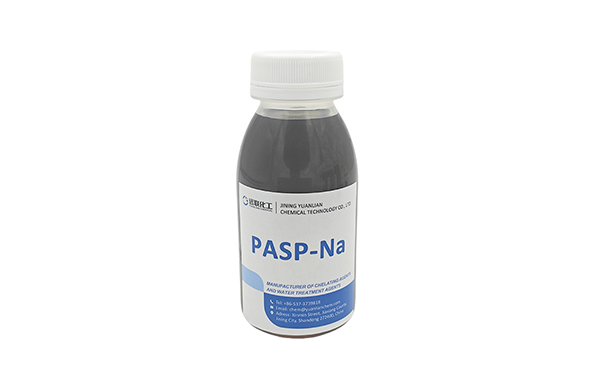
PASP-Na is a polymer of aspartic acid, a natural amino acid, and that origin shapes its environmental file. Under OECD 301B testing it reaches ready-biodegradability, typically more than 60 per cent mineralisation within 28 days, breaking down to carbon dioxide, water and inorganic nitrogen. It contains no phosphorus and no NTA-type chelator, so a programme built on it adds nothing to the phosphorus load of the discharge. Aquatic toxicity sits low, with effect concentrations in the hundreds of milligrams per litre, well above the 2 to 50 mg/L field dose.
That profile is the reason the polymer appears in specifications written for sites under ISO 14001 or facing a tightened discharge permit. It does not replace the performance question; it answers the audit question at the same time.
Cooling towers: the largest use
Open cooling loops concentrate the make-up water as steam leaves and solids stay behind. Calcium carbonate scale on the heat-exchange bundle is the fault that shortens the season between cleans. PASP-Na is normally dosed as a continuous slip-stream into the sump, with the rate set from the local water analysis rather than a fixed number. Hard, alkaline make-up in southern Europe commonly needs the upper part of the 4 to 15 mg/L active range; soft water in the north often sits lower.
The polymer pairs with an oxidising biocide, but the contact needs managing: shock-chlorination at high free chlorine can degrade organic polymers, so most sites add the biocide and the polymer on offset timers or drop the polymer during the shock. Run the compatibility check against your actual biocide before scaling the dose.
Boilers and steam systems
In boilers the concern shifts from carbonate to the hardness that would deposit on tubes and on turbine blades downstream. PASP-Na is used as part of a deposit-control programme at low dose, frequently below 10 mg/L active, with the exact figure following the feed-water specification and the steam pressure. It works as a dispersant for the precipitated solids that do form, keeping them mobile so the blowdown removes them.
Boiler programmes also carry an oxygen-scavenger and a phosphate or polymer conditioner, and the interaction between them decides the result more than any single ingredient. Treat PASP-Na as one line in that programme, not the whole of it, and confirm the supplier's data against your boiler house rather than a generic chart.
Reverse osmosis and membrane loops
Membrane trains reject salt, which means the concentrate stream on the high-pressure side grows saltier with every pass. Calcium and sulphate there reach saturation quickly, and a scale layer on the membrane cuts flux and shortens element life. PASP-Na is dosed into the feed ahead of the membrane, often 1 to 5 mg/L active, to hold the threshold and protect the element.
Because the polymer is a dispersant as well as an inhibitor, it helps keep colloidal foulants from settling on the sheet. It is not a replacement for antiscalant chemistry where strontium or silica dominate; in those cases IDS-Na4 or a phosphonate may be the primary line and PASP the support. Match the molecule to the ion, and confirm with a scaling-index calculation on your own water. The technical library carries the background on metal selectivity for the biodegradable set.
PASP against polyacrylate and phosphonate
Three families sit on the buyer's table. Polyacrylates disperse well and cost little, but they largely resist breakdown and accumulate in sludge and sediment, which the discharge permit eventually counts. Phosphonates such as HEDP and PBTCA control hardness efficiently and stay stable at high temperature, yet every kilogram carries phosphorus that the effluent budget must absorb. PASP-Na lands between them: performance with a closed environmental file.
The trade is price and temperature ceiling. Polyacrylate is the lower-cost default; phosphonate wins where heat is high; PASP wins where the nutrient load and the persistence question decide the purchase. A site under a total-phosphorus limit rarely chooses phosphonate on its own, and a site facing an audit rarely keeps polyacrylate without a note in the file. PASP-Na answers both without a second argument.
Choosing the grade and the active content
PASP-Na is traded most often as a 30 to 40 per cent aqueous solution, with powder grades available where the application or the freight favours a dry form. The headline active figure is not the whole story: the molecular-weight distribution decides how the polymer performs, and two drums at the same per-cent can behave differently if one is skewed short and the other long. A specification that names the distribution, or at least a viscosity band tied to it, protects you from that surprise.
Residual monomer is the other line to watch. Free aspartic acid left from an incomplete reaction weakens the product and shifts the dose you calculated, because you paid for polymer and received amino acid. Require the monomer limit by a named method on the certificate of analysis, and the batch is either in or out.
What to put in the specification
A one-line enquiry — "PASP 40 per cent, please quote" — invites two honest answers that are not the same product. Fix the lines that vary: CAS reference 181828-06-8, active content with tolerance, molecular-weight or viscosity band, residual monomer limit by named method, pH, density, and the heavy-metal profile. Name the test method for each limit, not only the value, so a substitution cannot hide behind a different lab routine.
Ask for the OECD 301B report, the safety data sheet and a batch certificate before the first drum, and keep the retained-sample record so a later dispute starts from a known batch rather than a memory.
Running a trial without a surprise
A side-stream or a single tower is enough to read the effect before the whole site depends on it. Hold the dose, log the make-up water, and weigh the bundle or read the fouling factor at the interval you already use. Compare the clean-in-place frequency and the blowdown phosphorus with the prior programme; the polymer should show its value in fewer cleans and a flat nutrient line, not in a dramatic single number.
Set the review window before you start, and agree the switch criterion with the plant. A trial that ends with "it seemed fine" teaches nothing; one that ends with a recorded fouling trend and a phosphorus balance either justifies the change or kills it cleanly.
Frequently asked questions
Is PASP-Na a chelating agent like EDTA? No. It is a polymeric scale inhibitor and dispersant rather than a strong complexing chelant. It holds ions in suspension and distorts crystals rather than binding them tightly in a ring, which suits threshold treatment more than heavy-metal stripping.
Does PASP contain phosphorus? No. The polymer carries no phosphorus and no NTA-type chelator, so a treatment programme built on it adds nothing to the phosphorus load of the discharge.
Can it replace a phosphonate in a boiler? In many low- to mid-pressure programmes it can take the dispersant role, but where high temperature and hard scale dominate, the phosphonate may still be needed. Confirm against your feed-water specification and steam pressure.
How is it dosed in cooling water? Typically as a continuous slip-stream into the sump at 4 to 15 mg/L active for the polymer, set from the water analysis rather than a fixed rate.
Is it hazardous to ship? Liquid PASP-Na grades are generally classified as non-dangerous goods under ADR, though the exact class is stated in section 14 of the safety data sheet and should match the mode of transport used.
A scale-inhibition programme is a chemical choice and a permit choice at once. For the OECD 301B report, the specification sheet and a sample for bench evaluation, contact [email protected] or call +86-537-3739818. Full product details are available at the company website: https://www.yuanlianchem.com
Yuanlian Chemical specializes in the production of polyaspartic acid (PASP),tetrasodium iminodisuccinate(IDS), GLDA, MGDA etc. with stable quality and excellent quantity!

Contact us