



-

- 2026-09-24
Pulp and Paper Chelating Agents: Frequently Asked Questions
European pulp and paper producers run some of the most metal-sensitive process chemistry in the chemical industry. Trace iron and copper catalyse the breakdown of bleaching chemicals, resin and pitch foul wires and felts, and calcium builds up in the increasingly closed water loops that mills rely on to cut fresh-water use. A well-chosen chelating agent changes how those metals behave without adding persistent substances to the effluent. The questions below come up most often when a mill moves from a lab check to a full line trial.
Why do pulp and paper mills use a chelating agent?
Wood contains metals. Even after debarking and washing, the fibre carries iron, manganese and copper picked up from soil, process water and worn equipment. In a peroxide bleaching stage those metals act as catalysts: a small amount of iron can waste a large share of the hydrogen peroxide charge before it has bleached anything. A chelating agent binds the metal ions into stable, soluble complexes so they stop catalysing reactions the mill does not want.
The same logic applies outside bleaching. Metals in the white-water system seed scale and deposition, metals in recovered fibre drive odour and brightness loss, and transition metals in coating colour promote rheology drift during storage. Chelants are one of the few additives that address all three at once, which is why most modern mills carry at least one on the specification.
Which chelant suits hydrogen peroxide bleaching?
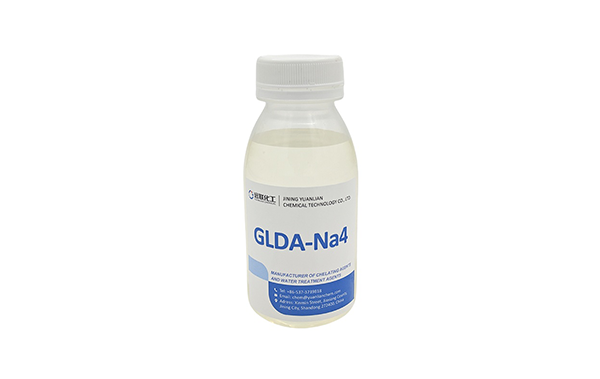
For alkaline peroxide bleaching, iminodisuccinate (IDS-Na4) is the usual first choice. Its copper and manganese complexes are strong at the pH of a peroxide stage, and it holds the metal through the warm, long residence time of a tower bleach. Glutamate diacetate (GLDA-Na4) and methylglycine diacetate (MGDA-Na3) are the common alternatives where the mill also wants a single chelant for the broader process, because both perform across a wider pH range than IDS.
The commercial question is grade and dose, not chemistry alone. A peroxide-stage programme typically runs in the low hundreds of grams per tonne of pulp, but the right figure depends on the metal load of the feedstock, which varies with wood species, season and how much recovered fibre is in the mix. A supplier that quotes a dose without asking about your metal profile is guessing.
How does a chelant control resin and pitch deposits?
Resin and pitch are the lipophilic extractives in wood that migrate to surfaces as the fibre is processed. Metals are not the direct cause, but they catalyse the oxidation and polymerisation that turns mobile extractives into sticky deposits on wires, felts and dryer sections. By tying up the catalytic metals, a chelant slows that conversion and keeps the extractives more manageable through the machine.
Chelants do not dissolve pitch, so they are part of a deposit-control programme rather than a replacement for it. Mills that see the biggest benefit pair the chelant with good cleaning cycles and a measured approach to white-water closure. The chelant reduces the rate at which deposits form; it does not remove what is already baked on.
What about calcium and iron in closed white-water loops?
Closing the water loop saves water and energy, but it concentrates calcium, barium and transition metals. Calcium carbonate scale blocks showers and heat exchangers, and iron stains the sheet. A chelant keeps these ions in solution at the concentrations a closed loop produces, which is why mills report fewer shower failures after bringing a loop under control.
The dose here is a function of the closure rate. A mill running at 95 per cent closure needs more chelant per tonne than one at 80 per cent, because the same metal load is spread over far less make-up water. Regular monitoring of loop metal and hardness, rather than a fixed dose, keeps the programme economic.
Can biodegradable chelants replace EDTA in pulp processing?
In most European mills, yes. IDS, GLDA and MGDA are all readily biodegradable in standard tests such as OECD 301, and that biodegradability is the deciding factor for mills under discharge consent or working toward an EU Ecolabel claim. EDTA persists in the environment and is increasingly questioned under chemical policy, while the three alternatives break down completely once they reach the treatment plant.
The practical catch is that the substitution is a formulation change, not a drop-in swap. Peroxide-stable performance depends on binding the right metals at the right pH, so the mill should confirm brightness, peroxide consumption and dirt count on a representative run before committing. A staged introduction, starting in one line, limits risk.
Do chelants affect paper strength or brightness?
Used at the correct dose, a chelant should improve brightness stability rather than harm it, because it removes the metal-catalysed yellowing that eats into the gains from bleaching. Strength properties such as tensile and tear are not directly altered by the chelant itself; indirect effects come only from cleaner processing and fewer deposits.
Problems appear when dose is mistuned. Too little leaves metal active; too much can complex metals that a later stage actually wants, or add cost with no return. The control is simple: measure loop and feed metal, set the dose to that, and review it when the wood mix changes. Brightness and dirt count on the reel are the quickest indicators that the setting is right.
Which grade works for pigment coating and filling?
Coating colour and filler systems are sensitive to metal-catalysed viscosity change, so the same chelants used in the fibre line apply: GLDA and MGDA are common where coating and process water share a treatment, and IDS is used where peroxide-bearing recycled content enters the furnish. Liquid grades blend more easily into coating kitchens than powders, which matters when the kitchen runs at high solids.
For mills supplying food-contact or child-safe paper, the grade choice should be confirmed against the relevant framework with the supplier's documentation. The chelant is a processing aid, but its residual level and purity profile are part of the conformance file for the finished sheet, so the specification has to state them.
Are there food-contact or environmental limits to watch?
Food-contact paper and board fall under the EU food-contact materials framework, and the specific limits depend on the end use and the national implementation. A mill should hold the supplier's composition disclosure, heavy-metal limits and any applicable status for the grade, and confirm it with its own regulatory function before the first delivery. Treating that document set as part of the purchase avoids surprises at the converter.
On the environmental side, discharge consent and receiving-water sensitivity set the practical ceiling. Biodegradable chelants help, but the mill still monitors chelant and metal in effluent. Mills working toward EU Ecolabel for tissue or graphic paper will find that switching away from persistent chelants supports the chemical-hazard criteria in the award.
How do I trial a chelant on my line?
Start narrow. Pick one line or one bleach stage, set a baseline of brightness, peroxide consumption, dirt count and deposit frequency, then introduce the chelant at a dose based on measured metal load. Run for a full campaign so the data covers a wood-mix change, not just a favourable day.
Keep the trial controlled: change one variable, record the chelant addition against production, and compare like for like. Ask the supplier for the certificate of analysis, the biodegradability report and the safety data sheet before the trial so the conformance file is ready if the result is positive. A trial that cannot be repeated is a demonstration, not a decision.
Frequently asked questions
Does a chelant replace the need for good housekeeping? No. A chelant reduces the rate at which metals cause trouble, but closed loops, clean showers and a sensible cleaning cycle remain the backbone of deposit control. Treat the chelant as part of the programme, not the whole of it.
Will switching chelant change my effluent permit position? In most cases it improves it, because biodegradable chelants place less persistent load on the receiving water than EDTA. Confirm the specific effect against your consent with measured effluent data from the trial.
Can I use one chelant across bleaching, coating and water treatment? Often, where the same metal-control problem spans those areas. GLDA and MGDA cover the widest pH range; IDS is strongest in the peroxide stage. A single supplier that stocks the relevant grades keeps the paperwork and quality control in one place.
Yuanlian Chemical supplies GLDA-Na4, MGDA-Na3 and IDS-Na4 with the certificates of analysis, biodegradability reports and safety data sheets that European mills need for QA and conformance. To scope a trial on your line, write to [email protected] or call +86-537-3739818, and link through to the product centre at https://www.yuanlianchem.com for the current grade list and technical dossier.
Yuanlian Chemical specializes in the production of polyaspartic acid (PASP),tetrasodium iminodisuccinate(IDS), GLDA, MGDA etc. with stable quality and excellent quantity!

Contact us