



-

- 2026-10-12
PASP and Water-Use Efficiency: a Practical Farm Guide
Water has become the variable European growers plan around rather than take for granted. Longer dry spells, tighter abstraction licences and the cost of pumping have moved irrigation efficiency from a side topic to a core part of the cropping plan. Sodium polyaspartate (PASP-Na) sits in that plan as a soil and fertiliser additive that helps the crop make more of the water it receives. This guide looks at where it earns its place on a farm, how it differs from the nutrient-leaching story that surrounds the same molecule, and what a grower should ask for before the first application.
The water-stress problem on European farms
A field that runs short of water does not fail all at once; it loses yield quietly through smaller fruit, weaker tillering and shallower rooting. Southern Europe lives with this every summer, and northern growers now see it in dry springs that arrive before the canopy can cover the ground. The issue is rarely the total rainfall over a season but the timing and the soil's ability to hold moisture where the root can reach it. An additive that improves that hold, without adding to the nutrient burden a farm is already regulated on, is worth a proper look rather than a glance.
What PASP does in the root zone for water
Sodium polyaspartate is a polycarboxylate, and its carboxylate groups interact with water and with soil particles in a way that changes how moisture behaves. Rather than holding water like a sponge, it changes the availability of the moisture films around soil colloids so the root can draw on them more steadily between irrigations. The effect shows up as a slower fall in plant water status after a watering stops, which gives the crop a wider window before stress sets in. This is a physical and chemical behaviour of the polymer, not a claim about the plant itself, and it is most reliably confirmed in the field conditions of the farm in question.
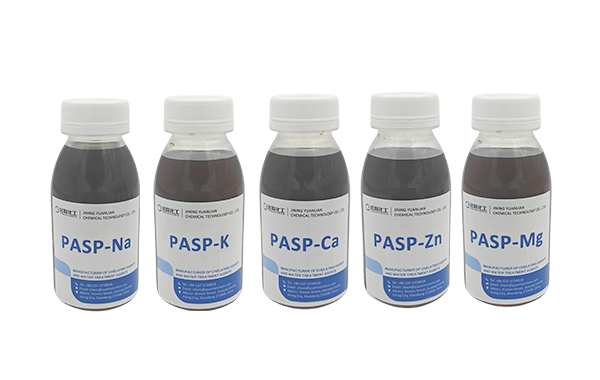
Holding moisture where the root can reach it
The practical value appears where irrigation is intermittent or where the soil is light and drains quickly. In a sandy or loamy field, much of a watering can pass below the root zone before the crop uses it; an additive that keeps more of that moisture plant-available reduces the gap between what is applied and what is grown. Growers report steadier emergence and less midday wilting when the product is part of a programme, though the size of the effect depends on soil type, the crop and the season. The honest position is that it supports the existing irrigation plan; it does not remove the need for one.
Reducing irrigation demand and runoff
Because the crop makes more of each watering, the same yield can often be reached with somewhat less applied water, or the same water carries the crop through a longer dry stretch. That matters where abstraction is licensed or where pumping is a real cost. There is also a runoff angle: water held in the root zone is water that does not leave the field carrying soil and nutrients with it. Used alongside a nutrient plan built around the EU Nitrates Directive, PASP-Na fits a broader move toward doing more with less water and less loss, rather than a separate, conflicting goal.
Fitting PASP into a fertiliser programme
On most farms the molecule enters through the fertiliser or the irrigation line rather than as a standalone pass. It is tank-mix compatible with standard liquid fertilisers and with many crop-protection products, so it rides along with what is already being applied. The usual approach is a modest rate per hectare across the growth stages that matter most for water stress, rather than a single large dose. As with any input, the rate that pays back is the one matched to the crop, the soil and the irrigation schedule, which a short on-farm check settles more reliably than a catalogue figure.
Reading the trade against synthetic polymers
PASP-Na is often weighed against synthetic polyacrylates and against older, more persistent soil conditioners. Its advantage is that it is readily biodegradable and leaves no phosphorus behind, so it does not add to the discharge or accumulation questions that surround some alternatives. It is not a silver bullet for a poorly designed irrigation system, and it will not rescue a field that is simply under-watered. What it offers is a low-burden way to lift the efficiency of the water already in the plan, which is a different and more defensible claim than promising a yield jump.
A practical route into the field
Start with one field or one irrigation zone that is easy to compare with the rest. Apply the product through the existing fertigation or spraying equipment at a rate agreed with the supplier, keep the irrigation volume and timing the same as the control, and watch emergence, midday wilting and, in the end, the yield. A season of this comparison tells a grower more than a shelf of brochures. Where the soil is light and the water licence is tight, the case for repeating tends to be clearest; where rainfall is reliable and the soil is heavy clay, the benefit is smaller and should be judged accordingly.
What to ask a supplier
Ask for the biodegradation data, the recommended rate range, the tank-mix compatibility notes and a reference from a farm with a similar soil and crop. Ask whether the grade is stable in your water and through your fertiliser mix, and whether the supplier can hold a consistent molecular-weight band across deliveries. Confirm that the product is supplied with the documentation needed under your fertiliser and plant-protection rules, because an input that cannot be traced is a liability no matter how well it performs in the field.
Frequently asked questions
Does PASP add phosphorus to my land? No. The polymer carries no phosphorus, so it does not add to the nutrient load regulated under the Nitrates Directive.
Will it let me stop irrigating? No. It supports an irrigation plan by improving water availability; it does not replace the water a crop needs.
Is it compatible with my fertiliser mix? In most standard liquid fertilisers and many crop-protection tanks it is, but a jar test on your actual mix confirms it before you commit a sprayer load.
How do I judge whether it paid back? Compare one treated zone with an untreated one over a season, watching emergence, wilting and final yield rather than relying on a single observation.
Bring more efficiency to the water your farm already uses. Visit the product centre at yuanlianchem.com for specifications, certificates and sample requests, or write to [email protected] to discuss rates for your soil and crop.
Yuanlian Chemical specializes in the production of polyaspartic acid (PASP),tetrasodium iminodisuccinate(IDS), GLDA, MGDA etc. with stable quality and excellent quantity!

Contact us