


-

- 2026-10-19
EDDS-Na3 for Household and Cleaning Products: A Guide
Ethylenediamine disuccinate, supplied as EDDS-Na3, is a biodegradable chelating agent that formulators reach for when they need strong, selective metal binding without a persistent synthetic molecule. It has gained ground in cleaning products where trace-metal control drives product stability and appearance. This guide covers where EDDS-Na3 fits in household and institutional cleaning, and what to verify before it enters your formula. (Personal care use is covered in a separate article; this one keeps to cleaning and home-care applications.)
Why formulators look at EDDS-Na3
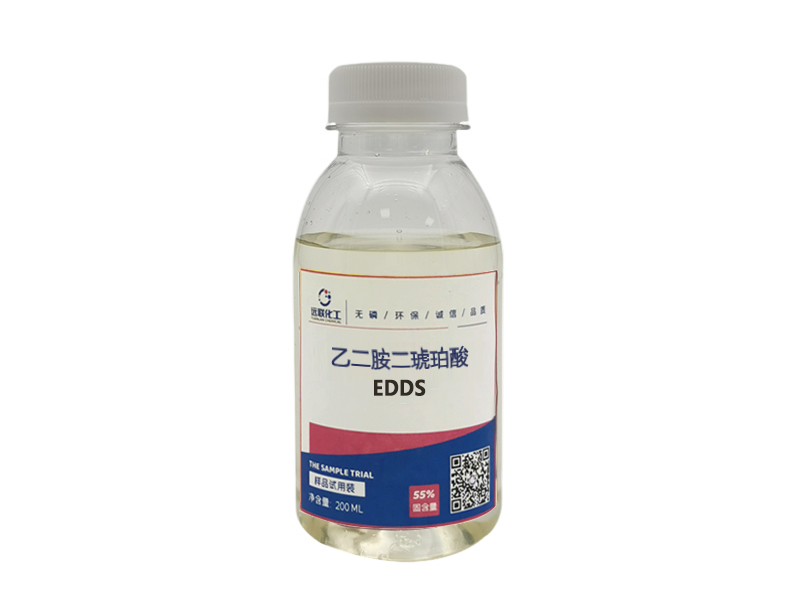
EDDS-Na3 is a tetrasodium salt of ethylenediamine disuccinic acid, a structural cousin of EDTA but built to biodegrade more readily. Its carboxylate and amine donors bind metal ions firmly, and it shows useful selectivity for iron and copper, which are the metals most likely to spoil a cleaning product through catalysed oxidation. For brands moving away from EDTA for environmental or marketing reasons, EDDS is a credible alternative that still delivers dependable chelation in the wash.
Laundry and fabric care
In laundry, EDDS-Na3 ties up iron and copper that would otherwise catalyse the breakdown of bleach and fragrances or cause fabric discolouration. It supports stain removal on rust and metal-marked textiles and helps keep wash liquor clear in hard water. Because it is a firm binder, lower use levels can achieve the metal-control target than with weaker chelants, though the exact rate depends on water profile and soil load. As always, confirm the level on your own wash panel rather than transferring a figure from a different formula.
Dishwashing formulations
Both automatic and hand dishwashing benefit from EDDS-Na3's ability to hold transition metals in check while the surfactants and builders handle grease. In automatic dishwashing, it helps protect glass clarity by limiting metal-induced films and supports the oxidant system against catalytic breakdown. In hand dish liquids, it softens wash water and reduces residues on dried glassware. The high-temperature, high-alkalinity dish environment should be reproduced in any validation trial, since chelant behaviour shifts with both parameters.
Hard-surface and bathroom cleaners
Bathroom and all-purpose cleaners meet lime scale, rust and metal-stained soils, so a chelant that selectively binds iron and copper earns its place. EDDS-Na3 helps dissolve and suspend these soils and prevents re-deposition during rinsing, leaving surfaces clearer. It is comfortable in neutral to alkaline sprays and wipes, which covers most household hard-surface formats. As with other chelants, very acidic descalers are a different use case and deserve their own compatibility check.
Industrial and institutional cleaning
I&I cleaners for food plants, laundries, hospitals and general facilities often run at higher strength and temperature, and many operate under discharge or procurement rules that favour biodegradable inputs. EDDS-Na3 fits where firm metal binding matters for product stability and where the operator wants to avoid EDTA. Combining it with alkaline or caustic builders is common, but precipitation at high electrolyte load and any compatibility with cationics should be confirmed in a bench trial before scale-up.
Automotive and exterior care
Car wash and exterior cleaning encounter iron fallout, brake dust and mineral spotting that respond well to selective chelation. EDDS-Na3 helps lift these metal-based soils and protects the formula from catalytic oxidation during storage. Wheel and rim cleaners, which face some of the most aggressive metal soils, are a logical fit where the pH and corrosion constraints of the product allow it. As with all metal-binding agents, the chosen concentration should reflect the soil challenge rather than a generic default.
Compatibility and handling
Add EDDS-Na3 to the aqueous phase early so it complexes metals before surfactants and actives are introduced. Verify stability with your specific surfactant and builder set, particularly at the use dilution where hardness can precipitate some combinations. Check clarity and viscosity after temperature cycling, and confirm that fragrance and colour remain stable, since free metal ions are a known driver of off-notes and fading. These checks are standard but easy to skip under schedule pressure, which is exactly when they matter most.
Sourcing considerations
Specify on active chelant content and request a certificate of analysis covering appearance, pH, active level and heavy-metal limits. Confirm REACH status and CLP classification, and ask for biodegradation data such as the OECD 301 series to support environmental claims. State your intended application when requesting a quote, because food-contact or I&I lines may need extra documentation. Compare offers per unit of active chelant delivered, not per tonne, to keep the comparison honest.
Regulatory and labelling fit
In the EU, cleaning products sit under the Detergents Regulation (EU) 648/2004 for labelling and the CLP regulation for hazard communication, and the chelant contributes to both. EDDS's biodegradable profile supports eco-label arguments, but the finished product must still meet the full scheme criteria, including degradability and aquatic toxicity thresholds. Keep the REACH registration, safety data sheet and biodegradation data on file, because retailers and auditors increasingly ask for the chelant's documentation alongside the formula. A complete file shortens the path from development to shelf.
Frequently asked questions
How does EDDS differ from EDTA in cleaning? EDDS provides similar firm chelation but is designed to biodegrade more readily, which is why brands drop EDTA for it; the formula should still be re-validated rather than swapped directly.
Is it suitable for acidic descalers? EDDS works most reliably in neutral to alkaline products; strongly acidic descalers need a different chelant choice, so check the pH window first.
Will it replace a builder like citrate? It controls metal ions rather than supplying bulk builder capacity, so it is used alongside citrate or zeolite, not as a full substitute for them.
Does it help with odour or colour drift? By binding catalytic iron and copper it reduces a common cause of oxidation-driven off-notes and fading, but final stability must still be confirmed in your formulation.
EDDS-Na3 gives cleaning product developers a biodegradable, selectively binding chelant that suits hard-surface, laundry, dishwashing and I&I formats. To discuss grades, request samples or check pricing, contact our team at [email protected] or +86-537-3739818, and browse the catalogue at Yuanlian Chemical.
Yuanlian Chemical specializes in the production of polyaspartic acid (PASP),tetrasodium iminodisuccinate(IDS), GLDA, MGDA etc. with stable quality and excellent quantity!

Contact us