


-

- 2026-10-22
EDDS-3Na in Agriculture: A Crop Nutrition Buyer's Guide
Iron chlorosis on high-pH ground is one of the most visible signs that a nutrient is present in the soil but unavailable to the plant. Correcting it with a simple salt rarely holds, because the free metal precipitates before the root can use it. EDDS-3Na, the trisodium salt of ethylenediamine disuccinate, has become a reference biodegradable chelating agent for this job. It forms strong, selective complexes with iron, zinc and manganese, and it degrades through normal biological pathways rather than persisting in soil and water. For buyers building a credible micronutrient programme, that combination of agronomic strength and low environmental load is the main attraction.
Why iron and zinc availability fails in the field
On calcareous, alkaline and saline soils, free iron and zinc convert rapidly to insoluble hydroxides and carbonates. The plant root sits in a nutrient-rich medium that it cannot use, and the classic symptom is young-leaf chlorosis that spreads as the season advances. The same problem appears in alkaline irrigation water, where the metal drops out of solution in the tank or the line. Chelation holds the nutrient in a protected, soluble form so it reaches the root or the leaf intact.
Where EDDS-3Na earns its place
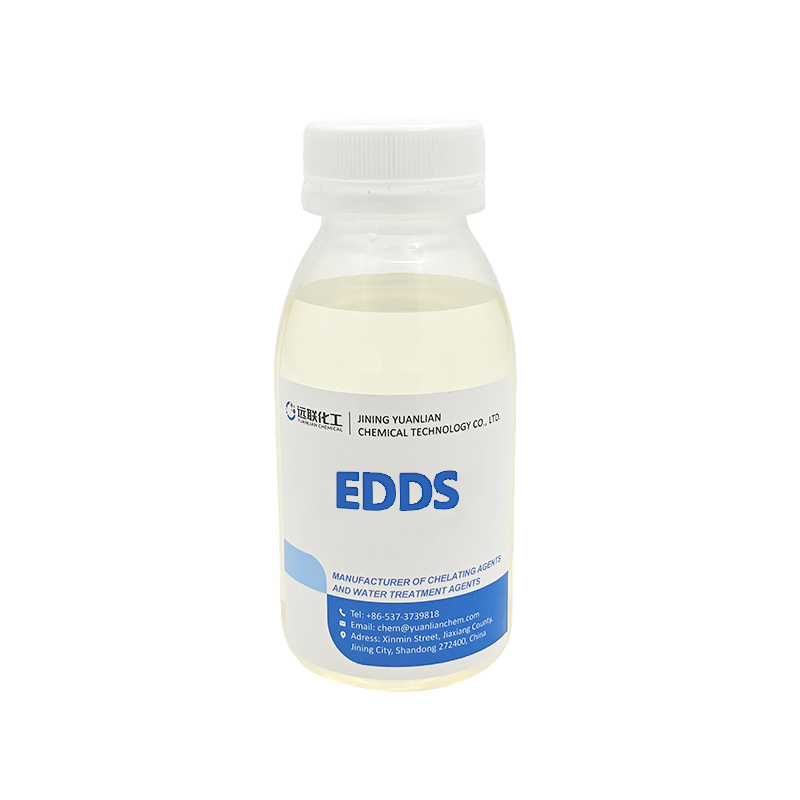
EDDS-3Na is valued where both performance and biodegradability are required. Its conditional stability constants for iron are high enough to keep the nutrient available across a wide pH range, while the molecule itself is recognised as readily biodegradable under the OECD 301 test series. That profile makes it a sensible choice for programmes sold into markets with strict environmental expectations, and for growers who want to avoid the accumulation associated with persistent synthetic chelants.
Selecting the right grade
EDDS-3Na is typically supplied as a liquid of defined active content, sometimes pre-complexed with iron to give a ready iron chelate. For a buyer, the decision starts with whether to purchase the free chelant and complex in house, or to buy the pre-formed iron chelate and simplify the blend. Check the active percentage, the iron content if pre-complexed, the clarity of the solution and the heavy-metal impurity ceiling, because fertiliser products carry their own contaminant limits under the applicable framework.
Soil application on alkaline ground
The clearest field response to EDDS-3Na comes on alkaline and calcareous soils where iron chlorosis is chronic. Applied to the root zone, the chelated iron remains available long enough for the plant to take it up, and the greening response is usually visible within a short window after application. Placement matters: the complex should reach the active root zone rather than being broadcast where it may be diluted or fixed before use.
Foliar correction of acute deficiency
When chlorosis is already showing, foliar application gives the fastest visual correction because the nutrient goes straight to the leaf. EDDS-3Na is well suited to this route, provided the tank mix is clean and the spray is timed to avoid leaf scorch under strong sun. A foliar pass handles the acute symptom, while a soil or fertigation programme addresses the underlying availability problem.
Support for zinc and manganese programmes
Iron gets most of the attention, but EDDS-3Na also complexes zinc and manganese effectively. These two nutrients influence enzyme activity, reproductive development and stress tolerance, and they too become unavailable on high-pH ground. Including them in a chelated programme helps avoid the hidden deficiencies that show up as poor fruit set or uneven maturity rather than obvious chlorosis.
A note on metal-contaminated land
Because EDDS-3Na binds strongly with several heavy metals, it has been studied for assisting the clean-up of metal-polluted soils through chelant-assisted phytoextraction. This is a distinct use from crop nutrition and follows different handling and regulatory logic. Growers should keep the two applications separate: the agronomic dose for nutrition is not the regime used in remediation work, and the paperwork differs.
Regulatory and labelling considerations
In the EU, micronutrient fertiliser products are governed by Regulation (EU) 2019/1009 where a fertilising claim is made, and the word "chelate" has a specific defined meaning. EDDS-3Na's biodegradability supports compliance with the environmental intent of the rules, but the final product still needs the correct contaminant limits, claim language and label text. Confirm whether the material is being bought as a fertilising product or as a technical input for onward formulation, because the document set changes accordingly.
Questions to ask before ordering
Ask for the active content and the method behind it, the impurity profile, the recommended storage conditions and shelf life, and the biodegradation data supporting any environmental statement. If buying pre-complexed iron, confirm the iron content and the stability of the complex in your water. A supplier who supplies consistent batches and transparent documentation is worth more than a low price that varies batch to batch.
Frequently asked questions
Is EDDS-3Na the same as EDTA? No. EDTA is a strong but persistent chelant, whereas EDDS-3Na is structurally related yet readily biodegradable, which is why it is preferred where environmental load is a concern.
Which crops benefit most? Crops prone to iron chlorosis on alkaline soils, such as citrus, vines, pome and stone fruit, olives and many vegetables, tend to show the clearest response.
Can it be used through fertigation? Yes. It stays in solution during dilution, which suits fertigation and liquid feeding, provided the final mix pH and hardness are checked.
Does it accumulate in soil? It is designed to degrade through biological pathways rather than persist, which is a key reason for its use over older synthetic chelants.
EDDS-3Na gives formulators and growers a biodegradable way to keep iron, zinc and manganese available where alkaline soils would otherwise lock them away. To discuss grades, pre-complexed options or a trial sample for your crop programme, contact [email protected] or call +86-537-3739818. Explore the wider catalogue at https://www.yuanlianchem.com.
Yuanlian Chemical specializes in the production of polyaspartic acid (PASP),tetrasodium iminodisuccinate(IDS), GLDA, MGDA etc. with stable quality and excellent quantity!

Contact us