



-

- 2026-11-02
PASP and Non-Carbonate Scales: Iron, Manganese and Silica
Most writing on sodium polyaspartate centres on calcium carbonate, and for good reason: it is the common scale and the agent handles it well. Yet many water systems fail on scales that have nothing to do with carbonate. Iron and manganese stain and clog, while silica forms hard, acid-resistant deposits that defeat normal cleaning. Understanding how the polymer behaves with these species matters for anyone designing a programme for groundwater, geothermal or high-recovery loops. The mechanism is sequestration and stabilisation rather than precipitation, and the window is narrower than it is for calcium.
Carbonate is only part of the scaling story
A programme judged only on its calcium carbonate inhibition can still lose a heat exchanger to another species. Iron arrives from corrosion, groundwater or upstream process streams; manganese follows a similar path and is harder to oxidise. Silica enters with the make-up and concentrates as water is recovered, forming deposits that resist acid and mechanical cleaning alike. Each of these scales interacts with the polycarboxylate through a different pathway, so a single carbonate-focused figure gives a false sense of coverage. The useful question is how the agent behaves with the actual mix in the water.
Sequestration of iron and manganese
Sodium polyaspartate binds ferrous and manganous ions in soluble complexes through its carboxylate groups, holding them in solution so they do not precipitate as hydroxides or deposit on surfaces. The effect is most visible in groundwater supplies and ageing mains, where iron and manganese vary through the year and cause staining and turbidity. The sequestrant does not remove the metal from the water; it keeps it transported and manageable, which suits systems where the metal load is moderate and the aim is to stop deposition rather than to strip the metal out.
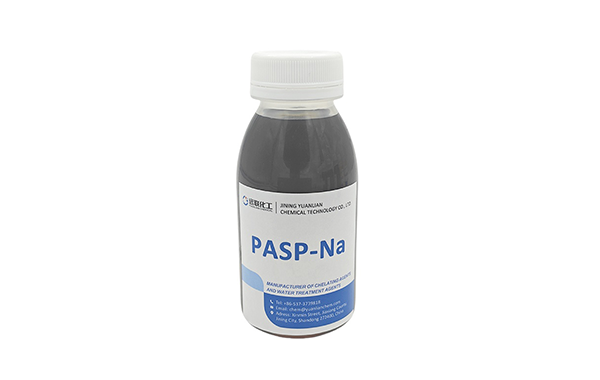
How the cation complex forms
The binding is a coordination between the carboxylate oxygen and the metal cation, and it is sensitive to the oxidation state. Ferrous iron and manganous ion complex readily, while oxidised ferric iron tends to precipitate as hydroxide, which the polymer can only disperse rather than hold in true solution. This distinction explains why oxidation ahead of the polymer can worsen deposition: the metal passes beyond the state the sequestrant can manage. Programme design therefore watches the redox condition as closely as the dose.
Silica and the polymerisation problem
Silica is the awkward member of the group. Dissolved silicate polymerises as concentration and pH rise, building into colloidal and then deposited forms that are dense and resistant to cleaning. Sodium polyaspartate stabilises the silica by adsorbing at the growing particle surface and slowing the polymerisation that leads to scale. The control is partial and depends on the silica level and the recovery rate; at very high concentration the agent delays rather than prevents deposition, so it is paired with limits on the concentration factor and with blowdown management.
Where these scales appear
Iron and manganese dominate in groundwater-fed boilers, cooling make-up and potable networks with ageing mains. Silica concentrates in high-recovery reverse-osmosis trains, geothermal loops and cooling towers running on reclaimed water. The same polymer can address more than one species in a single programme, which is part of its appeal, but the dose that suits iron may not suit silica, so multi-species water needs a screened blend rather than a single figure copied from a carbonate test.
Molecular weight and the binding window
Molecular weight shapes both the sequestration strength and the dispersion. Lower bands penetrate fine pores and suit clear streams with dissolved metal; higher bands carry more carboxylate sites per chain and bind more metal, but can over-disperse colloidal silica if mismatched. The binding window is narrower than for calcium, so the grade is chosen against the dominant problem species. A blend of bands sometimes performs better than a single band where iron, manganese and silica coexist.
pH, redox and concentration
pH moves the speciation of every species here: higher pH favours metal hydroxide precipitation and silica polymerisation, which works against the sequestrant. Redox decides whether iron is in the complexable ferrous state or the precipitating ferric state. Concentration factor sets how far silica and metal build before deposition. None of these is fixed by the polymer alone; the programme sets the conditions and the agent works within them, which is why the water is read before the dose is written. Field checks that ignore one of these three tend to overstate what the polymer can achieve on its own, so all three are read together.
Screening against the real water
Screening uses the actual make-up and concentrate, not a synthetic standard. Hold the sample at plant temperature and pH, add the polymer at two or three doses, and measure the soluble metal and silica remaining after a set contact time, plus any deposited weight on a test surface. Compare against a no-polymer control and against the existing programme. A screen that uses the real water and a realistic concentration factor predicts field behaviour far better than a single bench point.
Frequently asked questions
Does PASP remove iron from water? No. It holds iron and manganese in soluble complexes so they do not deposit; removal needs oxidation, filtration or precipitation elsewhere.
Can it stop silica scale completely? It stabilises silica and delays polymerisation, but at high concentration it delays rather than prevents, so pair it with blowdown and recovery limits.
Why does oxidation sometimes make iron worse? Oxidised ferric iron precipitates as hydroxide, which the polymer can disperse but not hold in true solution.
How is the grade chosen? Against the dominant species and the molecular-weight window; blends suit water where iron, manganese and silica coexist.
Commercial supply and specification support are described at https://www.yuanlianchem.com.
Yuanlian Chemical specializes in the production of polyaspartic acid (PASP),tetrasodium iminodisuccinate(IDS), GLDA, MGDA etc. with stable quality and excellent quantity!

Contact us