



-

- 2026-11-12
Chelating Agents for RO and UF Membrane Cleaning Programmes
A reverse osmosis train rarely fails in a single event. Output slides over a few months, the differential pressure creeps up, and the log records a clean that used to restore the flow and now only half does it. By the time the element is autopsied, the deposit that caused the loss has usually been sitting there through several cleaning cycles, partly dissolved, partly redeposited. Getting the cleaning chemistry right is therefore less about finding a stronger product and more about identifying what is actually on the membrane.
Why a fouled element needs chemistry, not more feed pressure
The instinct when permeate flow drops is to raise the feed pressure to hold recovery. That works for a while and then stops working, because the deposit adds resistance that pressure cannot overcome, and the extra pressure compacts the fouling layer against the membrane surface. Once a layer is compacted it is harder to remove than it was when it first formed, and the element is also being run outside its design envelope. Cleaning early and cleaning properly is the cheaper route, and it protects the membrane from the mechanical stress that shortens its life.
Reading the deposit before choosing a chemical
Membrane foulants fall into a small number of groups, and each responds to a different chemistry. Carbonate hardness responds to acid. Metal oxides and hydroxides respond to acid plus a reducing agent, and to chelation. Colloidal silica and clay respond to alkaline conditions with a surfactant and a dispersant. Biological film and organic matter respond to caustic with a wetting agent, sometimes with an enzyme. Sulphate scale sits between the groups and is the one that punishes optimism.
A plant can identify the deposit cheaply. Weigh a small piece of a sacrificed element, ignite it to estimate the organic fraction, then digest the ash in dilute acid and measure calcium, magnesium, iron and silica. Where the budget allows, X-ray diffraction confirms the crystal form. That single analysis changes the cleaning programme more than any product substitution, because it tells you whether the chelant is there to hold hardness, to keep iron in solution, or to break up a colloidal film.
The two-stage clean and where the chelant belongs
Most programmes run an alkaline stage followed by an acid stage, at low pressure and low crossflow, with the permeate line open to drain. The alkaline stage lifts organic and biological soil and disperses colloids. The acid stage dissolves carbonate and metal hydroxide. Between them they cover most of what accumulates on a spiral element.
The chelant usually sits in the alkaline stage, and its job is narrower than buyers expect. It does not remove the bulk soil; the caustic and the surfactant do that. It holds the calcium, magnesium, iron and manganese that the caustic liberates, so those metals leave with the cleaning solution instead of forming hydroxide flocs that settle onto the membrane and set into a film. In hard-water sites that single function is often the difference between a clean that restores flux and one that leaves a haze behind.
Where iron is the dominant foulant, a chelant is also worth adding to the acid stage, or an acid formulated with one. Iron released from a deposit can re-precipitate as the pH rises during rinse, and a chelant keeps it mobile until it is flushed clear.
Polyamide compatibility and the pH ceiling
Thin-film composite polyamide is the membrane most plants run, and it sets the boundaries of the cleaning recipe. It tolerates a pH range that is broad but not unlimited, typically from about 2 to about 11 or 12 for short cleaning contact, narrower for continuous exposure. Free chlorine attacks the polyamide layer and shortens element life, so any cleaning product carrying an oxidiser needs to be checked against the element manufacturer's stated tolerance. Temperature matters as well, with most makers capping cleaning solutions somewhere near 45 °C.
The practical consequence is that the chelant is chosen inside a box, not in open field. A product that needs a pH outside the membrane's window is not available to you, however well it performs in a beaker. That is why alkaline-stable agents with good calcium binding at pH 10 to 11 are the ones that appear in membrane cleaning formulations, and why a chelant whose performance peaks in strongly acidic conditions rarely earns a place.
Matching the agent to the duty
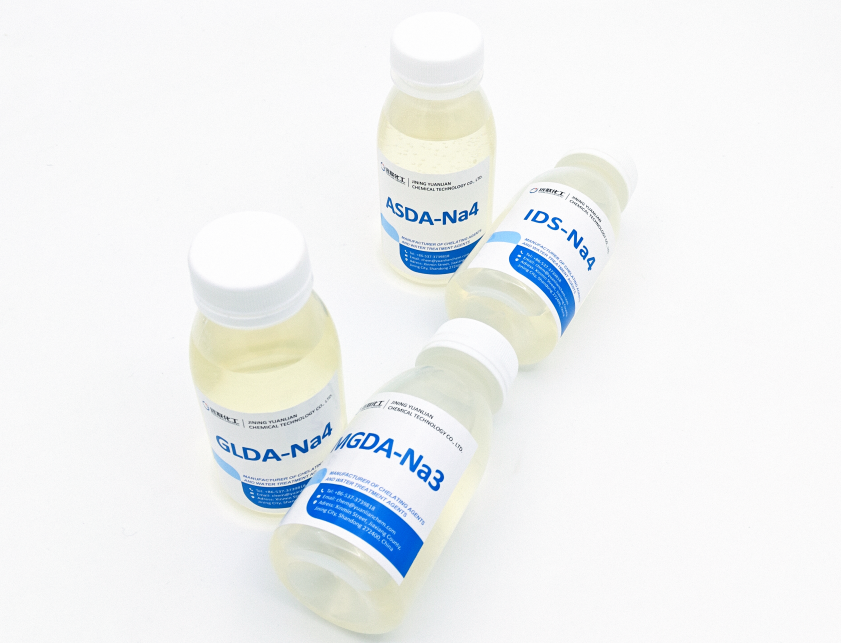
Four biodegradable agents cover most of the demand, and they are not interchangeable.
|
Agent |
Where it earns its place in cleaning |
Watch point |
|
GLDA-Na4 |
High-pH alkaline stage, broad hardness control, liquid blending |
Chloride content in the grade supplied |
|
MGDA-Na3 |
Hard-water sites, high calcium and magnesium load |
Foaming in low-flow circulation |
|
IDS-Na4 |
Alkaline and acid stages, good hydrolytic stability |
Slightly lower binding than GLDA at high pH |
|
PASP-Na |
Iron and manganese dispersion, anti-redeposition |
Not a scale dissolver on its own |
The choice follows the deposit analysis. A carbonate-dominant deposit with modest iron does well on GLDA in the alkaline stage and a plain acid stage after it. An iron-heavy deposit on a borehole-fed plant benefits from PASP in the alkaline stage, because dispersion keeps the iron from plating onto the membrane while the rest of the clean proceeds. A site with very hard feed and a colloidal silica problem needs both a chelant and a dispersant, and the dose has to be set against the hardness load rather than against the product's recommended range on a data sheet.
Technical notes on how these agents behave at high pH and in the presence of oxidisers sit in the companion articles on chelant stability across the pH window and on why chelants work less well inside a membrane element, both of which are worth reading before a programme is rewritten.
Sequence, dose and flush discipline
A workable sequence for a spiral element is short and unhurried. Flush with permeate to displace the feed. Circulate the alkaline cleaning solution at low flow for fifteen to thirty minutes to bring the element to temperature and displace air. Soak for one to two hours, or longer for heavy organic load, then recirculate again and monitor the solution for colour and turbidity, which tell you whether anything is coming off. Flush to drain until the rinse water is neutral and clear. Repeat with the acid stage if the deposit analysis calls for it. Record flux, differential pressure and salt passage after each stage.
Dose for chelants in cleaning duty is usually expressed as a percentage of the cleaning solution and commonly falls between 0.1 and 1 per cent by weight, with the upper end used when hardness or iron loading is high and the contact time is short. More is not automatically better: an over-dosed alkaline solution can be harder to rinse out, and residual chelant in the element holds metals that then precipitate during the next run. Clean one stage at a time, and never combine alkaline and acid in the same circulation.
Reading the result and deciding what to change
The verdict comes from normalised data, not from a single reading on the day. Flux after cleaning is corrected to a reference temperature and compared with the commissioning baseline. Differential pressure across the first stage is compared the same way. Salt passage is checked because a clean that restores flow while pushing passage up may have damaged the membrane rather than cleaned it.
If recovery reaches the high eighties or better of the baseline, the programme is working. If it stalls around sixty to seventy per cent, the deposit was misjudged, or the contact time was too short, or the temperature never got high enough in a large vessel. If flux recovers and then decays within weeks, the problem is upstream and belongs in pretreatment, not in the cleaning chemical.
Effluent, disposal and the biodegradable argument
Cleaning solutions are dumped, and in a plant that cleans monthly the volume adds up. EDTA in a spent cleaning solution passes through conventional treatment largely intact and remobilises metals in the receiving water. The biodegradable alternatives are not identical in behaviour, but they are designed to mineralise under OECD 301 conditions, which is what a discharge permit or a site environmental review tends to ask about.
For sites that buy a finished cleaning chemical rather than blending their own, the product itself falls under the EU Detergents Regulation, and the surfactant and chelant content both need to be declared on the safety data sheet and the ingredient list. Checking that documentation at the purchasing stage avoids an argument at the discharge consent stage.
If the plant also runs a pretreatment programme, the articles on scale control without phosphorus and on the municipal water treatment route explain how the antiscalant and the cleaner should be kept apart in the specification, since the two have opposite jobs.
Frequently asked questions
Can a chelant replace the acid stage? Not on a carbonate-heavy deposit. Acid dissolves carbonate quickly and cheaply. The chelant complements it by holding the released metals in solution and by dealing with deposits the acid cannot reach.
How often should an element be cleaned? When normalised flux falls by about ten per cent from baseline, or differential pressure rises by ten to fifteen per cent, or salt passage rises. Fixed calendars ignore the actual fouling rate.
Is a higher cleaning temperature always faster? Up to the membrane maker's limit, warmer solutions work faster. Beyond it, the polyamide layer ages. Most makers cap cleaning near 45 °C, and the cap applies to the solution in the vessel, not the feed tank.
Will a biodegradable chelant clean as well as EDTA? On hardness and iron it performs close to EDTA in alkaline conditions, and the difference is usually smaller than the difference between a correct and an incorrect cleaning sequence.
What documentation should come with the chelant? Certificate of analysis with assay and chloride, safety data sheet, biodegradability evidence to OECD 301, and a statement on food-contact suitability if the plant is in the food chain.
To discuss a cleaning programme, request a sample for bench work alongside your deposit analysis, or ask for documentation sets, write to [email protected] or call +86-537-3739818. Product ranges for water treatment and green chelating agents are listed at yuanlianchem.com, with mechanism notes at yuanlianchelating.com.
Yuanlian Chemical specializes in the production of polyaspartic acid (PASP),tetrasodium iminodisuccinate(IDS), GLDA, MGDA etc. with stable quality and excellent quantity!

Contact us