



-

- 2026-11-17
MGDA-Na3 in Disinfectant Cleaners: a Buyer's Guide
A disinfectant cleaner is asked to do two jobs in one pass, and both of them are sensitive to water chemistry. The biocide has to reach the surface at its effective concentration, and the cleaning agents have to lift the soil that would otherwise shield the organisms from it. Hardness ions interfere with both. That is the whole reason a chelating agent appears in the ingredient list of a product whose active substance is something else entirely.
Why a disinfectant needs a sequestrant at all
The argument is not that the chelant kills anything. It is that hardness and soil decide whether the biocide arrives in a usable form. Calcium and magnesium in the dilution water react with anionic surfactants and with the fatty acid fraction of the soil, forming insoluble salts that deposit as a film rather than rinse away. That film is where the remaining organisms sit.
There is a second, quieter effect. Trace iron and copper catalyse the decomposition of oxidising actives, so a product dosed with tap water at a site with old galvanised pipework can lose its active concentration faster than the stability data, generated in demineralised water, suggests. A chelant holds those metals and slows the loss.
The three oxidiser families, and what each does to a chelant
Disinfectant cleaners on a European shelf fall into three groups, and a chelating agent behaves differently in each.
Chlorine-releasing products, whether hypochlorite or a chlorinated isocyanurate, are the harshest environment. Free chlorine attacks the chelant as well as the soil, and aminopolycarboxylates are not exempt. A product of this family needs the chelant chosen for tolerance and the dose set on measured chlorine demand, not on habit.
Peroxygen products, meaning hydrogen peroxide, percarbonate and peracetic acid, sit in the middle. Peroxide is compatible with aminopolycarboxylates in normal use, and chelation actively helps by removing the metals that would catalyse its breakdown. Peracetic acid is more aggressive than peroxide and shortens the window in which the pair stays stable.
Non-oxidising actives, chiefly quaternary ammonium compounds, biguanides and polymeric biguanides, are the friendliest case. There is no oxidation pathway to defend against, and the chelant's work is confined to hardness and trace metals. This is where MGDA-Na3 sits most comfortably.
Where MGDA-Na3 fits in the formula
MGDA-Na3 is the trisodium salt of methylglycinediacetic acid, an aminopolycarboxylate derived from alanine. It binds calcium and magnesium across the alkaline range in which hard-surface cleaners are usually built, stays stable from about pH 2 to 13.5, and brings no phosphorus and no NTA-type chelant into the formula. Under OECD 301 testing it meets the ready-biodegradability threshold, which matters when the product carries an environmental claim or faced an EU Ecolabel review.
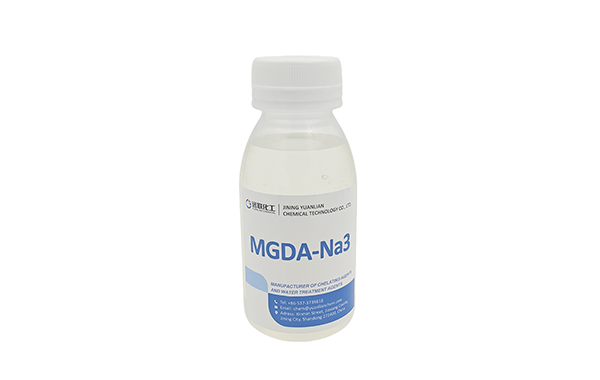
Its natural home is the alkaline to neutral quat or amine-based cleaner: healthcare surface products, food-contact and food-preparation area cleaners, washroom and floor products, and the concentrate behind a wall-mounted dosing station. It also serves peroxide-based products, where the metal control is part of the stability story rather than an afterthought.
With chlorine-releasing products it is a different conversation. The molecule is consumed by free chlorine, and a formulator who wants a chelant in a hypochlorite cleaner should test the specific combination across the product's shelf life rather than infer it from another product's data.
Setting the dose against soil and hardness together
Healthcare and food-service cleaning present a soil load that a household product never sees: protein, fat and mineral scale in the same film, on a surface that is cleaned many times a day. Hardness arrives with the dilution water, and in a building with a partially working softener it arrives at a variable rate.
The practical way to size the dose is to test at the hardness the site actually has, at both ends of its range, and at the soil level the product will meet. A dose that holds at 10 °French degrees and fails at 30 is not a sound specification, and the failure will appear as a visible film on dark surfaces long before a microbiological test shows anything.
Ready-to-use products carry the opposite risk. At a low active concentration, the chelant is a small part of a mostly water formula, and a dilution water change at the customer site can swamp it. Where the product is sold as a concentrate and diluted on site, the dose recommendation has to state the hardness range it was validated for.
Keeping the actives and the chelant compatible
The interactions that decide whether a formula holds are rarely dramatic. Quaternary ammonium compounds are cationic, and an anionic chelant at a high enough level can pair with them and cloud the concentrate or reduce the available biocide. MGDA-Na3 is used at levels low enough that this usually stays within tolerance, but a concentrate near a phase boundary will not forgive it.
Dyes and optical effects are the next casualty. Trace metals shift dye hue and bleach some of them over time, which is one reason chelation protects the colour of a coloured cleaner as well as its performance. Polymers used for anti-redeposition or for surface modification can also be sensitive to the ionic environment, so the order of addition in a concentrate is worth fixing early and then holding.
pH is the last variable and often the overlooked one. A chelant that performs at pH 11 may not hold the same metals at pH 4, so an acidic washroom descaler and an alkaline floor cleaner cannot share a dose rationale even when they share a raw material.
Concentrate, ready-to-use and impregnated wipe formats
Each format asks something different of the chelant. A concentrate needs solubility and stability at high ionic strength, and it needs to stay clear through a cold winter in an unheated store. A ready-to-use product needs a dose that stays effective when the customer's dilution water is harder than the plant's test water.
An impregnated wipe adds a third constraint: the liquor has to remain stable in contact with the nonwoven, and the surfactant system has to release from the fibre at the moment of use. Chelation helps here by keeping hardness from precipitating the surfactant inside the pack, which is the common cause of a wipe that feels dry at the top of the stack.
Claims, standards and the paperwork behind them
Two regulatory threads run in parallel. The biocide claim is governed by Regulation (EU) No 528/2012, and the efficacy evidence comes from the standard relevant to the claim: EN 1276 for bactericidal suspension testing, EN 13697 for surface testing without mechanical action, EN 1650 for yeasts and EN 14476 for virucidal claims. The chelant does not appear in that evidence as an active, and it should not be presented as one.
The detergent side of the product falls under Regulation (EC) No 648/2004, which governs labelling and the data that must be available. For the raw material, keep the batch certificate of analysis, the safety data sheet, the OECD 301 report and the REACH registration status on file, and make sure the biodegradability wording on the label matches what those documents support.
A trial that settles the question
The test that means something is run in the water the customer has, not the water the lab has. Prepare the dilution at low, middle and high hardness for your market, apply the product to a soiled test surface at the contact time on the label, and assess both the visible residue and the biocide concentration after storage. Add a four-week stability check at 30 °C and, for a concentrate, a cold-storage check at 5 °C.
If the product is sold into healthcare, run the surface test on a dark tile as well as a white one. Films that no one notices on white grout are the complaints that reach the brand.
Frequently asked questions
Does the chelant contribute to disinfection? No. It supports the biocide by removing hardness and trace metals that interfere with contact and stability. Any claim of kill must rest on the biocide and its efficacy data.
Can MGDA-Na3 go into a hypochlorite cleaner? Only after testing the specific combination. Free chlorine reacts with aminopolycarboxylates, so both the oxidant and the chelant are consumed. Many formulators keep the two in separate products.
Is it compatible with quaternary ammonium compounds? Yes at the levels used in surface cleaners. Keep an eye on concentrate clarity if the formula already sits near a phase boundary.
Which grades are supplied? The common offering is a clear aqueous solution at 40 to 47 per cent active content, with solid grades available for powder and tablet lines. The certificate of analysis states the batch value.
What hardness range should the dose cover? Test to the top of the range in your target market, not the average. A product validated only at low hardness will fail visibly at the harder end.
Does it affect the environmental claim? It supports one. The molecule is phosphorus-free, contains no NTA-type chelant and meets ready-biodegradability under OECD 301, which is the profile most environmental schemes look for.
For a sample, a certificate of analysis or a technical review of a disinfectant cleaner formula, contact [email protected] or call +86-537-3739818. The product centre at yuanlianchem.com lists grades and pack formats.
Yuanlian Chemical specializes in the production of polyaspartic acid (PASP),tetrasodium iminodisuccinate(IDS), GLDA, MGDA etc. with stable quality and excellent quantity!

Contact us