


-

- 2026-11-23
Chelant-Assisted Soil Washing: Choosing a Ligand That Leaves
A remediation contractor rarely gets to choose the contaminant. The site is given: a former galvanising works, a battery plant, a gasworks, a shooting range with lead shot through the topsoil. What the contractor chooses is the extraction chemistry, and on heavy-metal sites that choice has narrowed sharply over the past decade, because the ligand that performed most reliably is the one regulators now ask you to justify.
This article is about that choice as a project decision rather than a laboratory curiosity: which fraction of the metal a wash can actually reach, how the candidates compare, what the dose really depends on, and what the permitting file needs to contain before anyone mobilises a plant.
What washing does to a contaminated soil
Soil does not hold metal in one place. Operationally it is split into fractions that behave very differently under a wash: metal in pore water and on exchange sites, metal bound to carbonates, metal coprecipitated with iron and manganese oxides, metal bound to organic matter, and metal locked inside silicate and sulphide minerals.
A chelant wash attacks the first two fractions effectively and the oxide and organic fractions partly, depending on pH and contact time. It does essentially nothing to the residual fraction. That single fact decides project feasibility: if two-thirds of the lead sits in the residual fraction, no ligand at any dose will move it, and the mass balance will fail in the treatability report. A sequential extraction on a representative sample answers this before a litre of reagent is ordered.
Why EDTA became the default, and why buyers are moving away
EDTA is cheap, well characterised and extremely effective across a broad metal range. For thirty years that combination made it the reflexive choice for soil washing, and a great many treatability studies in the literature are EDTA studies.
The problem is what happens afterwards. EDTA-metal complexes are stable and the free ligand is slow to biodegrade, so the chelator leaves the washing plant still holding its metal load and travels with the spent liquor into groundwater, surface water and treatment works. Metal that was immobile in the soil becomes mobile in the aquifer. In effect the site trades a solid-phase problem for a dissolved one, and the receiving water body notices. Several European regulators treat this as the decisive objection, and remediation projects that specify EDTA increasingly have to demonstrate capture and destruction of the complex rather than simple discharge.
EDDS, GLDA, MGDA and IDS: what each does well
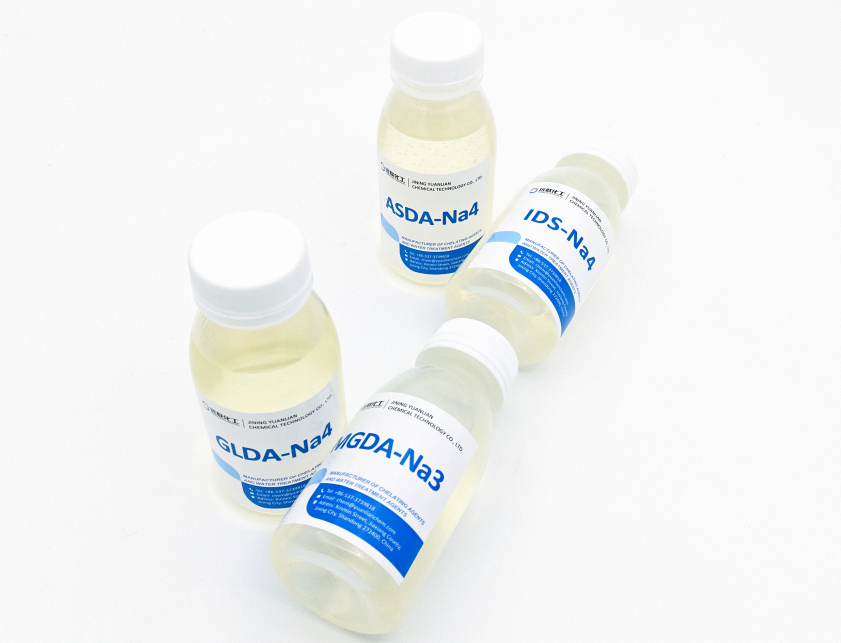
The biodegradable set does not behave as a single substitute, and treating them as interchangeable is the most common specification error.
EDDS-3Na binds copper and lead strongly and is the closest match to EDTA on those two metals, which makes it the natural first candidate where copper is the driver. Its biodegradability is well documented, and it degrades within days to weeks once the washing is finished — the property that matters most for the groundwater argument.
GLDA-Na4 is broader and works well at alkaline pH, where EDTA loses effectiveness and many carbonate-rich soils sit. It handles cadmium, nickel and zinc cleanly and tolerates high calcium, which matters because a calcareous soil will consume a large share of any ligand before it reaches the contaminant.
MGDA-Na3 is the strongest of the three on calcium and magnesium and holds performance at high pH, so it suits soils where hardness ions dominate the demand and where a wash at pH 10 or above is planned for other reasons.
IDS-Na4 sits at the value end. Binding strength is lower, so the dose per tonne of metal is higher, but the cost per kilogram is lower and it performs adequately on zinc and cadmium in sandy, low-humus material. On a large site with a single dominant metal, that trade can decide the tender.
The fraction chelation cannot reach
Two boundaries are worth stating plainly, because both appear in specifications that chemistry cannot deliver.
Chromium is the first. Chelants bind Cr(III) as a cation and will mobilise it, but Cr(VI) exists as an oxyanion — chromate and dichromate — and carries no site for a ligand to coordinate. A washing programme aimed at hexavalent chromium has to reduce it to the trivalent state first, then address the cation. Selling a chelant for a chromate problem is a category error, and it will show up as zero removal in the first trial.
The second is the residual fraction described above. Metals held inside silicate lattices, or as discrete sulphide grains that the wash never dissolves, stay put. Chelant washing is a fraction-selective technology, and any quotation promising a total-metal target without a sequential extraction behind it should be treated as a guess.
Dosing: the metals you want plus the metals that compete
Stoichiometry looks simple and is not. A first-pass calculation on moles of contaminant gives a number that will be wrong by a factor of three to ten, because the ligand has no idea which metal you care about. Calcium, magnesium, iron and aluminium all compete, and in a calcareous or iron-rich soil they can consume the majority of the dose.
The practical approach is empirical. Run the sequential extraction, then a dose ladder in a jar or tumbler across at least five points spanning an order of magnitude, with a liquid-to-solid ratio that matches the intended plant — typically between 3:1 and 10:1 by weight. Hold contact time constant, measure the target metals in the filtrate, and report removal against the extractable fraction rather than the total. The curve usually shows a knee: beyond it, extra ligand buys a marginal gain and a much larger treatment bill for the spent liquor.
Multi-stage washing is often cheaper than a single high dose, because each stage meets fresher reagent against a lower residual metal concentration. Two stages at half the dose frequently beat one stage at full dose on both removal and reagent cost, at the price of more plant and more liquor to treat.
Keeping the plume on site
The technical success of a wash and the regulatory success of a project are decided by what happens to the spent liquor. Nothing in this section is optional.
Recovery comes first. Counter-current washing, vacuum extraction and, where the plant allows it, a final water rinse all reduce the mass of chelant left in the treated soil. The target should be a residual chelant concentration that the monitoring plan can defend, not simply a metal concentration that passes.
Treatment of the wash liquor comes next. Metals are recovered by sulphide or hydroxide precipitation at a controlled pH, sometimes after an oxidative step to break the complex so the metal becomes precipitable at all. Advanced oxidation with hydrogen peroxide and UV will destroy the ligand itself, which is what a discharge consent for a chelated stream usually requires. Budget for this stage early: on many projects the liquor treatment costs more than the washing step.
Site hydrology decides the rest. A clay-rich soil holds the liquor and gives the operator time; a gravelly, permeable subsoil gives it a route to groundwater. Where permeability is high, the washing area needs a sealed base, a cut-off and a leachate collection system, and the monitoring wells need to be in place before mobilisation rather than after the first complaint.
The paperwork: soil law, groundwater and waste classification
Three regimes overlap on a European site. The soil framework sets the remediation target; the Water Framework Directive and its daughter directives set groundwater quality standards and oblige the project not to cause deterioration; and waste law decides whether the spent liquor and the fines fraction are waste, and under which entry.
Practically, that means the permitting file needs a mass balance, a groundwater risk assessment covering the ligand itself rather than only the metals, and a degradation statement for the chosen chelant with an OECD 301 result attached. Where the site sits above a drinking-water abstraction, the argument has to be stronger, and a persistent ligand is very hard to defend regardless of how well it removed the metal.
A treatability trial a regulator will accept
Four elements make the difference between a trial that supports a permit and one that is dismissed.
Sample representatively — composite across the contamination plume, not a single hot spot, with the heterogeneity described. Baseline properly — total metal, sequential extraction, pH, organic matter, carbonate content and particle size, because the fines fraction carries most of the metal and most of the reagent demand. Report against the extractable fraction and show the residual fraction so the ceiling is visible. And include a control and a blank so that metal released by the physical washing action alone is separated from metal released by the ligand.
Run the same trial on the two shortlisted candidates rather than one. The comparison costs a fortnight and usually changes the selection, because the soil's calcium or iron content shifts the ranking away from the laboratory default.
Frequently asked questions
Can a biodegradable chelant match EDTA on lead removal?
On the exchangeable and carbonate fractions, EDDS-3Na comes close on lead and is generally comparable on copper. On soils where a large share of the lead is bound in oxides, the gap widens and the dose has to rise. Compare on the extractable fraction of your own soil, not on published percentages from a different site.
Is chelant washing cheaper than excavation and disposal? Usually, on large sites with treatable soil and a landfill cost that is high. It is rarely cheaper on small sites, on clay-heavy soils that are hard to wash, or where the spent liquor has no discharge route. The comparison has to include liquor treatment and monitoring, not just reagent and plant hire.
How much chelant ends up left in the treated soil? That depends on the recovery stage, not on the ligand. Counter-current washing plus a rinse typically brings residual concentrations down to a level the monitoring plan can defend, but the figure has to be measured on the treated material rather than estimated from the dose.
Do these ligands work on sandy soil as well as clay? Sandy soil is easier to wash because the liquor moves freely and the fines fraction is smaller, but it also gives the spent liquor a fast route to groundwater. Clay holds the liquor and slows the kinetics, so contact time has to be longer. Both are manageable; they need different plant designs.
For treatability protocols, grade selection or a comparison of EDDS, GLDA, MGDA and IDS on a specific soil, contact [email protected] or call +86-537-3739818. Product documentation for the biodegradable chelating range is published at yuanlianchem.com. The groundwater and waste rules referenced here are available on EUR-Lex.
Yuanlian Chemical specializes in the production of polyaspartic acid (PASP),tetrasodium iminodisuccinate(IDS), GLDA, MGDA etc. with stable quality and excellent quantity!

Contact us