



-

- 2026-11-24
MGDA-Na3 in Soap and Syndet Bars: A Formulator's Guide
A bar of soap and a syndet bar sit next to each other on the same shelf and are formulated nothing alike. One is a salt of fatty acids with free alkali and a water content that has to be controlled to a tenth of a per cent. The other is a compressed blend of synthetic surfactants, starch and a waxy binder. What they share is a problem most liquid formulators never have to solve: the product is almost dry, and every reaction inside it has to happen in a film of water that may not exist yet.
That is why chelant selection for bars is not simply the liquid detergent answer at a lower dose. Metal control still matters — for scum, for colour, for rancidity — but the mechanism, the dose window and the failure modes are different.
Two bars, two different metal problems
In a true soap, the metal problem starts with the fatty acid stock. Sodium soaps are soluble; calcium and magnesium soaps are not. The moment the bar meets hard water, the calcium in the water converts dissolved soap into an insoluble scum that deposits on skin, on the basin and on the tiles, and it takes the lather with it. Nothing about the bar itself is at fault, which is why the complaint often arrives as "your soap doesn't lather" from a customer in a hard-water region while the same bar performs well elsewhere.
The second problem is trace transition metal. Iron, copper, nickel and manganese arrive with the fatty acid feedstock, with the caustic, with the brine and from the processing equipment itself. At parts per million they are enough to catalyse oxidation of the unsaturated fatty acids, and the visible results are a yellow to brown discolouration that deepens in storage, dark spots where a metal particle sat, and the aldehydic odour that consumers call rancidity.
A syndet bar has the same two problems in a different balance. There is no soap to precipitate, so scum is not the issue in the same way, but hardness still suppresses lather and leaves a film on skin. Trace metal still drives discolouration, and because syndet bars often carry fragrance and colour at higher levels than soap, a shift in either is more visible.
Why a water-poor matrix changes the rules
Chelation is a reaction in solution. In a bar at 10 per cent moisture, the chelant is present but the water needed to mobilise it is limited, so binding is slower and less complete than in a liquid. Two practical consequences follow.
The first is that the chelant works mainly at the point of use, not during storage. Once the bar meets water at the basin, the local water activity rises sharply and binding proceeds normally, which is why a modest dose protects lather even though the bar itself is dry.
The second is that the dose window is narrow and runs in both directions. Too little and the scum and colour problems persist. Too much and the bar takes up water more readily, becoming softer and more prone to mush in the dish, with a higher wear rate that the consumer notices as the bar disappearing faster. In practice, most bar formulations land between 0.1 and 1.0 per cent of the finished weight, with syndet bars often at the lower end because their surfactant system is less sensitive to hardness.
What MGDA-Na3 does at the wash basin
MGDA-Na3 binds calcium and magnesium strongly across the alkaline window a soap operates in, which is the range where many chelants weaken. At pH 10 to 10.5, with free alkali present and a substantial electrolyte load from the soap and added sodium chloride, the ligand still holds hardness ions and keeps them from converting soap into scum.
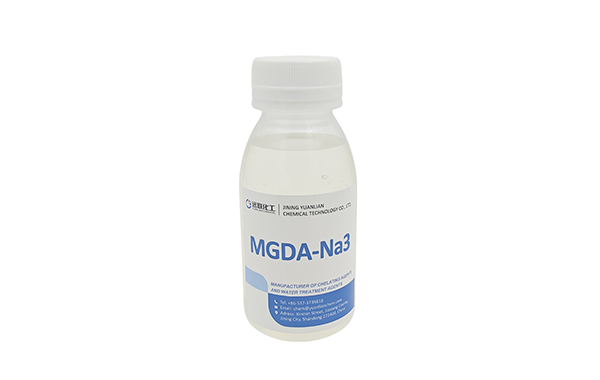
The practical outcomes are measurable. Lather volume in hard water rises towards what the same bar delivers in soft water. The scum ring in the soap dish and on the basin rim thins out. Skin feel after washing changes, because the insoluble calcium soap that leaves the slippery-then-tight sensation is no longer forming on the skin surface.
There is a limit worth stating. A chelant in a bar cannot soften the water in the basin; it can only hold the hardness that arrives in the small volume of water the bar actually contacts. In very hard water the effect is proportional to dose and to contact time, so a bar cannot deliver what a water softener delivers, and a claim that implies otherwise will not survive a consumer trial in a hard-water city.
Rancidity, discolouration and the metals nobody measures
Oxidation is the failure that costs the most and shows up latest. Unsaturated fatty acids react with oxygen through a radical chain, and trace transition metals accelerate both the initiation and the decomposition of the hydroperoxides that follow. Copper and iron are the usual culprits, manganese and nickel appear often enough to matter, and all of them are cheap to measure and rarely measured.
A chelating agent sequesters those ions in a form that cannot take part in the catalytic cycle, which slows colour drift and delays the onset of odour. This is why the same base formula can behave well in one plant and badly in another: the metal load in the feedstock and the equipment differs, and nobody put it in the specification.
Two honest boundaries apply here. A chelant is not an antioxidant, and it does not substitute for one — a bar carrying a vulnerable oil blend still needs tocopherol or a synthetic antioxidant, and the two work on different parts of the problem. A chelant also does not repair oxidation that has already happened, so it has to be in the formula from the start rather than added after a complaint.
Process and formulation practicalities
Liquid MGDA-Na3 is normally added to the soap base after saponification, at 60 to 70 °C with adequate agitation, and before the base is dried and plodded. Adding it late, or into a base that is already too viscous, produces the speckled bars that get blamed on the chelant when the real fault is dispersion.
The water the liquid grade brings has to be counted in the moisture balance, which in a milled soap is tight. A formulator moving from a powdered chelant to a 40 per cent solution typically has to recover 0.5 to 1.5 per cent water elsewhere in the process, and the place to take it from is the drying stage rather than the formula.
In syndet bars the chelant usually goes into the dry blend as a powder grade, or into the binder phase if the process has one. Powder handling needs a dry store and a sealed feed, because the material is hygroscopic enough to cake in an open bin over a humid weekend.
Chloride content deserves attention in any bar that runs through steel plodders, extruders and dies. High chloride in a chelant grade adds to corrosion of the equipment and to the risk of pitting on the die face, and it is one of the numbers a buyer should put in the specification rather than assume.
Specification and trial
The specification should fix active content on the salt basis, chelation value in milligrams of calcium carbonate per gram, pH of a 1 per cent solution, chloride, iron and copper limits, colour of the liquid grade, and the CAS number and INCI name on the supplier's statement. For a personal-care bar the labelling name matters as much as the chemistry, and it should come from the supplier's documentation rather than from a trade name.
A trial that settles the question needs four arms: a control, and three doses spanning the intended window. Assess bar hardness with a penetrometer, wear rate across repeated wet-and-dry cycles, lather by a standard foam test plus a small panel, and colour after eight weeks at 40 °C in the dark. Add a metal-spiked arm if the feedstock is variable, because that is where a chelant's contribution separates from the noise.
Frequently asked questions
Can MGDA-Na3 replace the sequestrant already in a soap bar? Usually yes, but not at the same weight. The salt basis, the active content and the pH contribution all differ, so convert to active content first and then run a dose ladder rather than a straight swap.
Will a chelant make the bar softer? It can, because it increases water uptake at the surface. The effect is small within the 0.1 to 1.0 per cent window and becomes obvious above it, which is one reason to find the lowest dose that solves the scum and colour problems rather than the highest dose the cost allows.
Does it help with the white film left on skin after washing? Yes, where that film is calcium or magnesium soap. If the film comes from a syndet's fatty alcohol or from a polymer, the chelant will not change it and the fix sits in the surfactant system.
Is a biodegradable chelant stable enough for a three-year shelf life? The chelant itself is stable in a dry bar. The risk sits with the rest of the formula: oxidation of the fatty acid blend, fragrance degradation and colour drift all continue in storage, and the chelant only removes one of the catalysts.
For grade selection, a dispersion trial or a comparison of MGDA-Na3 with GLDA-Na4 in a specific bar formula, contact [email protected] or call +86-537-3739818. Product documentation is published at yuanlianchem.com, and the detergent labelling rules that govern the ingredient list are on EUR-Lex.
Yuanlian Chemical specializes in the production of polyaspartic acid (PASP),tetrasodium iminodisuccinate(IDS), GLDA, MGDA etc. with stable quality and excellent quantity!

Contact us