


-

- 2026-02-27
Synergistic Performance: Deep Dive into Chelation and Surfactancy in Industrial Cleaning
In the demanding fields of fine chemicals, industrial detergents, and textile processing, formulation stability and interfacial efficiency are the ultimate benchmarks of product excellence. R&D engineers often encounter a performance "ceiling": simply increasing surfactant concentration rarely yields a linear improvement in cleaning power. In fact, untreated water hardness can render even the most advanced surfactants ineffective.
The solution lies in the molecular synergy between Chelating Agents and Surfactants. This technical analysis explores how their coordinated interaction achieves a "1+1>2" effect in high-performance cleaning systems.
1. The Hard Water Bottleneck: Why Surfactants Fail
Surfactants function by reducing surface tension and emulsifying hydrophobic soils. However, in practical industrial applications, process water typically contains divalent cations such as Calcium () and Magnesium ().
When anionic surfactants (such as LAS or SLES/AES) encounter these ions, they react to form insoluble "calcium soaps." This reaction triggers three critical failure points:
-
Active Ingredient Depletion: Surfactants are precipitated out rather than performing cleaning work.
-
Surface Fouling: The formation of graying effects on textiles and mineral scale buildup on precision machinery.
-
Inhibited Wetting: Hardness ions interfere with the surfactant’s ability to penetrate complex soil matrices.
2. The Role of Chelants: Beyond Water Softening
A chelant’s function extends far beyond simple sequestration. It acts as a strategic catalyst within the cleaning matrix through several mechanisms:
-
Sequestration & Activation: By "capturing" metal ions into stable ring structures, chelants liberate surfactant molecules to focus entirely on wetting and emulsification.
-
Soil Matrix Disruption: Many industrial soils (organic pigments, proteinaceous stains, or mineral deposits) are held together by metal-ion bridges. Chelants "snatch" these ions, causing the soil structure to collapse from within.
-
Anti-Redeposition: Chelants modify the zeta potential of the cleaning liquor, increasing electrostatic repulsion between the substrate and the removed dirt, effectively preventing "graying" or soil re-settling.
3. Selection Guide: High-Performance & Sustainable Chelants
In alignment with modern environmental mandates (such as REACH and the EU Ecolabel), the industry is shifting from traditional EDTA/NTA toward Green Chelating Agents with superior biodegradability profiles.
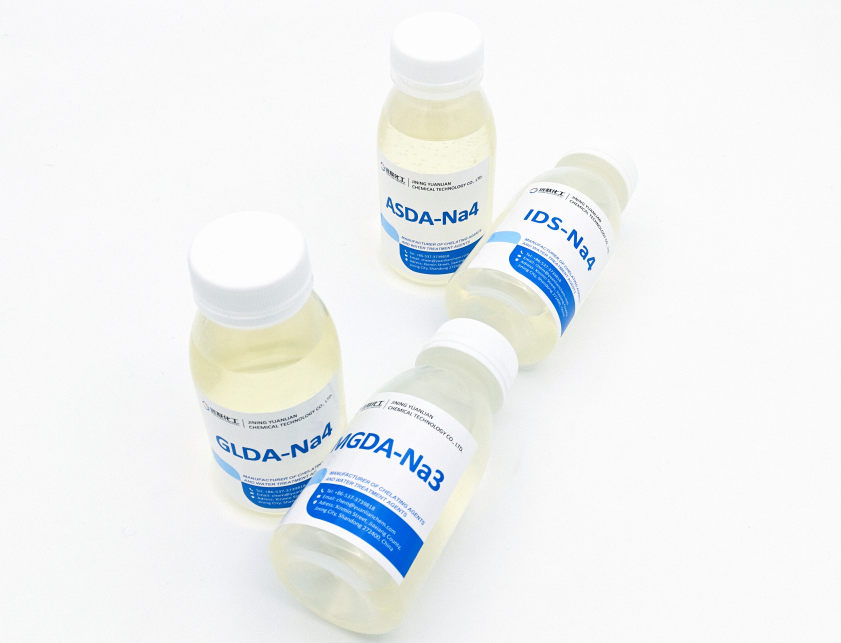
A. MGDA-Na3 (Methylglycinediacetic Acid)
The "powerhouse" for heavy-duty applications. MGDA offers exceptional thermal stability and maintains high chelation constants even at extreme pH levels. It is currently the gold standard for I&I (Industrial & Institutional) cleaning and automatic dishwashing (ADW).
B. GLDA-Na4 (Glutamic Acid Diacetic Acid)
Derived from natural plant-based L-glutamate, GLDA is the premier choice for "green" and personal care formulations. It boasts high solubility and works seamlessly in clear liquid systems without compromising product aesthetics or stability.
Comparative Performance Matrix
4. Field Applications & Case Studies
-
Textile Scouring & Bleaching: In high-alkali scouring, MGDA prevents the formation of silicate scale and removes pectin/mineral impurities from fibers. This ensures uniform whiteness and eliminates the risk of "spotting" or "pinholes" during subsequent dyeing.
-
CIP (Clean-in-Place) Systems: In food and beverage processing, combining chelants with low-foam non-ionic surfactants effectively removes proteinaceous soils and mineral milk-stone. This synergy reduces chemical consumption and shortens cleaning cycles, significantly cutting operational expenditure (OPEX).
5. Formulation Optimization Trends
Modern formulation chemistry is moving toward Sustainability-Driven Performance. Key considerations for technical procurement include:
-
Regulatory Alignment: Transitioning to phosphorous-free (P-free) and readily biodegradable builders to meet global compliance standards.
-
Synergy Ratios: Optimizing the molar ratio of chelant to hardness ions to ensure maximum surfactant availability at the lowest possible cost.
-
Multifunctionality: Selecting chelants that also provide secondary benefits, such as peroxide stabilization or corrosion inhibition.
Conclusion
The pairing of chelants and surfactants is a masterclass in molecular coordination. By leveraging this synergy, manufacturers can develop products that not only meet the rigorous cleaning demands of modern industry but also uphold the highest standards of environmental responsibility.
Yuanlian Chemical specializes in the production of polyaspartic acid (PASP),tetrasodium iminodisuccinate(IDS), GLDA, MGDA etc. with stable quality and excellent quantity!

Contact us