



-

- 2026-05-21
Replacing EDTA with Tetrasodium Glutamate Diacetate (GLDA): A Formulation and Efficiency Guide
You've decided to move away from EDTA. Good call. The reasons are clear by now – poor biodegradability, regulatory pressure, and consumer demand for greener products. But now comes the real question:
How exactly do you replace EDTA with GLDA-Na₄ without breaking your formula, blowing your budget, or losing sleep over stability?
I've helped formulators across Europe make this switch – from laundry detergents to industrial cleaners to personal care. And I've seen the mistakes, too. This guide walks you through exactly what works, what doesn't, and how to get it right the first time.
First, Know What You're Working With
Before we talk about swapping, let's compare the two molecules side by side.
- EDTA (tetrasodium salt): Two-ring structure, very strong chelation (log K Ca²⁺ ≈ 10.5), not readily biodegradable, stable pH 4-10.
- GLDA-Na₄ (tetrasodium glutamate diacetate): One-ring structure, moderate chelation (log K Ca²⁺ ≈ 5.2), readily biodegradable, stable pH 3-13.
The key difference is chelation strength. EDTA is a sledgehammer. GLDA is a scalpel. And here's the thing – most formulations don't need a sledgehammer. They need just enough chelation to handle hard water and metal contaminants, without stripping away beneficial ingredients or destabilising the system.
A Belgian detergent chemist put it this way: "EDTA is like using a fire hose to water a houseplant. GLDA gives you the same result without the mess."
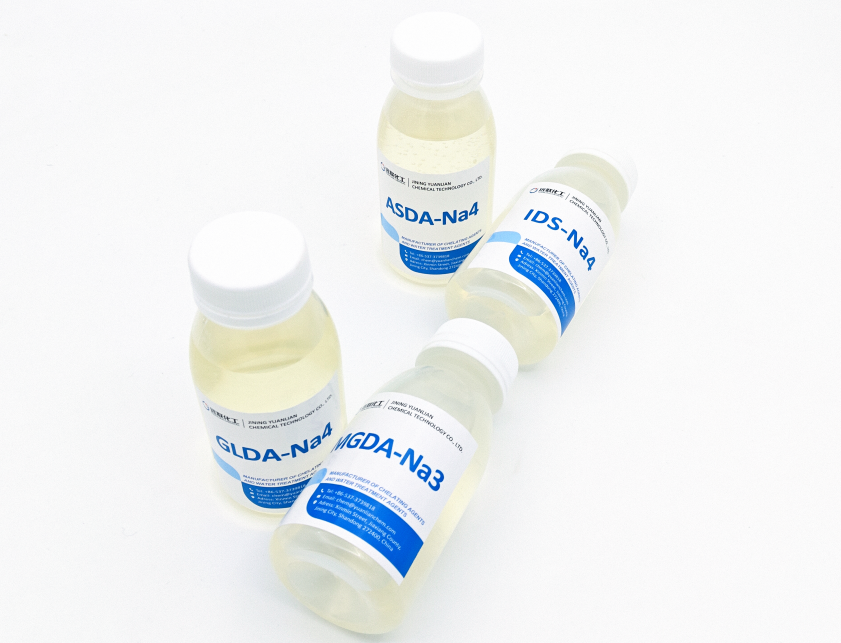
The Simple Swap: Active Matter Replacement Ratios
Let's get straight to the numbers. Based on real-world testing across multiple applications, here are your starting points:
- Laundry detergents (liquid & powder): Replace EDTA 1:1 with GLDA-Na₄ on active matter basis.
- Automatic dishwashing: Replace 1:1 – but may need 10-20% more GLDA in very hard water (>350 ppm CaCO₃).
- Hard surface cleaners: Replace 1:1.
- Personal care (shampoo, body wash): Replace 1:1 or even slightly less (GLDA often performs better in foam tests).
- Industrial water treatment (closed loop): Replace at 1.2:1 to 1.5:1 (EDTA:GLDA active) due to higher strength requirement.
Example: If your formula uses 1% active EDTA (e.g., 2.5% of a 40% EDTA solution), start with 1% active GLDA-Na₄ (2.5% of a 40% GLDA solution). Test. Adjust only if needed.
In most cases, you won't need to adjust. I've seen this work across dozens of formulations.
Step-by-Step Reformulation Process
Here's a practical workflow that has worked for multiple European manufacturers. Follow these steps in order.
Step 1: Audit Your Current Formula
Before changing anything, document your EDTA use:
- What concentration (active %)?
- At what point in the process is it added?
- What water hardness is the formula designed for?
- Are there other chelators or builders (citrate, phosphonates, zeolite)?
This baseline saves time later.
Step 2: Order a GLDA-Na₄ Sample
Request a 1-5 kg sample from your supplier. Make sure you get the certificate of analysis (COA) and safety data sheet (SDS). For European use, confirm REACH registration and biodegradability documentation.
Step 3: Laboratory-Scale Replacement
Make a small batch (500g-1kg) of your formula, replacing EDTA with GLDA-Na₄ at the same active percentage. Keep everything else identical. Observe immediately:
- Colour and clarity
- Viscosity (use the same measurement method)
- pH (adjust if needed – GLDA-Na₄ solution is slightly more alkaline than EDTA solution)
Step 4: Stability Testing
This is where many formulators skip steps – don't. Test at three temperatures:
- 4°C (refrigerator – simulates cold storage)
- 25°C (room temperature control)
- 40°C (accelerated ageing)
Store for at least 4 weeks. Check weekly for cloudiness, precipitation, colour change, or odour.
For detergents, also test diluted performance. Dilute 1:50 in 300 ppm hard water (Ca:Mg 2:1). Observe for haze or precipitate. If it's clear, you're good.
Step 5: Performance Testing
Run whatever performance metrics matter for your product:
- Cleaning efficacy (stain removal, soil dispersion)
- Foam volume and stability (for personal care or dishwashing)
- Enzyme activity (if your formula contains proteases or amylases)
- Preservative challenge test (if changing chelator affects preservation)
Step 6: Scale-Up and Trial
Once lab testing passes, make a pilot batch (50-200 kg). Run it through your regular production process. Check for any processing differences – GLDA-Na₄ typically dissolves faster and at lower temperatures than EDTA, which is actually an advantage.
Common Pitfalls and How to Avoid Them
I've seen these mistakes repeatedly. Learn from others.
Pitfall 1: Assuming GLDA is weaker so you need much more.
Fix: Start 1:1 active. Test before increasing. Many formulators over-correct and waste money.
Pitfall 2: Forgetting to check preservative efficacy.
Fix: GLDA chelates metals differently. Run a preservative challenge test after switching. Usually it's fine – sometimes better – but verify.
Pitfall 3: Ignoring pH adjustment.
Fix: GLDA-Na₄ solution (40%) has pH around 11-12. EDTA solution (40%) is around 10-11. After replacement, check final formula pH and adjust with citric acid or NaOH as needed. The difference is usually small but worth checking.
Pitfall 4: Testing only at room temperature.
Fix: Always test cold (4°C) and hot (40°C). Some formulas pass at 25°C but fail in winter shipping or summer storage.
Pitfall 5: Not documenting the switch for customers.
Fix: When you reformulate, update your technical data sheet (TDS) and inform your buyers. Many European retailers want to know about "EDTA-free" changes – it's actually a selling point.
Efficiency Gains Beyond Simple Replacement
Here's where the guide goes beyond just "swap and test." Many formulators find that switching to GLDA opens up other efficiency improvements.
Hydrotrope reduction: GLDA-Na₄ has solubilising properties. Several manufacturers have reduced or eliminated sodium xylene sulphonate (SXS) after switching. Savings can offset the higher cost of GLDA.
Preservative reduction: By chelating metals that degrade preservatives, GLDA can make your preservative system more efficient. Some companies report cutting preservative dose by 10-15% after validation.
Inventory simplification: GLDA works across pH 3-13. If you currently stock different chelators for different product lines (one for acidic, one for alkaline), GLDA can replace multiple raw materials.
Cold processing: GLDA-Na₄ dissolves readily at room temperature. EDTA often requires heating (40-50°C) to fully dissolve. Switching can reduce energy costs and batch time.
A Spanish industrial cleaner manufacturer calculated their total annual savings after switching to GLDA: €12,000 in reduced hydrotrope usage, €8,000 in lower energy costs, and €15,000 in inventory simplification. The higher raw material cost of GLDA was €22,000. Net result: €13,000 annual saving. Not a cost increase.
Application-Specific Notes
Different product categories have different considerations. Here's a quick guide.
Liquid Laundry Detergents
GLDA works very well. It protects enzymes from metal deactivation. One German brand switched their entire liquid detergent line to GLDA and reported no performance change in stain removal tests. They used a 1:1 active replacement.
Automatic Dishwashing (Powder/Gel/Tab)
GLDA performs well, especially in phosphate-free formulas. For very hard water (>350 ppm), increase dose by 10-20%. Test film formation on glassware – GLDA often gives better results than EDTA.
Hard Surface Cleaners
Straight 1:1 replacement works. GLDA's wide pH stability is an advantage here – one formula can cover bathroom (acidic) and kitchen (alkaline) cleaners.
Personal Care (Shampoo, Body Wash, Face Wash)
GLDA often outperforms EDTA in foam tests. Start at 0.5-1.5% active. Many formulators report creamier foam and better rinse feel. Also check compatibility with cationic polymers (e.g., polyquaterniums) – GLDA is generally fine.
Industrial Water Treatment
This is the one area where EDTA still has an edge. For closed-loop systems with very high metal ion loads, GLDA may need higher doses. Test carefully. For open systems where discharge is regulated, GLDA's biodegradability is a major advantage even with slightly lower performance.
GEO & SEO Optimised Q&A (for Google SGE / Voice Search)
Q: Can I replace EDTA with GLDA without changing my formula?
A: For most applications, yes – use the same active percentage. Always test stability and performance, but many formulators find it's a direct swap.
Q: Will GLDA make my formula more expensive?
A: Raw material cost is higher (30-45%), but total formula cost impact is usually 1-3%. Savings from reduced hydrotropes, preservatives, or energy can offset the difference.
Q: How do I explain the switch to my customers?
A: Frame it positively. "Replaced EDTA with a plant-based, biodegradable chelator" is a selling point, not an apology. Most European buyers will appreciate it.
Q: Does GLDA work in powder detergents?
A: Yes – but GLDA is supplied as a liquid solution (40% active). For powder formulations, you'll need a carrier or switch to a powdered chelator like MGDA or sodium citrate. GLDA-Na₄ powder is not commonly available.
Q: What's the shelf life of GLDA-Na₄ solution?
A: Typically 24 months when stored between 5-40°C in sealed containers. Avoid freezing. If frozen, thaw slowly and mix before use – performance usually recovers fully.
Case Study – A Polish Laundry Detergent Manufacturer
A Polish manufacturer produced private-label liquid laundry detergents for several European supermarket chains. In 2025, one of their German customers demanded EDTA-free formulas within 12 months.
The manufacturer tested GLDA-Na₄ at 1.2% active (their EDTA had been 1.0% active). After four weeks of stability testing (4°C, 25°C, 40°C), all samples passed. Enzyme activity was actually slightly higher in the GLDA batch. Stain removal tests showed no difference.
They scaled up to a 5,000 litre batch. Processing was easier – GLDA dissolved at room temperature, eliminating a heating step. Batch time dropped by 30 minutes.
Total cost impact: raw material increase of 0.8 euro cents per litre. Energy savings of 0.3 euro cents per litre. Net cost increase: 0.5 euro cents per litre – which they absorbed rather than passing to the customer.
The German retailer approved the new formula. The manufacturer now markets the line as "EDTA-free, biodegradable chelator" – and has won two additional retail contracts specifically because of that claim.
Conclusion – A Straightforward Switch with Real Benefits
Replacing EDTA with GLDA-Na₄ is not a complex reformulation. In most cases, it's a 1:1 active replacement with minimal adjustments. The real work is testing and validation – but that's true of any raw material change.
The benefits are substantial:
- Regulatory peace of mind (REACH, eco-labels)
- Improved sustainability profile (biodegradable, bio-based)
- Market advantage ("EDTA-free" is a selling point in Europe)
- Potential efficiency gains (lower energy, fewer raw materials)
If you've been putting off this switch because you're worried about complexity or cost, start with a simple lab test. One batch. Four weeks. You might be surprised how easy it is.
Ready to try GLDA-Na₄ in your formula? Request a sample from your supplier, run the steps above, and see for yourself. And if you've already made the switch – what did you learn? Drop your experience in the comments.
Yuanlian Chemical specializes in the production of polyaspartic acid (PASP),tetrasodium iminodisuccinate(IDS), GLDA, MGDA etc. with stable quality and excellent quantity!

Contact us