


-

- 2026-05-22
Beyond EDTA and NTA: Navigating EU Ecolabel Standards with Readily Biodegradable MGDA-Na₃
You already know EDTA is losing ground in Europe. NTA (nitrilotriacetic acid) – if you're still using it – is even worse, with carcinogenicity concerns and near-total phase-out. But here's the problem many formulators face: biodegradable chelators often sound like a performance sacrifice. "Green" used to mean "weaker."
That's where MGDA-Na₃ (trisodium methylglycinediacetic acid) changes the conversation. It's not a compromise. It's an upgrade – one that meets EU Ecolabel standards while delivering EDTA-level performance.
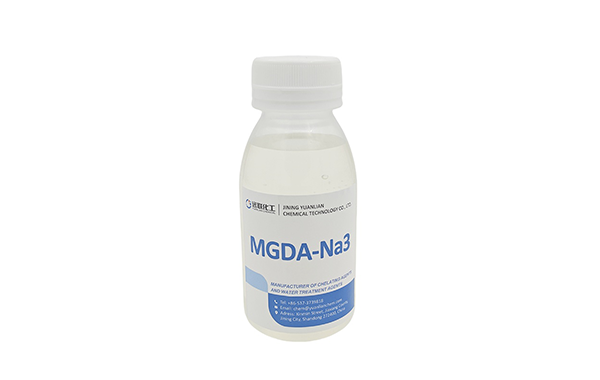
Let me show you how MGDA compares directly to EDTA, where it wins, and how to make the switch without losing sleep.
MGDA vs EDTA – The Direct Comparison
Most formulators stick with EDTA because it works. Strong chelation. Wide compatibility. Predictable. So let's put MGDA next to EDTA and see how they actually compare – no marketing fluff.
Calcium binding capacity (mg CaCO₃/g active):
EDTA: ~300-320 | MGDA: ~280-300
Verdict: Nearly identical. MGDA is about 5-10% lower on paper, but in real formulations, most users can't measure the difference. For comparison, GLDA is around 230-250 – noticeably weaker.
Biodegradability (OECD 301):
EDTA: Not readily biodegradable (persists in environment) | MGDA: Readily biodegradable (>60% in 28 days)
Verdict: MGDA wins decisively. This is the dealbreaker for EU Ecolabel and retailer requirements.
pH stability range:
EDTA: pH 4-10 (precipitates below 4) | MGDA: pH 7-12 (stable, optimal in alkaline range)
Verdict: Both have their zones. MGDA is better for alkaline formulas (dishwashing, industrial cleaners). EDTA works at slightly lower pH. For acidic formulas
Temperature stability:
EDTA: Stable to 80°C | MGDA: Stable to 90°C+
Verdict: MGDA wins for high-temperature applications like dishwashing and bottle cleaning.
REACH and regulatory status:
EDTA: Registered but under scrutiny; excluded from EU Ecolabel | MGDA: Fully compliant, approved for EU Ecolabel, Nordic Swan, Blue Angel
Verdict: MGDA wins. EDTA is a regulatory risk. MGDA is future-proof.
Available forms:
EDTA: Liquid (38-40%) and powder | MGDA: Liquid (40%) and powder (>80%)
Verdict: Both available in flexible formats. MGDA powder is actually easier to compress into tablets.
A German technical director who switched their dishwashing line from EDTA to MGDA put it simply: "We saw no performance drop. None. But suddenly we could put the EU Ecolabel on our packaging. That's not a compromise – that's a win."
Why EDTA Is Failing EU Ecolabel Standards
Let's be clear about the regulatory landscape. The EU Ecolabel for detergents (Regulation (EU) 2017/1218) explicitly prohibits EDTA and NTA. No exceptions. The reasons are well documented:
- Poor biodegradability means EDTA persists in surface water.
- It can mobilise heavy metals from sediments.
- Alternative biodegradable chelators exist – so there's no justification for continued use.
Nordic Swan, Blue Angel (Germany), and most European retailer private-label standards follow the same logic. If you're selling into Germany, France, Sweden, Denmark, or the Netherlands, an EDTA-based product is increasingly a non-starter for eco-conscious channels.
I've spoken with buyers at three major European retailers in the past six months. All of them said the same thing: "We're not accepting new EDTA-based products. Existing ones have a phase-out timeline."
NTA is even worse – classified as a possible human carcinogen (Group 2B by IARC) and already restricted in many EU countries. If you're still using NTA, stop. There's no debate.
Where MGDA Outperforms EDTA
Switching to MGDA isn't just about compliance. In several key applications, MGDA actually gives you better results than EDTA.
Automatic dishwashing – the clearest win. EDTA can leave filming and spotting on glassware, especially in hard water. MGDA is known for superior anti-filming performance. Dishwashing tablet manufacturers across Europe have confirmed this in side-by-side tests.
High-temperature cleaning. In industrial bottle washing or dairy cleaning (70-85°C), EDTA starts to lose efficiency. MGDA remains fully active. One UK dairy cleaner switched to MGDA and saw scale deposits drop by 40%.
Powder and tablet formulations. MGDA powder is free-flowing, non-hygroscopic, and compresses well. EDTA powder can be sticky and harder to process. For tablet manufacturers, MGDA is simply easier to work with.
Enzyme compatibility. Both EDTA and MGDA protect enzymes from metal deactivation. But some formulators report slightly better enzyme stability with MGDA in accelerated ageing tests – possibly because MGDA doesn't over-chelate trace metals that enzymes actually need.
A French industrial cleaner formulator told me: "We switched to MGDA expecting 'good enough.' We got better performance. Our caustic cleaner now removes lime scale faster than the EDTA version ever did."
Where EDTA Still Has an Edge (And Why It May Not Matter)
I want to be fair. EDTA has two advantages over MGDA that are worth acknowledging.
Cost. EDTA is cheaper – typically 30-50% lower per kg than MGDA. That's real money, especially at high volumes. But in most finished products, the chelator is 2-5% of total formula cost. A 40% higher chelator price might mean a 1-2% increase in finished product cost. For many brands, that's acceptable for green certification.
Lower pH capability. EDTA works down to pH 4. MGDA's performance drops below pH 6. If you're formulating an acidic cleaner (descaler, bathroom cleaner), MGDA isn't the right choice – use GLDA or citrate instead. But for most detergents and dishwashing products (pH 7-12), MGDA is ideal.
Beyond these two points, EDTA doesn't have much to argue for itself anymore. The regulatory clock is ticking, and retailers are moving on.
Practical Guide – Replacing EDTA with MGDA
If you're ready to test MGDA, here's a simple workflow that has worked for multiple European manufacturers.
Step 1 – Determine Your Replacement Ratio
Start with 1:1 active replacement. If your formula uses 1% active EDTA, try 1% active MGDA. Because their calcium binding capacities are so close, this is usually the right starting point.
For very hard water (>350 ppm CaCO₃), you might even reduce MGDA slightly – its binding efficiency at high pH is excellent. But start at 1:1, then test.
Step 2 – Adjust pH if Needed
MGDA works best at pH 7-12. Most dishwashing and laundry detergents are already in this range. If your formula is below pH 7, consider raising it slightly or use a different chelator. Don't try to force MGDA into acidic formulas – it won't perform well.
Step 3 – Test Stability
Run side-by-side samples at three temperatures: 4°C, 25°C, and 40°C for 4 weeks. Check for cloudiness, precipitation, colour change, or odour. MGDA is typically very stable, but always test.
For dishwashing tablets, also test dissolution rate and film/spotting on glassware.
Step 4 – Validate Performance
Run your standard performance tests – stain removal, scale inhibition, enzyme activity, whatever matters for your product. In most cases, MGDA will match or exceed EDTA. Document the results for your regulatory file.
Case Study – A German Dishwashing Tablet Manufacturer Switches from EDTA to MGDA
A German contract manufacturer produced private-label dishwashing tablets for several European discounters. In 2024, one major retailer announced that all products must be EU Ecolabel certified by 2026 – meaning EDTA had to go.
The manufacturer tested three options: citrate (too weak), GLDA (good but not great in hard water), and MGDA (excellent). They ran a blind test with 300 ppm hard water at 65°C.
Results:
- Citrate: Visible filming after 5 cycles
- GLDA: Slight spotting after 10 cycles
- MGDA: Clean, spotless glassware after 20 cycles
- EDTA (control): Clean, spotless glassware after 20 cycles
MGDA matched EDTA exactly. They switched their entire dishwashing line to MGDA at a 1:1 active replacement ratio.
Cost impact: Raw material cost increased by 3.5% per tablet. The retailer agreed to a 2% price increase; the manufacturer absorbed the remaining 1.5% – and gained the ability to sell into other eco-label markets.
The technical director's comment: "We were worried about performance. We shouldn't have been. MGDA is EDTA, just biodegradable. The switch was easier than we expected."
Q&A
Q: Is MGDA stronger than EDTA?
A: Nearly identical. MGDA's calcium binding capacity is about 280-300 mg CaCO₃/g vs EDTA's 300-320 mg. Most users can't tell the difference in real formulations.
Q: Can MGDA replace EDTA in automatic dishwashing tablets?
A: Yes – and many European manufacturers have already done so. MGDA provides excellent anti-filming and anti-spotting performance, often matching EDTA exactly.
Q: Is MGDA allowed under EU Ecolabel?
A: Yes. EDTA is prohibited. MGDA is fully compliant and is one of the preferred chelators for dishwashing and detergent eco-labels.
Q: How much more expensive is MGDA than EDTA?
A: Approximately double the raw material cost per kg. But in finished product terms, the increase is usually 1-3% of total formula cost – often acceptable for green certification.
Q: Does MGDA work in powder detergents?
A: Yes. MGDA is available as a free-flowing powder (>80% active), ideal for dry blends and tablet compression. EDTA powder can be more difficult to process.
Q: Is MGDA safe for the environment?
A: Yes. It is readily biodegradable (OECD 301) and has low aquatic toxicity. Unlike EDTA, it does not persist in the environment or mobilise heavy metals.
When to Use MGDA vs When to Consider Alternatives
Based on real-world results across European applications, here's a simple decision guide:
Use MGDA when:
- You need EDTA-level strength with green compliance
- Your application is automatic dishwashing (tablets, powders, gels)
- You have high-temperature cleaning (industrial, bottle washing)
- Your formula is alkaline (pH 7-12)
- You want powder or tablet compatibility
Consider alternatives (e.g., GLDA or citrate) when:
- Your formula is acidic (pH below 6) – GLDA is better here
- You don't need EDTA-level strength – citrate may be cheaper
- You're formulating a low-cost, non-eco-label product for price-sensitive markets
But for the core European market – especially dishwashing, industrial cleaning, and eco-labelled detergents – MGDA is the most direct, performance-matched replacement for EDTA.
Conclusion – MGDA Is the EDTA Replacement That Actually Matches Performance
Let's be direct. Many green chelators ask you to sacrifice performance for sustainability. MGDA doesn't. It delivers EDTA-level chelation strength, passes EU Ecolabel standards, and works seamlessly in high-temperature, high-hardness applications.
The cost is higher – but in finished product terms, it's usually a 1-3% increase. For access to eco-label markets, retailer listings, and future-proof compliance, that's a small price to pay.
Three things to do next:
- Request an MGDA powder or solution sample from your supplier.
- Run a 1:1 active replacement test against your current EDTA formula.
- Compare performance, stability, and – importantly – eco-label eligibility.
Most formulators who try MGDA don't go back to EDTA. Not because they're forced to. Because it works just as well, and the green story is simply better for business in Europe today.
Have you tested MGDA against EDTA in your formulation? I'd love to hear your results. Drop a comment or reach out – real-world data helps everyone make better decisions.
Yuanlian Chemical specializes in the production of polyaspartic acid (PASP),tetrasodium iminodisuccinate(IDS), GLDA, MGDA etc. with stable quality and excellent quantity!

Contact us