


-

- 2026-06-05
How GLDA-Na4 47% Liquid Improves Mild Skin Care Formulations
Hard water contains calcium and magnesium ions. These react with anionic surfactants – the cleansing agents in most body washes, facial cleansers, and shampoos – to form insoluble precipitates. The result is less foam, poor rinse feel, and a "draggy" sensation on skin.
GLDA chelates these hardness ions before they can interfere with surfactants. The difference is noticeable. A cleanser formulated with GLDA produces richer, creamier foam in hard water areas – which is most of southern Europe and the UK. It rinses cleaner too, without that sticky residue some mild surfactants leave behind.
Preservative Boosting
Metal ions – especially iron and copper – catalyse the degradation of many preservatives used in leave-on and rinse-off products. They also act as nutrients for certain microorganisms, reducing the efficacy of the preservation system.
GLDA removes these metals. The result is a more robust preservation system. Some formulators have successfully reduced their preservative levels by 20 to 30 percent after switching to GLDA, while maintaining the same challenge test results. For "preservative-free" or self-preserving systems, GLDA is often an essential component.
Preventing Discolouration and Rancidity
Nothing ruins a premium skin care product faster than colour change or off-odours. Metal ions catalyse oxidation of oils, butters, and botanical extracts. The result is yellowing, darkening, or the development of unpleasant smells.
GLDA chelates these catalytic metals. In accelerated stability testing (40°C for three months), a facial serum containing GLDA showed no colour change or odour development. The same formula without a chelator turned noticeably yellow and developed a slightly rancid note.
Protecting Sensitive Ingredients
Many of the active ingredients used in modern skin care are metal-sensitive. Vitamin C (ascorbic acid) oxidises rapidly in the presence of iron or copper. Certain plant extracts – green tea, chamomile, rosemary – discolour when metals are present. Peptides can degrade.
GLDA protects these investments. It is not an antioxidant itself, but it removes the metal catalysts that would otherwise trigger oxidation. For high-end serums and creams, this stabilising effect is worth the cost of the chelator many times over.
Compatibility with Other Ingredients
GLDA is exceptionally well-behaved in formulations. It works with:
-
Anionic surfactants (sodium lauryl sulfate, sodium laureth sulfate, sodium cocoyl glutamate)
-
Amphoteric surfactants (cocamidopropyl betaine, sodium cocoamphoacetate)
-
Non-ionic surfactants (decyl glucoside, polysorbates)
-
Cationic polymers (polyquaternium-10, guar hydroxypropyltrimonium chloride)
-
Thickeners (carbomers, xanthan gum, cellulose derivatives)
-
Preservatives (phenoxyethanol, ethylhexylglycerin, benzyl alcohol, sodium benzoate)
-
Emollients and oils (no compatibility issues)
It does not hydrolyse at low or high pH. It does not precipitate in cold temperatures. It does not react with fragrances or essential oils. For formulators, this predictability is valuable. You are not introducing a wild card into your formula.
Typical Use Levels in Skin Care
| Product Category | GLDA-Na4 47% Dosage | Primary Benefit |
|---|---|---|
| Facial cleansers | 0.1 – 0.3% | Foam stability, mildness |
| Body washes and shower gels | 0.1 – 0.5% | Hard water performance |
| Shampoos | 0.1 – 0.5% | Foam quality, scalp mildness |
| Leave-on serums | 0.05 – 0.2% | Discolouration prevention |
| Facial moisturisers | 0.05 – 0.2% | Preservative boosting, rancidity prevention |
| Baby care (shampoo, wash, lotion) | 0.1 – 0.3% | Mild chelation, preservative support |
| Micellar waters | 0.05 – 0.15% | Stabilisation, metal control |
These are starting points. The optimal level depends on water hardness, preservative system, and the specific metal sensitivity of your actives.
European Regulatory and Certification Status
GLDA is fully compliant with EU cosmetic regulations (EC 1223/2009). It is not restricted or banned for any product category. More importantly for the clean beauty market:
-
COSMOS allows GLDA as a "nature-identical" ingredient (derived from fermentation of plant sugars)
-
Natrue accepts it under certain conditions
-
ECOCERT has no prohibition against GLDA in natural cosmetics
-
EU Ecolabel for rinse-off cosmetic products permits GLDA
-
Nordic Swan accepts it
EDTA, by contrast, is increasingly excluded from these certifications. Some allow it with restrictions, but the trend is toward elimination.
Practical Formulation Advice
If you are replacing EDTA with GLDA in an existing formula, here is what to expect.
Dosage adjustment: GLDA and EDTA have slightly different chelation capacities on a weight basis. Start with the same active percentage as your EDTA level (not the same raw material percentage). For example, if you use 0.2% EDTA (as active), try 0.2% GLDA active – which means about 0.43% of the 47% liquid. Adjust up or down based on stability results.
Addition point: GLDA is water-soluble. Add it to the water phase before heating or during cooling. It does not require special handling. It is stable through normal manufacturing processes, including high-shear mixing.
pH adjustment: The 47% liquid has a high pH (around 11). It will raise the pH of your water phase. For leave-on products with tight pH requirements (typically 4.5–6.5), you will need to adjust back down with a mild acid like citric or lactic acid. Plan for this in your process order.
The Yuanlian Chemical Difference
Not all GLDA is manufactured to the same standard. For skin care applications, purity matters. Impurities – especially heavy metals – defeat the purpose of using a chelator in the first place.
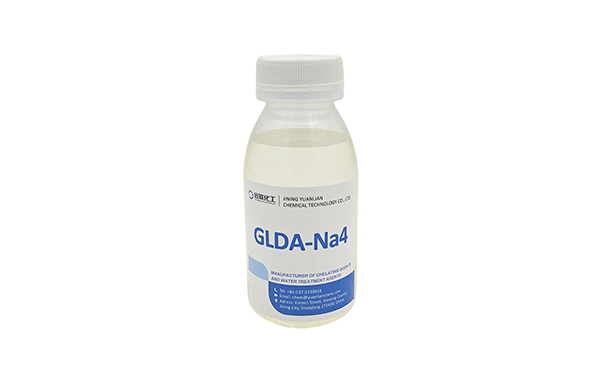
Yuanlian Chemical produces GLDA-Na4 47% liquid specifically for personal care and cosmetic applications. Their product features:
-
High purity with low heavy metals (Pb, Cd, Hg, As below detection limits)
-
Consistent active content (47% ± 1%)
-
Clear, nearly colourless appearance – suitable for transparent formulas
-
Full REACH registration
-
Batch-to-batch traceability with Certificate of Analysis
Several European natural cosmetics brands have already qualified Yuanlian GLDA as their EDTA replacement.
Common Questions from Formulators
Is GLDA safe for sensitive skin?
Yes. Dermatological testing shows it is non-irritant and non-sensitising. It is already used in baby care products across Europe.
Does GLDA count as "natural" under COSMOS?
GLDA is derived from glutamic acid produced by fermentation of plant sugars. COSMOS considers it "nature-identical." It is not classified as a synthetic polymer in the problematic sense.
Can I replace EDTA directly with GLDA in my existing formula?
In most cases, yes. Start with the same active percentage. Run stability testing. Adjust slightly if needed. Many formulators report direct substitution works seamlessly.
What is the shelf life of GLDA-Na4 47% liquid?
24 months from date of manufacture when stored in sealed containers at 5–40°C.
Is GLDA compatible with cationic conditioners?
Yes. Unlike some anionic chelators, GLDA does not precipitate with cationic polymers at typical use levels.
Conclusion: A Cleaner Choice Without Compromise
The clean beauty movement in Europe is not a fad. It is a fundamental shift in how consumers – and regulators – evaluate skin care products. Ingredients that persist in the environment are under scrutiny. EDTA, despite its excellent performance, is on the wrong side of that trend.
GLDA-Na4 47% liquid offers a way forward. It delivers the chelation strength formulators need. It is mild on skin. It is fully biodegradable. And it meets the criteria of the strictest clean beauty certifications.
For formulators developing mild skin care for the European market, GLDA is not just a green alternative to EDTA. It is an upgrade.
Yuanlian Chemical specializes in the production of polyaspartic acid (PASP),tetrasodium iminodisuccinate(IDS), GLDA, MGDA etc. with stable quality and excellent quantity!

Contact us