


-

- 2026-06-11
Maximizing Stability: The Technical Advantages of GLDA-Na4 in Hard Water Formulations
If you have ever tried to formulate a liquid detergent or an all-purpose cleaner for the German or UK market, you already know the problem. Hard water. It chews through weak builders, precipitates out active ingredients, and leaves customers staring at white residue on their dishes or laundry.
The usual fix has been EDTA or phosphonates. But those come with baggage—regulatory pressure, poor biodegradability, and in some cases, outright restrictions under the EU Detergent Regulation.
GLDA-Na4 (tetrasodium glutamate diacetate) has been around for a while. But only recently have formulators started treating it as a genuine workhorse rather than a niche alternative. The reason? It handles hard water better than most people expected.
What Makes Hard Water Such a Problem
Hard water is essentially water loaded with calcium (Ca²⁺) and magnesium (Mg²⁺) ions. When you add surfactants, builders, or enzymes into that mix, two things happen.
First, the calcium ions react with anionic surfactants and fatty acids to form insoluble soap scum. That scum deposits on surfaces, reduces cleaning efficiency, and leaves a visible film.
Second, hardness ions can deactivate certain ingredients. Proteases, for example, are sensitive to calcium in ways that formulators do not always expect.
A chelating agent's job is simple: grab those hardness ions before they cause trouble. But not all chelates do that job equally well, especially in challenging water conditions.
GLDA-Na4: A Quick Product Profile
GLDA is an amino-acid-based chelator derived from glutamic acid. That matters because glutamic acid is natural—it is one of the most abundant amino acids in nature.
Basic specifications:
| Property | Value |
|---|---|
| CAS No. | 51981-21-6 |
| INCI Name | Tetrasodium Glutamate Diacetate |
| Forms | Liquid (approx. 47% active) |
| pH (as supplied) | 11.0–12.0 |
| Biodegradability | Readily biodegradable (OECD 301) |
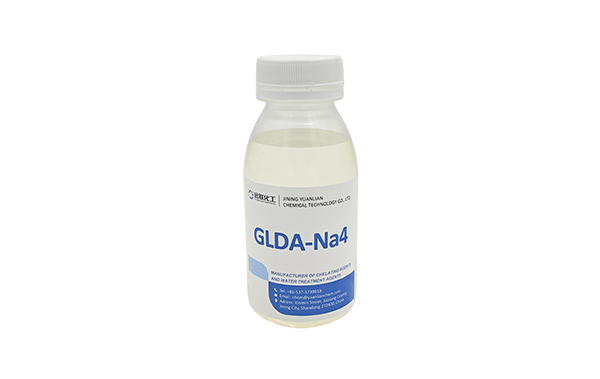
The tetrasodium salt form is the most common for detergent and cleaning applications. It is supplied as a clear, slightly yellowish liquid that blends easily into most aqueous formulations.
The Technical Advantages in Hard Water
1. Strong Calcium Binding at Practical pH
GLDA has a stability constant for calcium (log K ≈ 7.1) that sits in a sweet spot. It is strong enough to sequester hardness ions effectively, but not so strong that it becomes expensive or difficult to biodegrade.
In practical terms, this means GLDA prevents calcium from reacting with surfactants, fatty acids, and other sensitive ingredients across the pH range of most cleaning products—typically 7 to 12.
2. Stability Across Dilution
Here is where some chelates fail. They work fine in the concentrated bottle but fall apart when the customer dilutes the product in hard tap water.
GLDA-Na4 maintains its chelating power even at low concentrations. That matters for "dilute and use" products like all-purpose cleaners or laundry liquids that get poured into a washing machine full of hard water.
3. Compatibility with Enzymes
Proteases and amylases are expensive. Formulators do not want to see them losing activity on the shelf or during the wash.
EDTA has a reputation for destabilising certain liquid enzyme preparations over time. GLDA is noticeably gentler. Multiple stability studies have shown that GLDA-Na4 allows enzymes to remain active longer, both in concentrated formulations and in the wash liquor.
4. Prevents Soap Scum Formation
When a formulation contains soap or fatty acids, hard water creates insoluble calcium soaps. Those deposit on fabrics, reducing absorbency and trapping odours.
GLDA prevents this by binding the calcium before it can react with the soap. The result is cleaner rinsing, softer fabrics, and fewer complaints from customers.
Biodegradability: The EU Advantage
No conversation about detergent ingredients in Europe is complete without discussing what happens after the product goes down the drain.
GLDA-Na4 is readily biodegradable under OECD 301D/E. More than 60% degradation within 28 days, and often significantly faster in real-world conditions.
What that means for your label:
-
Eligible for EU Ecolabel (Regulation (EU) 2017/1218)
-
Compliant with Nordic Swan and Blue Angel
-
No persistence concerns under REACH
-
Meets the Detergent Regulation (EC) No 648/2004 requirements
EDTA, by contrast, is not biodegradable. Phosphonates are only partially biodegradable. For brands that need to make credible sustainability claims, GLDA removes an entire category of compliance risk.
Where GLDA-Na4 Works Best
Automatic dishwashing (ADW) liquids and powders are probably the most obvious application. ADW formulations run at high pH, high temperature, and face the toughest hard water challenges. GLDA prevents filming on glassware and helps remove starch and protein soils.
Laundry liquids benefit from GLDA's enzyme compatibility and soap scum prevention. In compact liquids (3x, 5x, 8x concentrated), GLDA stays stable without crystallising or separating.
Hard surface cleaners use GLDA at lower levels (1–3%) to boost grease removal and prevent streaking on glass and tiles. It works particularly well in products designed for kitchen and bathroom use.
Industrial and institutional cleaning is a growing segment. Breweries use GLDA for beerstone removal. Dairies use it for milk scale. Cooling towers use it as a phosphorus-free scale inhibitor.
Practical Formulation Guidelines
Based on feedback from formulators working across Germany, France, Italy, and the Benelux countries.
Typical use levels:
| Application | GLDA-Na4 (% active) |
|---|---|
| Laundry liquids | 1–5% |
| ADW liquids/powders | 2–8% |
| Hard surface cleaners | 1–3% |
| Industrial descalers | 5–15% |
Compatibility: GLDA-Na4 works with all common anionic, non-ionic, and amphoteric surfactants. It is compatible with proteases, amylases, cellulases, and mannanases. No issues with preservatives, fragrances, or optical brighteners.
pH considerations: GLDA-Na4 is supplied at pH 11–12. In final formulations, it remains effective from pH 7 to 13. If your formula is pH-sensitive, account for the extra alkalinity contribution.
GLDA-Na4 vs Traditional Chelators in Hard Water
| Property | GLDA-Na4 | EDTA | Phosphonates |
|---|---|---|---|
| Calcium binding (log K) | 7.1 | 10.5 | Moderate |
| Biodegradable (OECD 301) | ✅ Yes | ❌ No | ❌ Poor |
| EU Ecolabel eligible | ✅ Yes | ❌ No | ❌ Restricted |
| Enzyme compatibility | Excellent | Poor | Moderate |
| Stability in hard water dilution | Excellent | Good | Moderate |
| Works in high-pH formulations | ✅ Yes | Moderate | ✅ Yes |
The lower stability constant compared to EDTA is not a weakness. It is a design feature. GLDA is strong enough to do the job but weak enough to biodegrade quickly after use. That balance is precisely what European regulators want to see.
Common Formulation Pitfalls to Avoid
Assuming more is better. GLDA is efficient. Start at the lower end of the recommended range and test upward only if needed. Overdosing adds cost without improving performance.
Using it alone in extremely hard water. Above 25°dH (very hard water, common in parts of the UK and Netherlands), GLDA performs best with a co-builder like sodium citrate or a polymer.
Forgetting to test for compatibility with cationic surfactants. Standard good practice applies—do not mix concentrated GLDA with concentrated cationics in the same batch step.
The Regulatory Outlook
The EU Detergent Regulation is under revision. Early signals suggest tighter limits on phosphonates and a clearer pathway for readily biodegradable chelates like GLDA and MGDA.
By moving to GLDA-Na4 now, formulators gain regulatory headroom for the next five to ten years. They also gain marketing claims that actually mean something: "biodegradable", "EU Ecolabel compatible", "low environmental impact".
Retailers across Europe—Lidl, Carrefour, Aldi, Tesco—are increasingly requesting full ingredient disclosure and proof of sustainability claims. GLDA-Na4 helps you provide that proof.
Sourcing GLDA-Na4 for the European Market
When evaluating GLDA-Na4 suppliers, request:
-
OECD 301 biodegradability data (not just claims)
-
Certificate of Analysis with heavy metal limits (Pb, Cd, Hg, As)
-
REACH registration confirmation (if sourcing from outside the EU)
-
Stability data in concentrated alkaline systems
Major suppliers include Nouryon (Dissolvine® GL-47S), BASF, and a growing number of specialty chelate producers.
For formulators looking to balance performance and cost, Yuanlian Chemical offers GLDA-Na4 with competitive pricing, full REACH documentation, and consistent quality suitable for detergent applications.
The Bottom Line
GLDA-Na4 is not a futuristic concept. It is a proven, commercially available chelating agent that handles hard water formulations as well as—or better than—traditional options in many applications.
It binds calcium effectively. It stays stable when diluted. It is gentle on enzymes. And it biodegrades completely, which means fewer regulatory headaches and more credible sustainability claims.
If you are reformulating away from EDTA or phosphonates, GLDA-Na4 deserves a place on your test bench.
Yuanlian Chemical specializes in the production of polyaspartic acid (PASP),tetrasodium iminodisuccinate(IDS), GLDA, MGDA etc. with stable quality and excellent quantity!

Contact us