


-

- 2026-06-11
Why Your Green Formulation Needs Tetrasodium Glutamate Diacetate
Formulating a genuinely green cleaning product in Europe is harder than it looks. You swap out surfactants, remove phosphates, cut back on preservatives. Then you test in hard water—and nothing works. Performance tanks. Customers complain.
The missing piece is often the chelating agent. You need something that binds calcium and magnesium, prevents soap scum, and keeps surfactants working. But traditional chelates—EDTA, phosphonates, NTA—fail the sustainability test.
Tetrasodium Glutamate Diacetate (GLDA-Na4) is different. It works like a traditional chelate but disappears like a natural ingredient.
What Is GLDA-Na4?
GLDA is an amino-acid-based chelator made from glutamic acid—one of the most abundant amino acids in nature. You find it in tomatoes, cheese, and mushrooms.
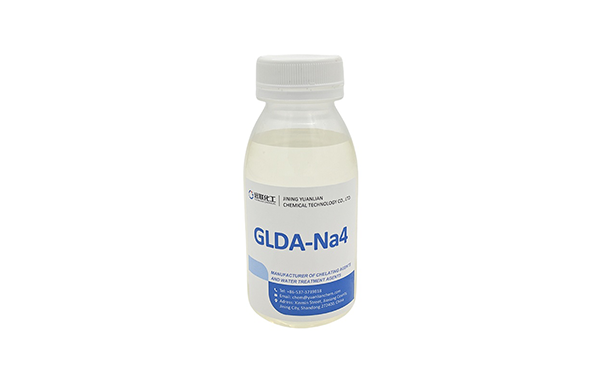
The diacetate structure grabs calcium, magnesium, and other metal ions. But because the backbone is natural, the whole molecule breaks down completely after use.
| Property | Value |
|---|---|
| CAS No. | 51981-21-6 |
| Forms | Liquid (~47% active) |
| pH (as supplied) | 11.0–12.0 |
| Biodegradability | Ready (OECD 301) |
The Green Credentials That Matter
Readily Biodegradable
GLDA-Na4 passes OECD 301—more than 60% degradation within 28 days. In real-world conditions, it breaks down even faster. EDTA shows virtually no degradation over the same period. For EU Ecolabel, ready biodegradability is a requirement.
No Persistent Metabolites
GLDA breaks down into carbon dioxide, water, and biomass. No hidden legacy.
Low Aquatic Toxicity
The 72-hour EC₅₀ for algae is above 100 mg/L—lowest category of concern. GLDA does not harm wastewater treatment microorganisms.
Non-Hazardous
Under EU CLP, GLDA-Na4 carries no hazard pictograms. No irritant, no corrosive, no health warnings. Simpler safety data sheets, fewer label warnings.
Performance: Green Means Nothing If It Does Not Clean
Here is where many green chelates fail. They biodegrade beautifully but cannot handle hard water. GLDA solves that.
Calcium Binding
GLDA has a stability constant for calcium of approximately log K = 7.1. Strong enough to sequester hardness ions in typical washing conditions (pH 7–12, 30–70°C). Your surfactants keep working. Your enzymes stay active.
Soap Scum Prevention
When calcium meets soap, you get scum. It makes fabrics stiff and dull. GLDA binds the calcium before it reacts, leaving soap free to do its job.
Enzyme Compatibility
EDTA destabilises some liquid enzyme preparations. GLDA is gentler. Enzymes stay active longer—longer shelf life, better cleaning.
Where to Use GLDA-Na4
Automatic Dishwashing (ADW): Prevents filming on glassware, removes tea and coffee stains. Typical use: 2–8%.
Laundry Detergents: Protects surfactants, prevents soap scum, removes protein stains. Typical use: 1–5% (liquids), 2–6% (powders).
Hard Surface Cleaners: Improves wetting and rinsing, prevents streaks. Typical use: 1–3%.
Industrial Cleaning: Removes beerstone, milk scale, calcium phosphate deposits. Typical use: 5–15%.
GLDA vs Traditional Chelates
| Property | GLDA-Na4 | EDTA | Phosphonates |
|---|---|---|---|
| Readily biodegradable | ✅ Yes | ❌ No | ❌ Poor |
| EU Ecolabel eligible | ✅ Yes | ❌ No | ❌ Restricted |
| Aquatic toxicity | Low | Moderate | Eutrophication risk |
| Hazard classification | None | None | Varies |
| Natural backbone | ✅ Yes | ❌ No | ❌ No |
This is not a close competition.
Regulatory Alignment
The EU is tightening restrictions on persistent chemicals. The Detergent Regulation is under revision. Phosphonates are under review. EDTA is not banned yet, but it is on the radar.
By choosing GLDA-Na4 now, you avoid future reformulation costs, retailer audit failures, and negative press about persistent ingredients.
Practical Formulation Tips
Dosage: Start at the lower end of the recommended range. GLDA is efficient. More is not always better.
Compatibility: Works with all common anionic, non-ionic, and amphoteric surfactants. Compatible with enzymes, preservatives, fragrances.
pH: GLDA-Na4 is supplied at pH 11–12. Account for the alkalinity if your target pH is lower.
Sourcing GLDA-Na4 for Europe
When evaluating suppliers, request OECD 301 data, Certificate of Analysis (heavy metals), and REACH confirmation.
Established suppliers include Nouryon (Dissolvine® GL-47S) and BASF. For formulators balancing performance and cost, Yuanlian Chemical offers GLDA-Na4 with full documentation, competitive pricing, and consistent quality.
The Bottom Line
You do not need to compromise between green credentials and cleaning performance.
GLDA-Na4 delivers:
-
Ready biodegradability (OECD 301)
-
Strong calcium binding for hard water
-
Enzyme compatibility
-
EU Ecolabel eligibility
-
No hazard classification
The shift toward sustainable chemistry is already here. European regulators, retailers, and consumers are demanding it. GLDA-Na4 is a proven, available way to meet those demands.
Test it in your next formulation.
Yuanlian Chemical specializes in the production of polyaspartic acid (PASP),tetrasodium iminodisuccinate(IDS), GLDA, MGDA etc. with stable quality and excellent quantity!

Contact us