



-

- 2026-06-15
Understanding PASP Sodium Salt: Properties, CAS No, and Industrial Applications
A Practical Overview for Formulators and Procurement Specialists
If you work with water treatment, detergents, or agricultural formulations, you have probably come across polyaspartic acid sodium salt. It is often mentioned alongside other biodegradable chelators and scale inhibitors. But what exactly is it? What does the CAS number tell you? And where does it actually work well?
This guide answers those questions in plain terms.
What Is Polyaspartic Acid Sodium Salt?
Polyaspartic acid sodium salt—often shortened to PASP sodium salt or simply PASP—is a water-soluble polymer. It is derived from aspartic acid, an amino acid found naturally in proteins. The "sodium salt" part means the carboxylic acid groups on the polymer chain have been neutralised with sodium hydroxide, making the compound fully soluble in water and stable in liquid formulations.
Unlike many synthetic polymers used in industry, PASP sodium salt is designed to break down after use. It is not persistent in the environment.
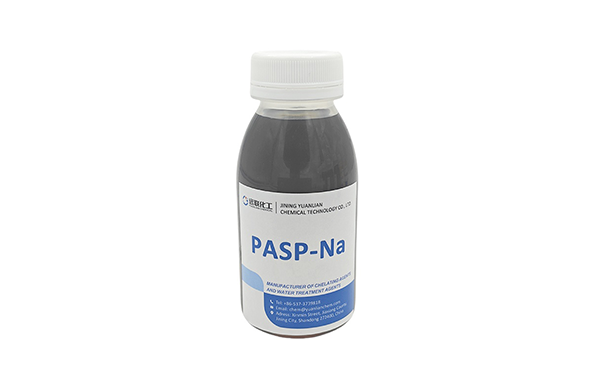
Basic identifiers:
| Property | Information |
|---|---|
| CAS No. | 181828-06-8 (polyaspartic acid sodium salt) |
| Alternative CAS | 25608-40-6 (polyaspartic acid, non-salt form) |
| Molecular formula | (C₄H₄NNaO₂)ₙ |
| Appearance | Light yellow to amber liquid or off-white powder |
| Solubility | Fully soluble in water |
| pH (1% solution) | 8.0–10.0 (typical for sodium salt form) |
Why the CAS Number Matters
The CAS number 181828-06-8 specifically refers to the sodium salt form of polyaspartic acid. This is the version most commonly used in industrial and agricultural applications.
Some suppliers list the non-salt form (25608-40-6). The practical difference is solubility and handling. The sodium salt dissolves immediately in water. The acid form may require pH adjustment to go into solution.
When you are comparing products from different sources, always check which CAS number they reference. It ensures you are comparing similar materials.
Key Properties That Define PASP Sodium Salt
Biodegradability
PASP sodium salt passes OECD 301 tests for ready biodegradability. In practical terms, this means it breaks down in the environment within weeks, not years. For applications where discharge is inevitable—cooling water, agricultural runoff, detergent wastewater—this is a significant advantage over traditional polymers.
Thermal Stability
The polymer remains stable at temperatures up to 80–90°C. Above that, gradual degradation begins. For most water treatment and detergent applications, this is perfectly adequate.
Chelating and Dispersing Ability
PASP sodium salt has a moderate affinity for calcium, magnesium, and other hardness ions. It does not chelate as strongly as EDTA or GLDA. But it performs very well as a dispersant—keeping particles suspended and preventing scale formation.
Non-Toxicity
Available toxicological data indicates low acute oral toxicity (LD₅₀ > 5000 mg/kg). No skin irritation or sensitisation concerns have been identified in standard tests. The compound carries no hazard classification under typical workplace exposure conditions.
Industrial Applications
Cooling Water Treatment
Scale formation on heat exchange surfaces reduces efficiency and increases energy consumption. PASP sodium salt is used as a scale inhibitor and dispersant in recirculating cooling systems. It works by interfering with crystal growth of calcium carbonate and calcium sulphate. Unlike phosphonates, it introduces no phosphorus into the discharge water.
Detergents and Cleaners
In automatic dishwashing and laundry detergents, PASP sodium salt acts as a co-builder. It helps prevent redeposition of soil onto cleaned surfaces. It also disperses particulate matter, keeping washing water cleaner for longer. Formulators often combine it with other chelating agents like MGDA or GLDA.
Agriculture
As covered in previous discussions, PASP sodium salt enhances fertiliser efficiency by reducing nutrient fixation in soil and improving uptake by plant roots. It is applied as a coating on granular fertilisers or as a liquid additive in fertigation systems.
Oilfield Applications
The polymer is used in drilling fluids and produced water treatment. It prevents scale deposition in pipelines and equipment. Its biodegradability is particularly valued in offshore operations where discharge regulations are strict.
Textile Processing
PASP sodium salt improves the effectiveness of bleaching and dyeing baths by sequestering metal ions that would otherwise interfere with the chemistry. It also prevents scale formation on machinery.
Comparison with Other Chelating Agents
| Property | PASP Sodium Salt | EDTA | GLDA |
|---|---|---|---|
| Biodegradable (OECD 301) | Yes | No | Yes |
| Calcium binding strength | Moderate | Strong | Moderate-strong |
| Dispersant ability | Excellent | Limited | Moderate |
| Cost per kg | Lower | Moderate | Moderate-higher |
| Thermal stability to 90°C | Yes | Yes | Yes |
PASP is not a direct replacement for EDTA in applications requiring very strong chelation. But where dispersancy and biodegradability are priorities, it often outperforms more expensive alternatives.
Handling and Storage
PASP sodium salt is supplied as an aqueous solution (typically 30–40% active) or as a dry powder. The liquid form is easier to handle for most industrial applications.
Storage recommendations:
-
Keep containers sealed to prevent evaporation
-
Store between 5°C and 40°C
-
Avoid contact with strong oxidising agents
-
Use mild steel, stainless steel, or plastic vessels (concrete and aluminium are not recommended for long-term contact)
The product is stable for at least 12 months under proper storage conditions.
Regulatory Status
Under EU REACH, polyaspartic acid sodium salt is not classified as hazardous. It is not subject to the restrictions that apply to phosphonates or certain persistent polymers.
For formulators targeting eco-labels like EU Ecolabel or Nordic Swan, the ready biodegradability of PASP makes it a preferred choice over non-biodegradable alternatives.
Sourcing Considerations
When evaluating PASP sodium salt from any supplier, request:
-
Certificate of Analysis with active content, pH, and viscosity
-
OECD 301 biodegradability test report
-
Heavy metal limits (lead, cadmium, mercury, arsenic)
-
REACH documentation if importing into the EU
The market includes producers in Europe, North America, and Asia. Quality varies, so lab testing of samples is recommended before bulk commitment.
Limitations to Keep in Mind
PASP sodium salt is not suitable for every application.
It does not chelate iron or copper as effectively as stronger agents like GLDA or EDTA. For formulations that need to handle heavy metal contamination, a blend of PASP with another chelator may be required.
It also has a temperature limit. Continuous exposure above 100°C will accelerate degradation. For high-temperature industrial processes, alternative chemistries should be considered.
Final Summary
Polyaspartic acid sodium salt (CAS 181828-06-8) is a biodegradable, non-toxic polymer with genuine utility across cooling water treatment, detergents, agriculture, and other industrial sectors.
It is not the strongest chelator available. But for applications that require dispersancy, scale inhibition, and environmental compliance, it offers a practical and cost-effective solution.
Understanding its properties—and its limits—allows formulators and procurement specialists to specify it with confidence.
Yuanlian Chemical specializes in the production of polyaspartic acid (PASP),tetrasodium iminodisuccinate(IDS), GLDA, MGDA etc. with stable quality and excellent quantity!

Contact us