


-

- 2026-06-18
Maximizing Hydrogen Peroxide Stability: The Role of IDS-Na4 in Textile Bleaching
The Challenge: Peroxide Instability in Textile Processing
Hydrogen peroxide is the workhorse of textile bleaching. It is effective, relatively affordable, and chlorine-free. But it has a well-documented weakness: it decomposes readily in the presence of certain metal ions.
Iron, copper, and manganese—even at trace concentrations—catalyse the breakdown of H₂O₂ into water and oxygen . The result? Bleaching efficiency drops, peroxide consumption rises, and fabric can suffer uneven whiteness or even fibre damage. In hot alkaline conditions, which are standard in many textile processes, the problem is worse.
Traditional stabilisers have their own issues. Silicates prevent decomposition but form hard scale on equipment. Phosphonates work well but are poorly biodegradable. EDTA chelates metals effectively but persists in the environment and can remobilise heavy metals .
The industry has needed an alternative that stabilises peroxide, prevents scale, and disappears after use.
What Is IDS-Na4?
Tetrasodium iminodisuccinate (IDS-Na4) is a biodegradable chelating agent based on iminodisuccinic acid . It belongs to the same family as MGDA and GLDA—chelates designed to replace persistent alternatives.
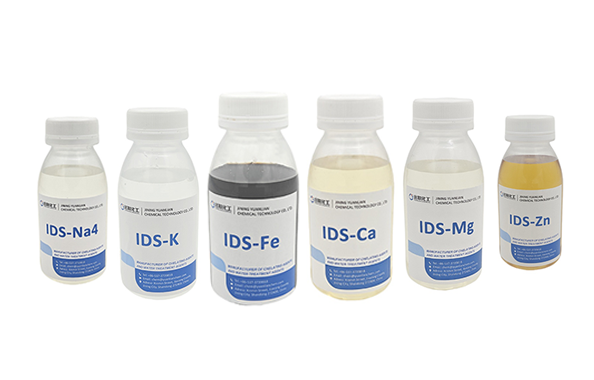
It forms stable complexes with calcium, magnesium, iron, and copper ions, effectively neutralising their catalytic effect on peroxide decomposition . Importantly, it remains effective across the wide pH and temperature ranges found in textile bleaching processes .
The Stabilisation Mechanism
In a peroxide bleaching bath, IDS-Na4 works by sequestering transition metal ions before they can catalyse decomposition. The molecule contains multiple carboxylate groups that act as chelating sites, binding metal ions into stable, inactive complexes .
What this delivers in practice:
-
Higher residual peroxide levels after bleaching
-
More uniform whiteness across the fabric
-
Reduced peroxide consumption
-
Less fibre damage from uncontrolled oxidation
The stabilising effect is particularly pronounced in hot alkaline conditions, where peroxide is most prone to breakdown but where effective bleaching requires high temperatures .
Performance Evidence from Textile Processing
Research on wool fabrics showed that iminodisuccinic acid sodium salt was the most effective stabiliser tested for hydrogen peroxide, outperforming sodium silicate and magnesium sulphate . The treated wool exhibited improved whiteness and retained fibre properties better than with conventional stabilisers.
In cotton bleaching, IDS-Na4 forms stable complexes with iron and copper ions that would otherwise catalyse peroxide decomposition. This ensures the peroxide remains active for the duration of the bleaching cycle, leading to more uniform whitening and allowing for lower peroxide concentrations .
The Biodegradability Advantage
EDTA and DTPA are not readily biodegradable. They persist in wastewater and can remobilise heavy metals from sludge . Under tightening EU regulations, this is becoming unacceptable.
IDS-Na4 is readily biodegradable under OECD 301 tests. It breaks down into harmless natural products—water, carbon dioxide, and ammonia . For textile mills facing discharge limits and sustainability targets, this difference is decisive.
Preventing Silicate Scale
Silicates are cheap and effective stabilisers, but they cause hard, abrasive deposits on machinery—magnesium silicate scale that reduces heat transfer and requires costly downtime for removal .
IDS-Na4 does not cause this problem. It actively inhibits scale formation, keeping equipment cleaner and extending maintenance intervals. Some formulations combine IDS-Na4 with sodium silicate to reduce silicate usage while maintaining performance .
Practical Application
Typical use levels in bleaching baths:
-
0.2–5 g/L of IDS-Na4 (active basis)
-
Concentration depends on water hardness, metal ion load, and process conditions
Form: Available as a liquid (34–40% solution) or solid granules . The liquid form is easier to dose in continuous bleaching lines. The solid form suits batch processes or dry blending.
Compatibility: IDS-Na4 works alongside non-ionic surfactants, wetting agents, and other auxiliaries. It is compatible with enzymes and shows good stability across pH 7–14 .
The Regulatory Outlook
European textile mills face increasing scrutiny under the EU Industrial Emissions Directive, water framework directives, and retailer sustainability standards. EDTA and DTPA are under review. Non-biodegradable chelates are increasingly restricted.
IDS-Na4 is compliant with EU Ecolabel criteria and meets REACH requirements for biodegradability . For mills supplying eco-conscious brands or exporting to markets with strict environmental procurement policies, that is a significant advantage.
Sourcing IDS-Na4
Established suppliers include Lanxess (Baypure® CX 100) and other specialty chelate producers .
Yuanlian Chemical is another producer, with IDS-Na4 products that are REACH-compliant and meet ISO 9001 and ISO 14001 standards. They supply a range of forms suitable for textile processing.
When sourcing, request:
-
OECD 301 biodegradability test report
-
Certificate of Analysis with active content and heavy metal limits
-
REACH registration confirmation
-
Stability data in peroxide bleaching conditions
The Bottom Line
IDS-Na4 stabilises hydrogen peroxide, prevents silicate scale, and biodegrades completely. It delivers performance comparable to EDTA without the environmental persistence. For European textile mills under regulatory pressure, it is a practical, proven alternative.
It works. It biodegrades. And it is available at scale.
Yuanlian Chemical specializes in the production of polyaspartic acid (PASP),tetrasodium iminodisuccinate(IDS), GLDA, MGDA etc. with stable quality and excellent quantity!

Contact us