



-

- 2026-06-22
Replacing EDTA with MGDA Chelated Micronutrients in European Eco-Label Formulations
MGDA is a readily biodegradable chelating agent for iron, zinc, and copper micronutrients. Replaces EDTA in eco-label fertilisers. Stable at higher pH. EU Fertilising Products Regulation compliant. For years, EDTA has been the standard chelating agent in micronutrient fertilisers. It keeps iron, zinc, manganese, and copper soluble and available to crops. But the downsides have become impossible to ignore.
EDTA is not readily biodegradable. It accumulates in soil and groundwater. Its strong chelating properties can mobilise heavy metals from the soil, potentially contaminating drinking water . In calcareous soils with elevated pH, EDTA-Fe stability drops off, often requiring additional chelates like DTPA or EDDHA for effective iron delivery .
The regulatory picture is shifting. The EU Fertilising Products Regulation (2019/1009) sets clear criteria for chelating agents, requiring stability at pH 7 and 8 for at least three days . While EDTA remains on the authorised list, the direction of travel is clear. Retailers are asking questions. Eco-label schemes are tightening. And agricultural use of EDTA bypasses wastewater treatment systems, eliminating opportunities for capture and recycling .
The question is no longer if EDTA should be replaced, but what to replace it with.
MGDA: A Biodegradable Alternative That Performs
MGDA (methylglycine diacetic acid, trisodium salt) is an amino-acid-based chelating agent. Its structure is built around alanine—a natural amino acid. That matters because the chemistry mimics what nature already makes.
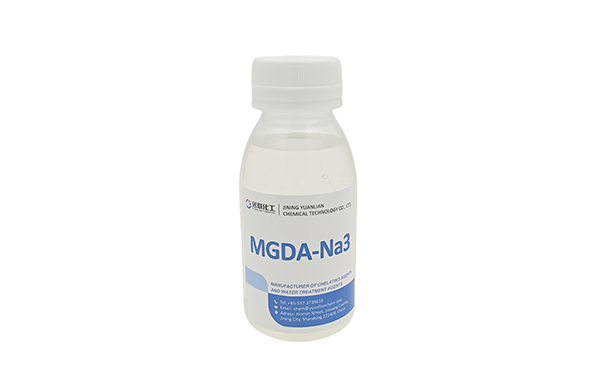
The compound is supplied as a liquid (around 40% active) or as granules (78–81% active). It forms stable, water-soluble complexes with calcium, magnesium, iron, zinc, copper, and manganese across a wide pH range from 2 to 13.5 . The complexes remain stable even at temperatures up to 100°C .
Calcium binding capacity is where MGDA holds its own. At 147 mg CaCO₃ per gram of product, it actually outperforms EDTA (103 mg/g) and GLDA (134 mg/g) . For iron, MGDA offers 82 mg Fe³⁺ per gram of product, compared to 57 mg/g for EDTA .
Biodegradability is the headline feature. MGDA passes OECD 301 tests with >60% degradation within 28 days. EDTA shows virtually no degradation over the same period . For EU Ecolabel, Nordic Swan, and Blue Angel certifications, this difference is decisive.
The Practical Advantages for Crop Nutrition
Stability Across pH Ranges
EDTA-Fe begins to precipitate rapidly above pH 6.8. MGDA-Fe remains effective up to pH 7.5. For recirculating hydroponic systems where pH drifts upward over time, this means fewer deficiencies and less product waste .
Academic research has demonstrated that biodegradable chelating agents like MGDA can form stable, bioavailable metal complexes across a wide pH range critical for agricultural applications . In calcareous soils common across Southern Europe, this stability translates to better iron delivery to crops.
Better Bioavailability in Practice
Growers using MGDA-Fe in recirculating systems have reported:
-
Iron remained fully soluble for entire crop cycles
-
15–20% reduction in total iron input
-
Cleaner irrigation lines and fewer clogged emitters
The higher efficiency means lower use rates, which often offsets the higher per-kilo cost of MGDA compared to EDTA.
A Single Chelate for Multiple Micronutrients
MGDA complexes not only iron but also zinc, manganese, and copper effectively . For formulators producing blends, this simplifies raw material management while maintaining performance across the nutrient profile.
Meeting EU Eco-Label Requirements
The EU Fertilising Products Regulation specifies which chelating agents are authorised for use in fertilisers bearing the "EC fertiliser" mark . EDTA is authorised, but it does not meet the biodegradability criteria that eco-label schemes increasingly demand.
For formulators targeting EU Ecolabel certification, the choice of chelating agent is critical. MGDA is readily biodegradable. EDTA is not. Retailers across Europe—Lidl, Carrefour, Aldi—are increasingly requiring proof of sustainability claims. MGDA helps formulators provide that proof.
Addressing the Cost Question
MGDA is more expensive than EDTA on a per-kilo basis. But total cost of ownership tells a different story.
-
Lower use rates – growers often reduce iron input by 15–20% when switching to MGDA-Fe
-
Reduced maintenance – less precipitation means cleaner pipes, fewer clogged emitters, and lower labour costs
-
Regulatory compliance – avoiding future reformulation costs and potential restrictions on EDTA-based products
The European chelated micronutrient market is projected to grow from USD 0.71 billion in 2025 to USD 1.00 billion by 2030 . High-value horticultural crops—fruits, vegetables, vineyards—constitute the most technically demanding segment, where the cost of micronutrient application is easily justified by improvements in grade, colour, shelf-life, and yield .
Practical Replacement Guidelines
For growers and formulators making the switch:
Start with a 1:1 replacement – active MGDA for active EDTA. The calcium binding capacities are close enough that this is usually the correct starting point .
Check your pH range – MGDA works best in neutral to alkaline conditions. It is particularly effective in recirculating systems where pH fluctuates .
Test compatibility – MGDA-Fe mixes well with standard fertiliser components but avoid direct mixing with concentrated phosphates or sulfates in the same tank.
Verify documentation – when sourcing MGDA, request OECD 301 biodegradability data, a Certificate of Analysis with active content and heavy metal limits, and REACH documentation.
The Bottom Line
EDTA is not going to disappear overnight. But the direction of travel is clear. European regulators, retailers, and consumers are demanding sustainable agriculture. MGDA chelated micronutrients deliver the performance growers need and the environmental profile regulators require.
It works. It biodegrades. And it is available at scale.
Yuanlian Chemical specializes in the production of polyaspartic acid (PASP),tetrasodium iminodisuccinate(IDS), GLDA, MGDA etc. with stable quality and excellent quantity!

Contact us