



-

- 2026-06-22
Correcting Micronutrient Deficiencies: The Bioavailability of MGDA-Chelated Minerals
Iron deficiency is one of the most common nutritional problems in agriculture, particularly in calcareous and alkaline soils across southern Europe . Despite iron being abundant in nature, it forms insoluble ferric oxides and hydroxides at neutral or alkaline pH, making it largely unavailable to plant roots . The result is chlorosis, stunted growth, and reduced yields.
For decades, growers have relied on EDTA to keep micronutrients soluble. It works—up to a point. But EDTA's persistence in the environment, its declining effectiveness above pH 6.8, and increasing regulatory scrutiny have pushed the industry to look for alternatives that actually deliver nutrients to crops without leaving a footprint.
MGDA (methylglycine diacetic acid) offers a different approach. It chelates minerals effectively, keeps them soluble across a wider pH range, and breaks down completely after use. The question is not whether it works—the science is clear—but how well it delivers nutrients to plants compared to traditional options.
What Bioavailability Means for Crop Nutrition
Bioavailability is the fraction of a nutrient that actually reaches plant tissues in a form the crop can use. In soil, most micronutrients are present but locked up. The role of a chelate is to keep them in solution long enough for roots to absorb them.
MGDA forms stable, water-soluble complexes with iron, zinc, copper, and manganese across a pH range from 2 to 13.5 . For iron, the logarithmic stability constant (log K) for MGDA-Fe³⁺ complexes is 16.5—the highest among all metal ions, indicating a strong binding affinity . This stability prevents iron from precipitating out of solution, keeping it available for root uptake.
The relative stability of MGDA complexes follows the order: Fe³⁺ > Cu²⁺ > Zn²⁺ . For growers, this means the chelate works hardest for the nutrients that are most difficult to keep soluble—iron and copper.
How MGDA Improves Micronutrient Uptake
Research on rice seedlings demonstrated the mechanism clearly. When plants were grown with increasing concentrations of MGDA, iron concentrations on root surfaces decreased, while iron concentrations in roots and shoots increased up to an optimal concentration . This indicates that MGDA effectively mobilises iron from insoluble forms and makes it available for uptake.
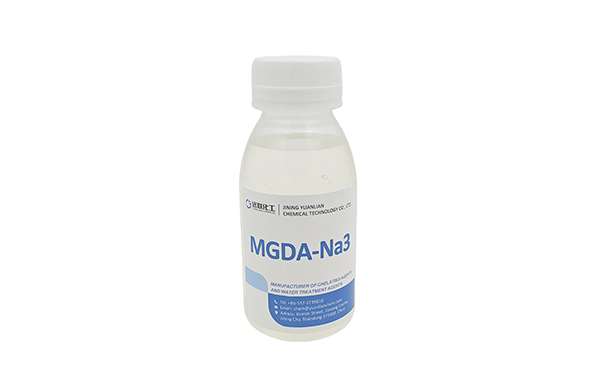
The mechanism is straightforward. At neutral or alkaline pH, iron exists mostly as insoluble ferric oxides and hydroxides . MGDA chelates ferric iron, increasing the soluble fractions that plants can absorb. The same principle applies to zinc and copper—though with slightly different binding strengths .
What this means in practice:
-
More of the applied micronutrient reaches the plant
-
Lower application rates are needed to correct deficiencies
-
Deficiencies resolve faster because the nutrient is already in a plant-available form
MGDA vs EDTA: Bioavailability Compared
EDTA forms stronger complexes with some metals than MGDA. But strength alone does not determine bioavailability. The question is whether the chelate releases the nutrient at the root surface.
MGDA's stability constants are sufficient to keep minerals soluble in the soil solution but allow release at the root interface. This balance between stability and availability is exactly what effective fertilisers require. EDTA, by contrast, can hold metals so tightly that release becomes rate-limiting in some conditions.
The biodegradability difference also affects long-term availability. EDTA persists and can remobilise heavy metals over time . MGDA breaks down after delivering its nutrient payload, reducing the risk of unintended metal mobilisation in the soil profile .
Environmental Profile Without Performance Trade-Off
MGDA is classified as readily biodegradable under OECD standards. In standard conditions, 89–100% of MGDA degrades within 14 days, while no EDTA degrades over 30 days . For European growers facing tightened discharge regulations and retailer sustainability requirements, this difference is decisive.
The toxicological profile is clean. MGDA is non-toxic and carries no hazardous classification under EU CLP. It does not accumulate in soil, does not mobilise heavy metals beyond its intended nutrient delivery, and does not persist in natural waters .
Practical Application for European Growers
For formulators and growers making the switch:
Start with a moderate replacement rate. Research suggests that MGDA concentrations above 0.25 mM can reduce plant growth due to over-chelation . For most field applications, this translates to lower rates than EDTA-based products. Test at 15–20% less than your current EDTA rate and adjust upward if needed.
Monitor pH. MGDA performs well across a wide pH range but is most effective in neutral to alkaline conditions where EDTA struggles. In calcareous soils common across Spain, Italy, and Greece, MGDA-Fe will typically outperform EDTA-Fe at the same application rate.
Consider the full nutrient package. MGDA complexes multiple micronutrients effectively. For blends containing iron, zinc, copper, and manganese, a single MGDA-chelated product can simplify inventory and application.
The Bottom Line
Micronutrient deficiencies cost European growers millions in lost yield and quality every year. Correcting them requires a chelate that keeps minerals soluble, delivers them to roots, and disappears afterwards.
MGDA does all three. It binds iron, zinc, and copper effectively. It releases them at the root surface. It biodegrades completely. For growers looking to improve nutrient efficiency while meeting sustainability targets, MGDA-chelated minerals are a practical, science-backed choice.
Yuanlian Chemical specializes in the production of polyaspartic acid (PASP),tetrasodium iminodisuccinate(IDS), GLDA, MGDA etc. with stable quality and excellent quantity!

Contact us