



-

- 2026-06-24
Balancing Defoaming Efficiency and Compressive Strength in Gypsum Screeds
The Trade-Off That Keeps Formulators Up at Night
Anyone who has formulated gypsum-based self-leveling screeds knows the dilemma. You add a defoamer to eliminate surface pinholes and improve aesthetics, but you worry about what it might do to strength. Or you formulate for maximum compressive strength, only to find the finished surface covered in tiny craters.
The tension is real. Air entrainment is unavoidable during high-speed mixing. Without an effective defoamer, those air bubbles become voids in the hardened gypsum matrix, reducing density and compressive strength. But add too much defoamer or choose the wrong type, and you can introduce other problems—incompatibility with superplasticizers, interference with setting time, or even surface defects from the defoamer itself.
The key is not choosing between defoaming and strength. It is understanding how to achieve both.
Why Air Entrainment Weakens Gypsum Screeds
When gypsum slurry is mixed, air is naturally incorporated. Without proper foam control, these bubbles become trapped during setting. The result is a structure with micro-voids that act as stress concentration points. The mechanical properties suffer—compressive strength drops, flexural strength decreases, and the finished surface is compromised.
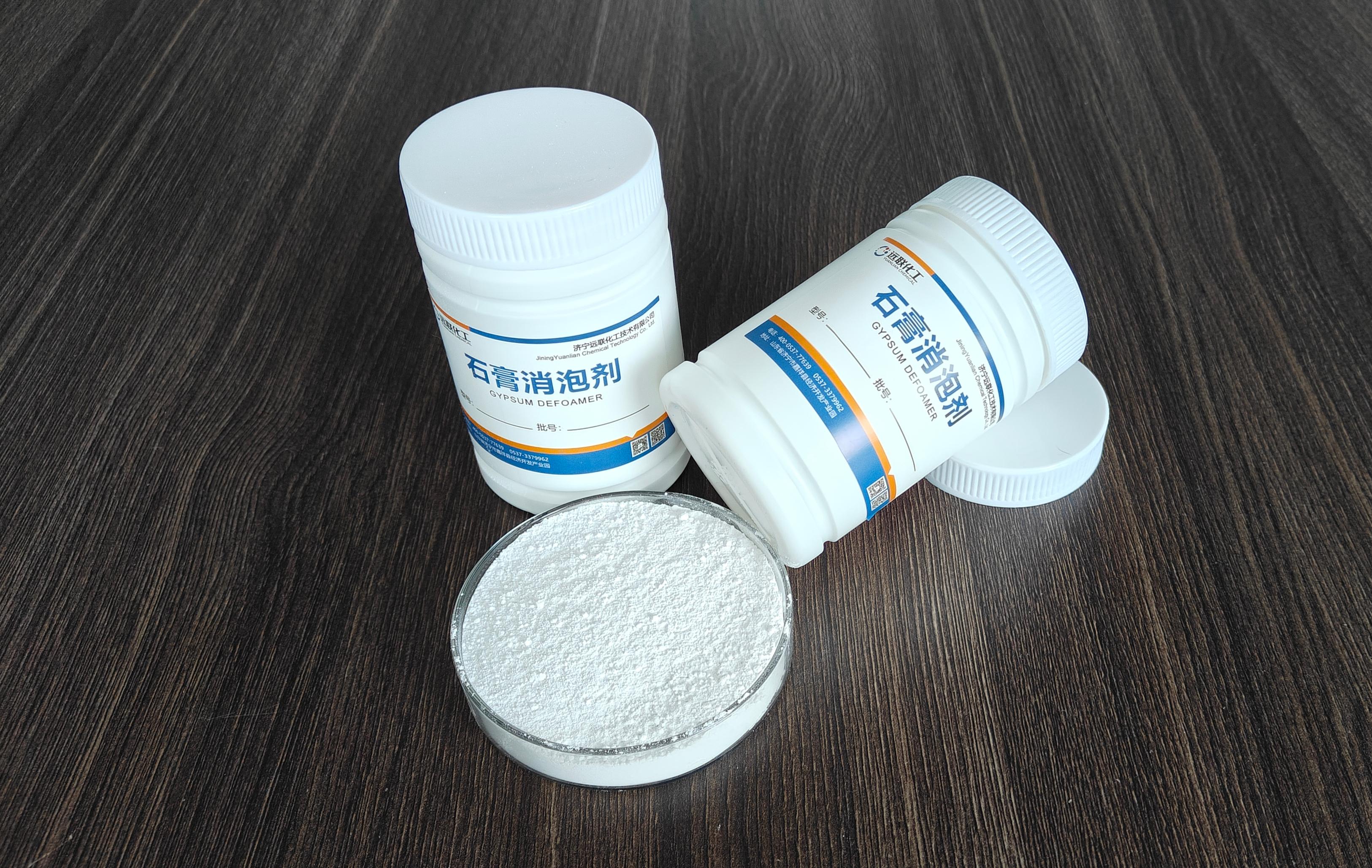
But not all air is bad. A small amount of evenly distributed, stable fine bubbles can actually improve freeze-thaw resistance and durability. The problem is uncontrolled, unstable large bubbles. These create the pinholes and structural weaknesses that cause callbacks and product failures.
This is where the defoamer comes in. Its job is to accelerate the collapse of those unstable large bubbles while leaving the beneficial fine bubbles intact. The right defoamer improves both surface quality and mechanical performance.
Selecting a Defoamer That Preserves Strength
Not all defoamers are created equal, and the choice has direct implications for compressive strength.
Powder Defoamers for Dry-Mix Systems
For gypsum-based screeds supplied as dry powders, powder defoamers are the standard choice. They are blended into the dry formulation and activate upon water addition. The best powder defoamers offer:
-
Rapid air release upon water contact, eliminating large bubbles before they become trapped
-
Compatibility with other powder additives like cellulose ethers and superplasticizers
-
Inert behaviour toward gypsum hydration—they should not accelerate or retard setting time
The active content and carrier material matter. Some defoamers use biodegradable oils on mineral carriers, others use mineral oils or silicone-based actives. The choice affects how the defoamer disperses and how much you need to use.
Dosage: Getting It Right
Dosage is where the balance between defoaming and strength is most critical.
Too little defoamer: Air remains trapped. Compressive strength suffers from micro-voids. Surface pinholes appear.
Too much defoamer: The defoamer itself can interfere with the gypsum matrix or with other additives like PCE superplasticizers, potentially affecting flowability and, in some cases, compressive strength.
Typical powder defoamer dosages range from 0.1% to 0.6% of total formulation, depending on the product and the level of air entrainment. For premium self-leveling applications, starting at the lower end and adjusting upward based on surface quality testing is the recommended approach.
Compatibility with Other Additives
Gypsum screed formulations are complex. They contain superplasticizers (polycarboxylate ethers), retarders, cellulose ethers, and often other performance additives. A defoamer that works in isolation may behave differently in the full formulation.
Superplasticizer synergy is critical. The defoamer must not compromise the flowability (slump) of the mortar. If the defoamer interacts negatively with the PCE, you lose the self-leveling performance that makes the product work.
Retarder compatibility matters too. Some defoamers can interfere with gypsum hydration. Quality defoamers are designed to be inert regarding the setting process. This is worth verifying with the supplier.
Measuring the Result
The ultimate test is the hardened screed. Two metrics matter most:
Surface quality. The finished surface should be smooth and free of pinholes or craters. This is visible and immediately assessable.
Compressive strength. Test cubes from the formulation should meet or exceed the target MPa. The same formulation without defoamer will have lower density and typically lower strength.
The best defoamers improve compressive strength by eliminating the large voids that weaken the structure. Some formulators report that effective defoaming increases wet density, which directly translates to higher compressive and flexural strength.
The Bottom Line
Balancing defoaming efficiency and compressive strength in gypsum screeds is not about compromise. It is about selecting the right defoamer at the right dosage and verifying compatibility with the full formulation.
The ideal defoamer eliminates unstable large bubbles, preserves the beneficial fine bubbles, and leaves the gypsum hydration process undisturbed. When it does all three, surface quality improves and compressive strength is maintained—or even enhanced.
Test defoamers in your full formulation, not in isolation. The interaction with PCE, retarders, and other additives will determine real-world performance. And always check the finished surface and the strength test results. That is where the balance is proven.
Yuanlian Chemical specializes in the production of polyaspartic acid (PASP),tetrasodium iminodisuccinate(IDS), GLDA, MGDA etc. with stable quality and excellent quantity!

Contact us