


-

- 2026-07-01
Maximizing Phase Stability in Concentrated Liquid Laundry Detergents via MGDA-Na3
The Stability Challenge in Concentrated Detergents
Anyone who has worked on concentrated liquid laundry detergents knows the frustration. You develop a high-performance formula, scale it up, and three weeks later the product separates. Cloudiness appears. Viscosity shifts. Crystals form at the bottom.
In concentrated liquid detergents—3x, 5x, or even 8x formulations—the challenge is amplified. Higher active ingredient concentrations mean less water to keep everything in solution. Calcium and magnesium ions from hard water can react with surfactants and builders, forming insoluble precipitates that destabilise the entire system.
Traditional chelating agents like EDTA address this, but they come with environmental baggage. They persist in the environment, and European regulators are tightening restrictions.
MGDA-Na3 (trisodium methylglycine diacetate) offers a different approach. It is a biodegradable chelating agent that maintains phase stability in concentrated liquid formulations without the environmental trade-offs.
Why Phase Stability Matters in Concentrated Systems
Compact liquid detergents are a growing segment across Europe. They save packaging, reduce transport emissions, and appeal to eco-conscious consumers. But they also create formulation challenges that standard liquids don't face.
Higher active ingredient concentrations mean the system is closer to its solubility limit. Metal ions, even at trace levels, can push the system past that limit. The result: phase separation, precipitation, or turbidity that makes the product look defective.
In transparent liquid detergents, precipitation is a visible problem. Any cloudiness or sediment signals to consumers that the product is compromised. For premium brands, maintaining clarity and stability throughout the product's shelf life is non-negotiable.
How MGDA-Na3 Stabilises Concentrated Formulations
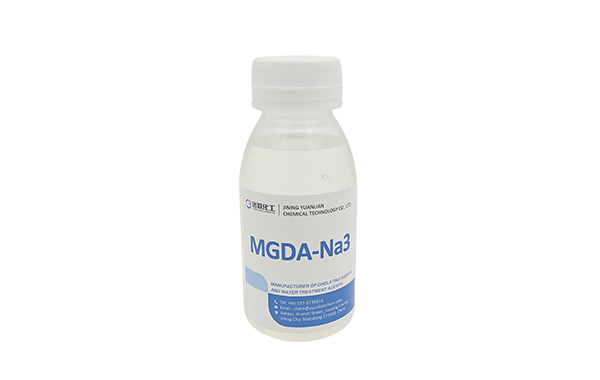
MGDA-Na3 works by forming stable, water-soluble complexes with calcium, magnesium, and other metal ions . By binding these ions, it prevents them from reacting with surfactants and builders to form insoluble precipitates.
High Solubility in Concentrated Systems
MGDA-Na3 is highly soluble across a wide pH range . In liquid formulations, it remains stable even at high active loads, preventing the crystallisation that can occur with other chelates in cold storage conditions . This matters for products distributed across diverse European climates, where temperature fluctuations during transport and storage are common.
Broad pH Tolerance
MGDA-Na3 performs effectively across pH 2 to 14, making it suitable for neutral and alkaline detergent formulations . In the alkaline conditions typical of laundry detergents, its chelating ability remains strong, ensuring hardness ions are sequestered regardless of formulation pH variations.
Temperature Stability
Concentrated liquids often face temperature fluctuations during storage and transport. MGDA-Na3 maintains stability at elevated temperatures, with documented performance at 100°C and above . This prevents the degradation that can trigger phase separation in warm warehouses or during hot-fill processing.
Compatibility with Surfactants
MGDA-Na3 has excellent compatibility with both anionic and non-ionic surfactants . Its small molecular structure and high polarity allow it to coexist with high concentrations of LAS, AES, and other common surfactant systems without causing layering or separation . This compatibility is essential for maintaining clarity in high-foaming liquid formulations.
The Preservation Advantage
MGDA-Na3 also contributes to formulation stability through a lesser-known mechanism. By chelating metal ions that microorganisms need for cell wall integrity, it weakens microbial defences and enhances the efficacy of preservatives . Studies have shown that MGDA-Na3 can help reduce preservative concentrations by 20–30% while maintaining antimicrobial protection .
For formulators, this means:
-
Reduced preservative load in finished products
-
Lower potential skin irritation from preservatives
-
Better shelf life without increasing preservative levels
-
Cost savings on preservative ingredients
Practical Formulation Considerations
Recommended concentration. In liquid laundry detergents, MGDA-Na3 is typically used at 0.2–1.0% active content for standard formulations, with higher levels (1.0–3.0%) in concentrated products .
Incorporation method. MGDA-Na3 blends easily into the aqueous phase. No heating is required. In liquid formulations, it dissolves completely and does not contribute to haze or precipitation .
Compatibility. MGDA-Na3 works with all common anionic, non-ionic, and amphoteric surfactants, as well as enzymes, preservatives, and fragrances. It also stabilises peroxide bleaches by chelating metal ions that would otherwise catalyse peroxide decomposition .
The Bottom Line
Concentrated liquid laundry detergents demand chelators that stay soluble at high active loads, tolerate temperature fluctuations, and prevent phase separation without compromising biodegradability. MGDA-Na3 delivers on all fronts.
It keeps formulations clear, prevents precipitation, and works across the pH and temperature range that modern detergents require. And it biodegrades completely—no persistence concerns, no regulatory headaches.
Yuanlian Chemical specializes in the production of polyaspartic acid (PASP),tetrasodium iminodisuccinate(IDS), GLDA, MGDA etc. with stable quality and excellent quantity!

Contact us