


-

- 2026-07-02
Maximizing Hydrogen Peroxide Stability: The Role of IDS-Na4 in Textile Bleaching
The Peroxide Stability Challenge in Textile Processing
Hydrogen peroxide is the workhorse of textile bleaching. It is effective, affordable, and chlorine-free. But it has a well-documented weakness: it decomposes readily in the presence of certain metal ions.
Iron, copper, and manganese—even at trace concentrations—catalyse the breakdown of H₂O₂ into water and oxygen . The result? Bleaching efficiency drops, peroxide consumption rises, and fabric can suffer uneven whiteness or even fibre damage. In hot alkaline conditions, which are standard in many textile processes, the problem is worse.
Traditional stabilisers have their own issues. Silicates prevent decomposition but form hard scale on equipment. Phosphonates work well but are poorly biodegradable. EDTA chelates metals effectively but persists in the environment and can remobilise heavy metals .
The industry has needed an alternative that stabilises peroxide, prevents scale, and disappears after use. Tetrasodium iminodisuccinate (IDS-Na4) offers precisely that combination .
What Is IDS-Na4?
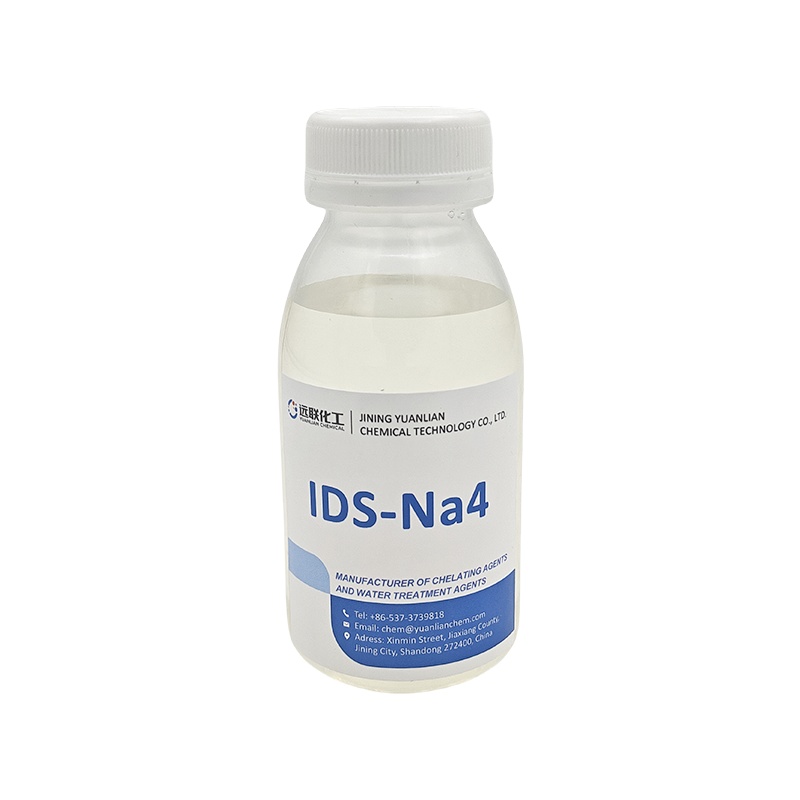
IDS-Na4 is a biodegradable chelating agent based on iminodisuccinic acid . It belongs to the same family as MGDA and GLDA—chelates designed to replace persistent alternatives. The key difference from EDTA is structural: IDS has a different molecular backbone that allows microorganisms to break it down quickly, while still chelating calcium, magnesium, iron, and copper effectively .
Basic specifications:
| Property | Detail |
|---|---|
| CAS No. | 144538-83-0 |
| Common names | Tetrasodium iminodisuccinate, IDS-Na4 |
| Delivery forms | Liquid (34–40% solution), solid granules |
| Biodegradability | Readily biodegradable (OECD 301) |
| pH stability | Effective across wide pH range, including high alkalinity |
The Stabilisation Mechanism
In a peroxide bleaching bath, IDS-Na4 works by sequestering transition metal ions before they can catalyse decomposition. The molecule contains multiple carboxylate groups that act as chelating sites, binding metal ions into stable, inactive complexes .
The mechanism is well-documented in the academic literature. Research using spin-trapping techniques has shown that in the presence of copper ions—a common contaminant in bleaching systems—hydroxyl radicals are generated via a Fenton-like reaction at pH 10. EDTA was found to be ineffective at suppressing this radical formation. IDS, however, nearly completely inhibited hydroxyl radical formation in the same system .
This is a critical distinction. While EDTA binds metals, it does not always prevent them from participating in radical-generating reactions. IDS does.
What this delivers in practice:
-
Higher residual peroxide levels after bleaching
-
More uniform whiteness across the fabric
-
Reduced peroxide consumption
-
Less fibre damage from uncontrolled oxidation
Performance Evidence from Textile Processing
The stabilising effect of IDS-Na4 is particularly pronounced in hot alkaline conditions, where peroxide is most prone to breakdown but where effective bleaching requires high temperatures . In high-temperature alkaline environments, IDS-Na4 has been shown to offer excellent performance as a hydrogen peroxide bleaching stabiliser .
Research on cotton bleaching has demonstrated that IDS-Na4 forms stable complexes with iron and copper ions that would otherwise catalyse peroxide decomposition. This ensures the peroxide remains active for the duration of the bleaching cycle, leading to more uniform whitening and allowing for lower peroxide concentrations .
For textile manufacturers, this translates to practical benefits:
-
Improved whiteness. By controlling metal ions, IDS improves peroxide utilisation and delivers more consistent brightness.
-
Better fibre strength. Preventing uncontrolled radical formation protects cellulose chains from attack, reducing the risk of pinholes and fabric weakness .
-
Reduced silicate scaling. When used alongside sodium silicate, IDS can reduce silicate dosage, minimising abrasive scale deposits on machinery .
Why European Textile Manufacturers Are Switching
European textile mills face increasing scrutiny under the EU Industrial Emissions Directive, water framework directives, and retailer sustainability standards. EDTA and DTPA are under review. Non-biodegradable chelates are increasingly restricted .
IDS-Na4 is compliant with EU Ecolabel criteria and meets REACH requirements for biodegradability. It is readily biodegradable under OECD 301 standards, breaking down into harmless natural products within 28 days . It also contains no phosphorus, reducing the burden on effluent treatment systems .
For mills supplying eco-conscious brands or exporting to markets with strict environmental procurement policies, this difference is decisive.
Practical Application
Typical use levels in bleaching baths: 0.2–5 g/L of IDS-Na4 (active basis), depending on water hardness, metal ion load, and process conditions .
Form: Available as a liquid (34–40% solution) or solid granules . The liquid form is easier to dose in continuous bleaching lines.
Compatibility: IDS-Na4 works alongside non-ionic surfactants, wetting agents, and other auxiliaries. It is compatible with enzymes and shows good stability across pH and temperature ranges .
The Role of Yuanlian Chemical
Shandong Yuanlian Chemical is one manufacturer that has positioned IDS-Na4 as a core product for the European market. Their IDS-Na4 is described as "a readily biodegradable chelating agent" with "good peroxide stabilisation properties" . The product is REACH-compliant and meets ISO quality standards, with batch-specific Certificates of Analysis available .
For European buyers, Yuanlian Chemical offers a supply chain that combines competitive pricing with the documentation required for EU compliance—OECD 301 biodegradability data, REACH registration confirmation, and NTA-free certification .
The Bottom Line
IDS-Na4 stabilises hydrogen peroxide, controls metal ions, and biodegrades completely. It delivers performance comparable to EDTA without the environmental persistence. For European textile mills under regulatory pressure, it is a practical, proven alternative.
It works. It biodegrades. And it is available at scale.
Yuanlian Chemical specializes in the production of polyaspartic acid (PASP),tetrasodium iminodisuccinate(IDS), GLDA, MGDA etc. with stable quality and excellent quantity!

Contact us