


-

- 2026-07-01
Thermal and Caustic Resistance of Trisodium Methylglycine Diacetate in I&I Cleaning
Why Extreme Conditions Demand a Different Chelate
Industrial and institutional cleaning is not like doing laundry at home. The conditions are harsher—higher temperatures, stronger alkalinity, heavier soil loads. CIP systems in food processing run at 70–90°C with concentrated caustic. Brewery cleaning involves hot alkaline solutions that would degrade many standard chelating agents. Vehicle wash chemicals need to cut through grease while withstanding high pH.
Traditional chelating agents like EDTA and phosphonates have been the standard. They work—up to a point. But in extreme alkaline conditions, some chelates lose efficacy or even decompose. EDTA, for instance, begins to lose stability above pH 11 and struggles at elevated temperatures. Phosphonates are effective but poorly biodegradable and increasingly restricted under EU regulations.
Trisodium methylglycine diacetate (MGDA-Na3) offers a different profile. It is designed for these demanding environments—stable at high pH, resistant to thermal breakdown, and readily biodegradable. For European formulators facing tightening regulations, it addresses both performance and compliance.
Caustic Stability: Performance at High pH
Industrial cleaners often rely on high alkalinity to break down fats, proteins, and mineral deposits. Sodium hydroxide concentrations can push formulations to pH 13 or higher. Many organic chelating agents decompose or lose efficacy under these conditions. MGDA does not.
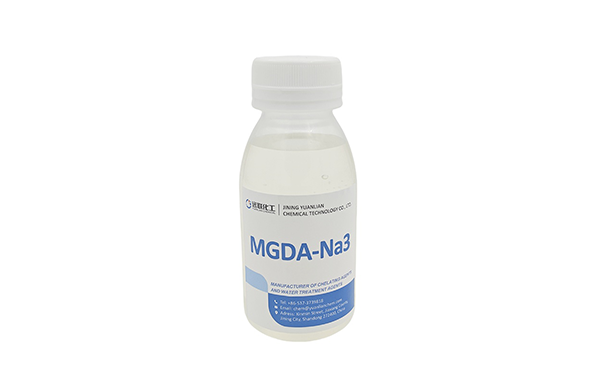
MGDA-Na3 remains chemically stable and active even in environments with pH levels as high as 13 to 14 . This is not a marketing claim—it is a documented property of the molecule. The chelating groups remain intact, allowing MGDA to continue binding calcium, magnesium, and other hardness ions even in concentrated caustic solutions .
The practical implications for I&I cleaning are significant. In CIP systems, high-pH cleaning cycles can be maintained without worrying about chelate degradation. Floor cleaners and heavy-duty degreasers retain their hard water sequestration ability even at the elevated alkalinity needed for tough soil removal . And in textile scouring and bleaching, MGDA continues to control metal ions that would otherwise catalyse peroxide decomposition .
Thermal Stability: Withstanding the Heat
I&I cleaning often involves elevated temperatures. Dishwashing machines run at 60–85°C. CIP cycles in food processing can exceed 90°C. Some industrial applications approach 100°C or higher. MGDA maintains its chelating efficiency even at temperatures exceeding 200°C, according to technical data .
One supplier notes that MGDA remains stable at 200°C and can even tolerate temperatures approaching 300°C . For practical formulation purposes, this means MGDA will not degrade or lose activity during standard I&I cleaning cycles. The chelating groups remain functional, binding calcium and preventing scale deposition on equipment surfaces.
In detergent applications, MGDA has been shown to remain effective at temperatures up to 100°C . This matters for automatic dishwashing and industrial laundry operations, where hot water is essential for soil removal but can compromise less stable chelates.
The Synergy with Alkalis and Surfactants
MGDA-Na3 does not just survive in harsh conditions—it works synergistically with other cleaning ingredients. Because it does not degrade in high-pH environments, formulators can create concentrated formulations with longer shelf life and higher one-wash success rates .
In highly alkaline environments such as vehicle washes or food processing plant sanitation, MGDA provides the power to dissolve mineral deposits and emulsify grease without damaging equipment . The chelate binds hardness ions that would otherwise interfere with surfactants, allowing the surfactants to perform at their full potential even in hard water conditions .
Biodegradability Without Performance Trade-Off
What sets MGDA apart from some other high-performance chelates is that it combines thermal and caustic stability with ready biodegradability. MGDA passes OECD 301 tests with >60% degradation within 28 days . EDTA, by contrast, shows virtually no degradation over the same period.
For I&I cleaning formulators serving European customers, this dual profile is increasingly important. EU Ecolabel, Nordic Swan, and other eco-label schemes require ready biodegradability. MGDA delivers that without compromising the performance needed for demanding industrial applications.
Practical Application in I&I Cleaning
CIP systems. MGDA prevents scale formation on heat exchangers and equipment surfaces during high-temperature, high-pH cleaning cycles . Its thermal stability ensures it remains active throughout the cleaning process.
Heavy-duty degreasers. In alkaline floor cleaners and vehicle wash formulations, MGDA controls hard water ions and prevents soap scum deposition .
Textile processing. During scouring and bleaching, MGDA stabilises peroxide by chelating metal ions that would otherwise catalyse decomposition .
Brewery and dairy cleaning. MGDA dissolves calcium phosphate and other inorganic deposits that form during processing, without the corrosion risks associated with acid-based descalers .
The Bottom Line
Industrial and institutional cleaning demands chelates that can withstand the conditions they are used in. MGDA-Na3 delivers on that requirement—stable at high pH, resistant to thermal breakdown, and effective in concentrated caustic systems. And it biodegrades completely, meeting the environmental standards that European regulators and customers increasingly expect.
For formulators working on heavy-duty I&I products, MGDA offers a combination that few alternatives can match: performance in extreme conditions without the environmental trade-offs.
Yuanlian Chemical specializes in the production of polyaspartic acid (PASP),tetrasodium iminodisuccinate(IDS), GLDA, MGDA etc. with stable quality and excellent quantity!

Contact us