



-

- 2026-07-06
Green Complexing Agents: A Structural Classification for Formulators
Why Classification Matters in Chelate Selection
For formulators working in detergents, industrial cleaning, or agricultural micronutrients, the choice of complexing agent is one of the most consequential decisions in product development. The right chelate determines how well your formulation performs in hard water, how stable your active ingredients remain, and whether your product meets increasingly stringent environmental standards.
The challenge is that the market now offers a growing range of biodegradable alternatives to traditional chelates like EDTA and DTPA. Understanding how these compounds are classified—by structure, denticity, and functional groups—helps formulators make informed choices without relying on marketing claims.
This guide provides a practical structural classification of green complexing agents, focused on what matters for formulation work.
What Makes a Chelate a Chelate
A chelate is a coordination compound where a multidentate ligand binds to a metal ion through two or more donor atoms, forming ring structures . The term comes from the Greek chelate—"claw"—because the ligand wraps around the metal ion like a claw .
Key concepts for formulators:
Denticity refers to the number of donor atoms a ligand uses to bind a single metal ion . Monodentate ligands (like ammonia or chloride) donate one electron pair. Polydentate ligands—including most complexing agents used in formulations—donate multiple pairs, forming more stable complexes .
Chelate ring size affects stability. Five- and six-membered rings are the most stable, which is why most effective chelating agents are designed to form rings of this size .
Stability constants (log K values) indicate how strongly a chelate binds a particular metal ion. Higher values mean stronger binding—but not always better performance, as the chelate must also release the metal at the right time for the application.
Structural Classes of Green Complexing Agents
Aminopolycarboxylates (APCs)
This is the most important class for detergent and cleaning applications. APCs contain amine nitrogen atoms and multiple carboxylate groups that coordinate with metal ions.
Traditional APCs (non-biodegradable):
-
EDTA (ethylenediaminetetraacetic acid) – hexadentate, binds through two amine nitrogens and four carboxylate oxygens . Very strong chelation but poorly biodegradable .
-
DTPA (diethylenetriaminepentaacetic acid) – octadentate, even stronger binding than EDTA.
Green APC alternatives:
-
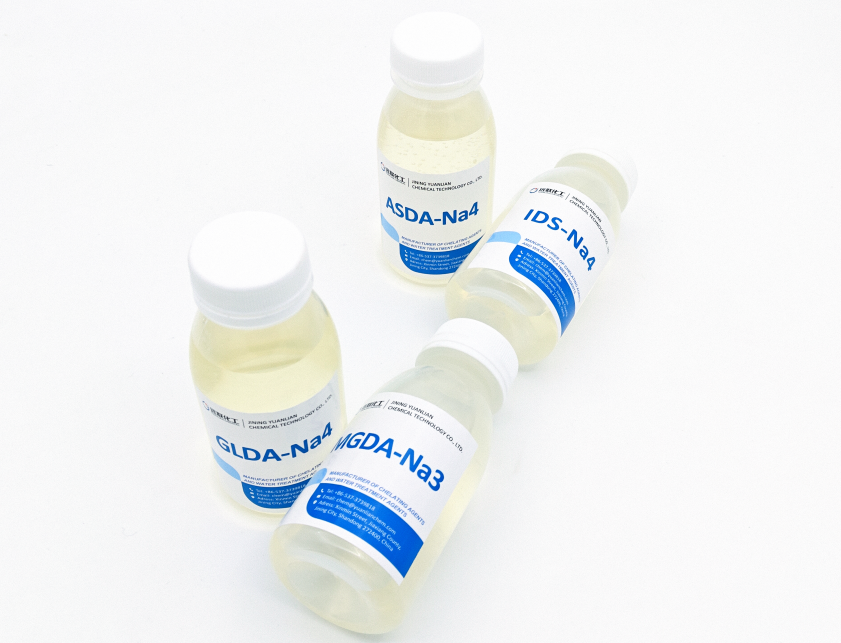
MGDA (methylglycinediacetic acid) – a low molecular weight APC based on an alanine backbone . Readily biodegradable (>60% in 28 days). Effective across pH 2–14.
-
GLDA (L-glutamic acid N,N-diacetic acid) – derived from glutamic acid, produced from renewable feedstocks . Over 60% degradation within 28 days .
-
IDS (iminodisuccinic acid) – a dicarboxylic acid-based chelate with a different backbone structure to EDTA. Studies show IDS degrades 4.5 times faster than EDTA . Offers good calcium binding and peroxide stabilisation .
Aminopolycarboxylate Structural Comparison
| Chelate | Molecular Weight | Biodegradability | Key Structural Feature |
|---|---|---|---|
| MGDA | ~271 | >68% (OECD 301) | Alanine backbone, tridentate? |
| GLDA | ~351 | >83% (OECD 301) | Glutamic acid backbone |
| IDS | ~337 | >80% (OECD 301) | Iminodisuccinate structure |
| EDDS | ~358 | >60% (OECD 301) | Ethylenediamine-disuccinate |
Other Green Chelate Classes
Polyaspartic acid (PASP) – a polymer rather than a small molecule. Contains peptide bonds and carboxyl groups that chelate metal ions. Biodegradable (OECD 301B) and used in agriculture and water treatment.
Citric acid and derivatives – naturally occurring, biodegradable, but weaker chelation than APCs. Used in lower-performance applications or as co-builders.
What the Structural Differences Mean in Practice
Binding Strength and Selectivity
The metal-binding affinity of green chelates follows a pattern. Studies on GLDA show its stability constant (log KML) is highest for Cu, followed by Fe(III), Ni, Zn, Cd, Fe(II), Mg, and Ca . This selectivity matters—if you are formulating for iron deficiency correction, you want a chelate that binds iron strongly. If you are softening water, calcium binding is what counts.
pH Performance
Chelate efficacy varies with pH. For IDS and GLDA complexes, sorption studies show maximum effectiveness at pH >6.0 . MGDA remains effective across a broader pH range (2–14), making it more versatile for formulations spanning acidic to highly alkaline conditions.
Biodegradability and Metal Complexes
One important nuance: the metal complex itself may degrade differently from the free chelate. Research shows that complexation with metals can increase the degradation rate of some chelates by up to 1.8-fold . For formulators, this means that biodegradability claims for the neat compound may not fully predict how the chelate behaves in the final product.
Selection Guide by Application
| Application | Recommended Chelate | Rationale |
|---|---|---|
| Laundry detergents (hard water) | MGDA, GLDA | Strong Ca/Mg binding, pH stability |
| Dishwashing (high pH, high temp) | MGDA | Thermal stability, scale prevention |
| Textile bleaching (peroxide stabilisation) | IDS, MGDA | Metal ion control, peroxide compatibility |
| Agriculture (micronutrient chelation) | IDS, GLDA, PASP | Biodegradability, Fe/Zn binding |
| Industrial descaling | IDS, GLDA | Scale removal at high pH |
The Bottom Line
Green complexing agents are not a single category—they represent a diverse family of structures with different strengths, pH profiles, and application fits. Understanding the structural classification helps formulators move beyond "biodegradable" as a label and select the chelate that actually matches the performance requirements of their system.
MGDA offers broad pH stability and thermal resistance. GLDA provides strong metal binding from renewable sources. IDS delivers good peroxide stabilisation and scale control. Each has its place. The key is matching the structure to the application.
Yuanlian Chemical specializes in the production of polyaspartic acid (PASP),tetrasodium iminodisuccinate(IDS), GLDA, MGDA etc. with stable quality and excellent quantity!

Contact us