


-

- 2026-07-06
Sustainable Chelating Agents for Extreme pH and High-Thermal Formulations: An Engineering Guide
The global shift toward green chemistry is no longer a marketing preference—it is a strict regulatory and operational mandate. In European industrial sectors, from industrial and institutional (I&I) cleaning to enhanced oil recovery and agricultural micronutrients, formulating stable products under aggressive conditions presents a unique challenge.
When a system exhibits extreme pH levels (below 2 or above 12) alongside high thermal loads, standard biodegradable chelating agents often fail due to hydrolysis, thermal decomposition, or loss of binding affinity.
This guide explores how to select the right sustainable chelating agent that satisfies European eco-label standards (such as the EU Ecolabel and Nordic Swan) while maintaining high performance under harsh conditions.
1. The Challenge of Harsh Environments on Green Chelates
Traditional phosphonates (like ATMP and HEDP) and synthetic aminopolycarboxylates (like EDTA) have historically been the backbone of heavy-duty chelation. However, EDTA’s poor biodegradability and phosphonates' contribution to eutrophication make them increasingly problematic under European environmental frameworks like REACH.
When substituting these with green alternatives, two primary degradation pathways must be mitigated:
-
Hydrolytic Instability: At extreme pH, the chemical bonds of many bio-based molecules undergo acid or base-catalyzed hydrolysis, rendering them inactive.
-
Thermal Decomposition: High temperatures accelerate kinetic degradation, causing the chelate to break down into smaller, non-chelating fragments, which often leads to unwanted precipitation.
2. Top-Performing Green Chelating Agents for Extreme Systems
To achieve optimal performance, formulators must match the specific binding constants and stability windows of modern green aminopolycarboxylates and polyamino acids.
| Chelating Agent | Chemical Name | Biodegradability | Optimal pH Range | Thermal Stability |
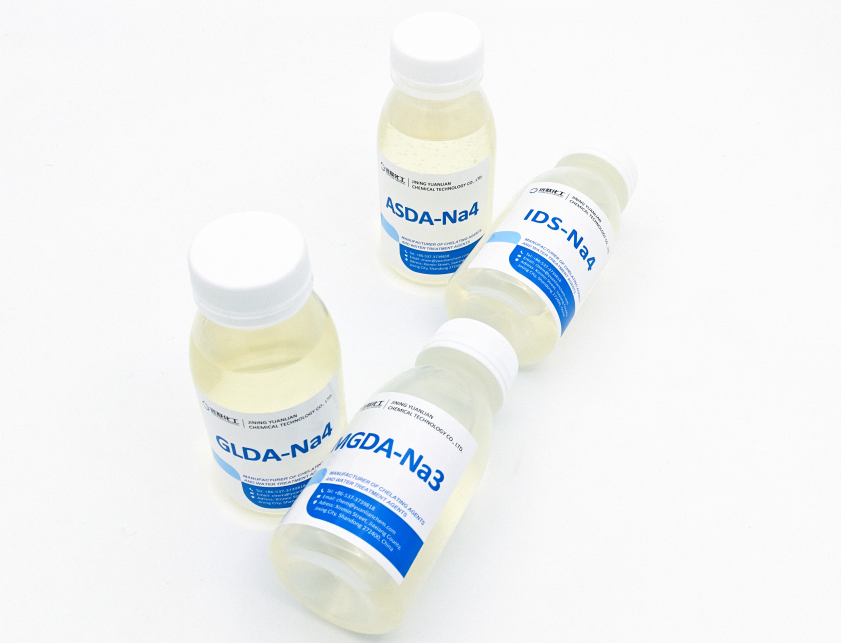
| GLDA | L-Glutamic acid N,N-diacetic acid, tetrasodium salt | Readily Biodegradable (OECD 301B) | 2 to 14 | Excellent (up to 150°C) |
| MGDA | Methylglycinediacetic acid, trisodium salt | Readily Biodegradable (OECD 301B) | 3 to 14 | High (up to 130°C) |
| IDS | Iminodisuccinate, tetrasodium salt | Readily Biodegradable (OECD 301E) | 4 to 11 | Moderate (up to 100°C) |
MGDA (Methylglycinediacetic acid)
MGDA is highly regarded for its exceptional performance in alkaline and high-temperature environments. Derived from alanine, it boasts a low molecular weight and strong binding affinity for $Ca^{2+}$ and $Mg^{2+}$ ions.
-
Best Suited For: High-alkaline industrial cleaning, automatic dishwashing detergents, and thermal process water treatment.
-
Performance Note: It remains highly stable at temperatures exceeding 100°C in highly alkaline liquors, outperforming traditional green alternatives.
GLDA (L-Glutamic acid N,N-diacetic acid)
Produced primarily from bio-based monosodium glutamate (MSG), GLDA offers the widest pH stability window among readily biodegradable chelates.
-
Best Suited For: Acidic descaling, oilfield acidification, and high-temperature surface treatments.
-
Performance Note: Unlike many alternatives, GLDA maintains high solubility and strong complexation capacity even at pH levels as low as 2, making it an excellent alternative to EDTA in acidic, high-heat applications.
3. Selection Matrix: Balancing pH, Temperature, and Ionic Strength
Choosing the correct sustainable chelate requires a deep look at the specific application parameters. Formulators should prioritize the following steps:
Evaluate the Conditional Stability Constant ($K'$)
The thermodynamic stability constant ($K$) changes drastically with pH. For instance, at a very low pH, hydrogen ions compete with metal ions for the binding sites of the chelating agent.
Ensure that the chosen chelate retains a sufficiently high conditional stability constant at your specific operating pH to prevent the target scale or metal stains from precipitating.
Assess Electrolyte Tolerance
Extreme pH systems often contain high concentrations of salts or caustic alkalis. GLDA exhibits significantly higher solubility in highly concentrated electrolyte solutions compared to MGDA, making it the preferred choice for concentrated liquid formulations.
Review Thermal Limits
If the process involves continuous thermal stress (e.g., pasteurization, geothermal processes, or textile dyeing), select a chelate that does not undergo decarboxylation. MGDA and GLDA retain their structural integrity far better than citric acid or gluconates under prolonged boiling or pressurized heating.
4. Compliance and Regulatory Alignment in Europe
Aligning with European market expectations means ensuring your raw materials support eco-certification.
-
REACH Registration: Ensure the chosen grade is fully registered and compliant with tonnage bands.
-
Biodegradability Credentials: Look for ingredients that achieve >60% biodegradation within 28 days via OECD 301B testing.
-
Renewable Carbon Index (RCI): Prioritize chelates with a high percentage of bio-based carbon to lower the overall carbon footprint of the finished product.
5. Conclusion
Replacing legacy chelating agents with green alternatives in extreme pH and high-thermal systems is entirely feasible with modern aminopolycarboxylates. By leveraging the high alkaline stability of MGDA or the broad pH flexibility and high solubility of GLDA, formulators can design high-performance, environmentally responsible products that meet the stringent demands of today's industrial sectors.
Yuanlian Chemical specializes in the production of polyaspartic acid (PASP),tetrasodium iminodisuccinate(IDS), GLDA, MGDA etc. with stable quality and excellent quantity!

Contact us