



-

- 2026-07-10
Understanding MGDA-Na3: The Next Generation of Biodegradable Chelating Agents
Regulatory pressure across Europe is accelerating the phase-out of phosphates and persistent chelating agents like EDTA. The EU Ecolabel for detergents explicitly prohibits EDTA and NTA, with major retailers in Germany, France, and the Nordic countries now refusing to accept new EDTA-based products. Formulators are caught between two requirements: maintain hard water softening efficiency and meet environmental compliance. Methylglycine diacetic acid trisodium salt—MGDA-Na3—offers a viable path forward.
Technical Profiles and Chelating Mechanism of MGDA-Na3
Core parameters. MGDA-Na3 (CAS 164462-16-2) has a molecular weight of 271.11 g/mol and a molecular formula of C₇H₈NNa₃O₆. Commercial liquid grades typically contain 39–41% active content with a pH of 10.0–12.0 (1% solution) and a density of approximately 1.30 g/cm³. Powder grades are available at ≥85% active content for solid formulations.
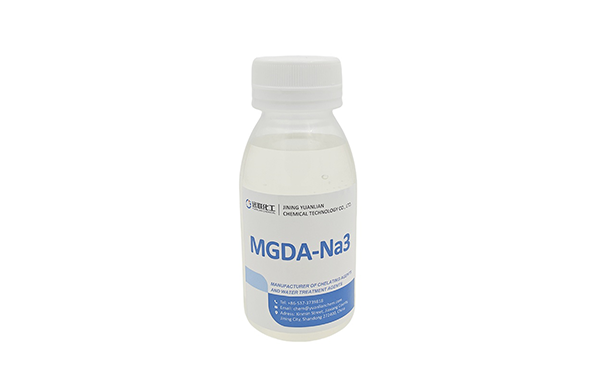
Chelation mechanism. As a multidentate ligand, MGDA binds metal ions through its three carboxylate groups and one tertiary amine. The conditional stability constants show a metal affinity order: Cu²⁺ > Fe³⁺ > Zn²⁺ > Mn²⁺ > Ca²⁺ > Mg²⁺ across pH 3–11. The calcium binding capacity reaches approximately 60 mg CaCO₃/g active, nearly matching EDTA's 300–320 mg range.
Environmental profile. MGDA is classified as readily biodegradable under OECD 301B, with 80% or more degradation within 28 days in standard wastewater treatment conditions. It breaks down without mobilising heavy metals in natural water bodies—a known risk with persistent chelants.
Key Technical Advantages Over Traditional Chelates
| Parameter | MGDA-Na3 | EDTA | NTA |
|---|---|---|---|
| Biodegradability (OECD 301) | Readily biodegradable (>60% in 28 days) | Not readily biodegradable (<1%) | Limited biodegradability |
| pH stability range | pH 7–12 (effective above 11) | pH 4–10 | pH 6–10 |
| Thermal stability | Effective above 100°C | Stable to 80°C | Limited above 70°C |
| Regulatory status | EU Ecolabel compliant | Prohibited for EU Ecolabel | Carcinogen concern (IARC Group 2B) |
| Calcium binding (mg CaCO₃/g) | 280–300 | 300–320 | ~250 |
High-pH performance. MGDA maintains calcium and magnesium binding capacity even at pH values above 11, where organic chelants like citrate and GLDA lose efficiency. This makes it particularly suited for automatic dishwashing detergents and alkaline industrial cleaners.
Compatibility with formulation systems. MGDA is compatible with surfactants, enzymes, and peroxide bleaching systems. It stabilises sodium percarbonate and sodium perborate without causing premature decomposition. In liquid detergents, it prevents the formation of insoluble calcium soaps that can deposit on fabrics and cause odour issues.
Dosage optimisation. Because of its high chelation efficiency per unit mass, formulators can often achieve equivalent performance at similar active replacement ratios—roughly 1:1 against EDTA in many applications. The lower molecular weight (271 vs 380 for EDTA tetrasodium salt) means more chelating sites per gram.
Primary Industrial Applications of MGDA-Na3
1. Institutional and industrial cleaning. Automatic dishwashing detergents represent the largest uptake sector. MGDA prevents filming and spotting on glassware in hard water—European manufacturers have confirmed side-by-side equivalence to EDTA in 20-cycle tests. In CIP systems, it dissolves existing calcium carbonate and phosphate scales while preventing new deposits.
2. Textile processing. MGDA prevents heavy metal ions (iron, copper, manganese) from interfering with dyeing processes. It sequesters metal ions that would otherwise catalyse oxidative degradation of fibres or alter shade development. The result is improved levelness and colour fastness without the environmental burden of persistent chelants.
3. Water treatment and scale inhibition. As a scale inhibitor, MGDA is effective in reverse osmosis systems, cooling towers, and boiler feed water. It converts insoluble metal salts and hydroxides into water-soluble complexes, making it suitable for cleaning old, dry calcium stains.
4. Personal care and home care. In liquid laundry detergents, MGDA improves detergency in hard water by preventing surfactant deactivation. It also functions as a preservative booster by chelating metals that would otherwise promote microbial growth. In cosmetics, typical usage rates are 0.1–0.2% to stabilise formulations and prevent metal-induced discolouration.
Strategic Selection: Factors to Consider for Your Formula
Form selection. Liquid MGDA-Na3 (40% active) is the preferred grade for large-scale liquid detergent production—it can be dosed directly without pre-dissolution and remains fluid down to -15°C. Powdered grades (>85% active) are better suited to tablet compression, where EDTA powder can be hygroscopic and difficult to process.
pH range. MGDA's performance drops below pH 6. For acidic formulations (descaling agents, acidic bathroom cleaners), GLDA or citrate may be more appropriate.
Cost assessment. MGDA raw material costs are higher than EDTA—approximately double per kilogram. However, in finished products where chelator content is 2–5% of total formula, the cost impact is typically 1–3%. For brands seeking EU Ecolabel or retailer certifications, this is an acceptable trade-off.
Supply chain sustainability. European buyers are increasingly scrutinising manufacturing processes. Suppliers with REACH compliance and demonstrable green chemistry credentials are preferred. The shift is not merely technical—procurement teams now evaluate the entire production chain, from raw material sourcing to waste management.
Technical Support and Next Steps
MGDA-Na3 addresses both the regulatory and performance requirements facing modern formulators. It is not merely a substitute for EDTA—in alkaline, high-temperature applications, it often outperforms the incumbent chemistry.
If you are reformulating to reduce EDTA dependency, or if specific hard water conditions require customised chelation data, contact our technical applications team for detailed Technical Data Sheets and application samples. We can advise on dosage optimisation, compatibility testing, and transition strategies for your specific product line.
Yuanlian Chemical specializes in the production of polyaspartic acid (PASP),tetrasodium iminodisuccinate(IDS), GLDA, MGDA etc. with stable quality and excellent quantity!

Contact us