



In industrial and institutional (I&I) cleaning, formulating stable, high-performance detergents for highly alkaline environments presents a persistent chemical challenge. High-pH systems—such as automatic dishwashing (ADW) detergents, heavy-duty bottle washers, CIP (Clean-in-Place) systems, and vehicle cleaners—frequently operate under conditions that promote rapid mineral scaling.
When hard mixing water containing calcium (Ca2+) and magnesium (Mg2+) ions encounters alkaline builders, the risk of calcium carbonate (CaCO3) precipitation increases dramatically. This scaling ruins mechanical equipment, clogs spray nozzles, leaves unsightly white films on surfaces, and drastically lowers cleaning efficiency.
Historically, phosphonates, polyacrylates, and EDTA were relied upon to suppress this precipitation. However, under modern European environmental frameworks (such as the EU Ecolabel criteria and strict limits on Critical Dilution Volume), non-biodegradable and phosphorus-heavy builders are being phased out.
To meet these strict environmental regulations while maintaining strong scaling control, formulators are increasingly turning to Trisodium Methylglycine Diacetic Acid (MGDA-Na3).
1. The Chemistry of Scaling in High-Alkalinity Environments
To control scale formation, it is helpful to look at the thermodynamic behavior of calcium carbonate at an elevated pH. In high-pH cleaning formulations (typically pH 10.0 to 13.0), the carbonate equilibrium shifts significantly, rapidly converting bicarbonate ions into reactive carbonate ions (CO32-).
When free Ca2+ ions from hard water contact this high concentration of CO32-, the solubility product (Ksp) of calcium carbonate is quickly exceeded, triggering instant nucleation and crystal precipitation:
Traditional carboxylic acids or low-molecular-weight polymers often struggle in these conditions. At high temperatures and high pH, their binding constants diminish, or they suffer from chemical degradation, leading to uninhibited crystal growth.
2. The Chelation Dynamics and Stability of MGDA-Na3
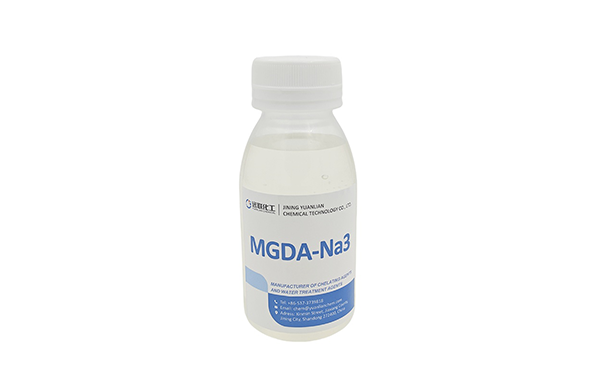
Trisodium MGDA is an advanced, aminopolycarboxylate-based chelating agent designed specifically to withstand harsh chemical environments. Its molecular structure features three carboxyl groups and a central nitrogen atom, enabling it to form a highly stable, water-soluble, claw-like ring structure around polyvalent metal ions.
High-pH Complex Stability
The strength of a chelating agent is determined by its stability constant (log K). MGDA-Na3 maintains a remarkably high stability constant for calcium (log K ≈ 7.0) across a broad pH range, remaining fully functional even at a pH above 12.0.
Unlike older alternatives, MGDA out-chelates carbonate ions for available Ca2+, effectively preventing the initial formation of CaCO3 crystal seeds.
Thermal and Hydrolytic Resistance
Industrial cleaning cycles often utilize high thermal energy (60°C to 90°C) to break down heavy greases. MGDA-Na3 exhibits excellent thermal and hydrolytic stability, ensuring it does not decompose or lose complexation capacity during hot washing or long-term concentrate storage.
3. Supply Chain Security and Upstream R&D: Yuanlian Chemical
For large-scale European detergent blenders and chemical distributors, matching raw material efficacy with strict manufacturing consistency is crucial. Yuanlian Chemical, an established manufacturer specializing in high-purity, green chemistry chelating agents, supports the global I&I cleaning market with an advanced production and technical infrastructure:
- Advanced High-Purity Synthesis: Yuanlian Chemical utilizes automated synthesis lines to manufacture premium MGDA-Na3 liquid and powder options. This precise processing ensures minimal unreacted raw material residues (like NTA or IDA) and excellent batch-to-batch uniformity, facilitating straightforward European REACH dossier management.
- Dedicated Application Testing: The company maintains specialized application laboratories equipped to evaluate chelation values, turbidity curves, and calcium carbonate binding capacities under diverse water hardness benchmarks. This enables their technical team to assist formulators in optimizing exact dosage requirements.
- Reliable Global Delivery: Operating from scalable, compliant production facilities, Yuanlian Chemical guarantees stable supply paths to international ports, providing industrial blenders with consistent inventory security.
4. Formulation Benefits in Dry-Mix and Liquid Systems
Integrating high-purity MGDA-Na3 into professional cleaning systems offers multiple chemical and physical advantages:
Synergy with Bleaching Systems
In commercial laundering and automatic dishwashing, sodium percarbonate or sodium perborate are commonly used for stain removal. MGDA-Na3 does not trigger premature hydrogen peroxide breakdown, keeping bleaching systems highly stable and effective during storage.
Excellent Scale Dissolution Rates
Beyond preventing new precipitation, MGDA-Na3 can actively dissolve existing scale buildup. Its fast chelation kinetics allow it to gradually strip calcium ions away from older CaCO3 deposits, helping to keep industrial machinery clean during routine use.
Pristine Surface Finishes
By eliminating calcium carbonate micro-crystals, MGDA-Na3 prevents the formation of white streaks and water spots on glassware, ceramics, and stainless steel, ensuring a spotless, professional finish.
5. Technical Comparison: Chelation Value and Compliance
Evaluating MGDA-Na3 against traditional alternatives highlights its performance advantages in modern commercial formulations:
| Chelating Agent | Chelation Value (mg CaCO3/g active) | Biodegradability (OECD 301B) | Stability at pH > 11 | Regulatory Status in Europe |
|---|---|---|---|---|
| EDTA-Na4 | ~260 | Poor (<20% in 28 days) | High | Stricter usage restrictions |
| STPP | ~200 | N/A (Mineral) | Poor (Hydrolyzes to orthophosphate) | Banned/Highly restricted in detergents |
| Citric Acid | ~220 (Highly pH dependent) | Readily Biodegradable | Poor | Weak chelation at elevated pH |
| Yuanlian Chemical MGDA-Na3 | ~290 | Readily Biodegradable (>60% in 28 days) | Excellent | Fully compliant with EU Ecolabel & REACH |
6. Conclusion
Preventing calcium carbonate precipitation in high-pH cleaning systems requires a careful balance of heavy-duty chelation, thermal stability, and strict environmental compliance. Trisodium MGDA effectively resolves this challenge by providing high calcium-binding efficiency at elevated pH levels while remaining fully biodegradable. Supported by the advanced manufacturing capabilities, rigorous quality control, and dedicated technical services of Yuanlian Chemical, detergent formulators can confidently design high-performance, eco-compliant cleaning products that fully meet the technical demands of the modern European marketplace.

Contact us