


-

- 2026-07-10
Elevating Detergent Performance: The Role of MGDA-Na3 in Sustainable Formulations
European regulators are tightening the screws. The EU Ecolabel criteria for dishwasher detergents explicitly limit total phosphorus content to 0.15–0.50 g per wash depending on water hardness . Phosphates are effectively banned in most home care applications. EDTA, once the industry workhorse, has come under sustained pressure for its persistence in the environment. Meanwhile, retailers across Germany, France, and Scandinavia are demanding "EDTA-free" claims on shelves.
The formulator faces a practical problem: remove the traditional chelating agents and hard water performance collapses. Calcium and magnesium ions deactivate surfactants, deposit on fabrics and glassware, and shorten product shelf life. Methylglycine diacetic acid trisodium salt—MGDA-Na3—offers a path through this regulatory maze without sacrificing cleaning efficacy.
Solving the Top 3 Hard Water Challenges in Home Care Formulas
Detergent precipitation. Anionic surfactants—LAS, AES, soap—form insoluble salts with calcium and magnesium in hard water. This "calcium soap" precipitates out of solution, reducing available surfactant concentration and depositing on fabrics as a greasy, malodorous residue. MGDA forms stable water-soluble complexes with Ca²⁺ and Mg²⁺, preventing this precipitation before it occurs . The calcium chelation capacity reaches approximately 60 mg CaCO₃ per gram active .
Fabric encrustation. With repeated washing, calcium salts accumulate in fabric fibres. The result: stiff, harsh-feeling textiles with diminished colour brightness. MGDA addresses this by maintaining calcium in solution throughout the wash cycle. In heavy-duty liquid detergents and soap-based formulations, it prevents calcium soap redeposition .
Spotting and filming. In automatic dishwashing, hard water leaves a white haze on glassware and cutlery. The problem becomes more acute with rinse-aid dosage and high-temperature drying cycles. MGDA's high complexation constants—maintained even at temperatures above 100°C—allow it to sequester calcium throughout the full wash cycle. Independent tests confirm MGDA-based phosphate-free dishwasher formulations deliver rinsing efficiency and stain removal comparable to traditional systems .
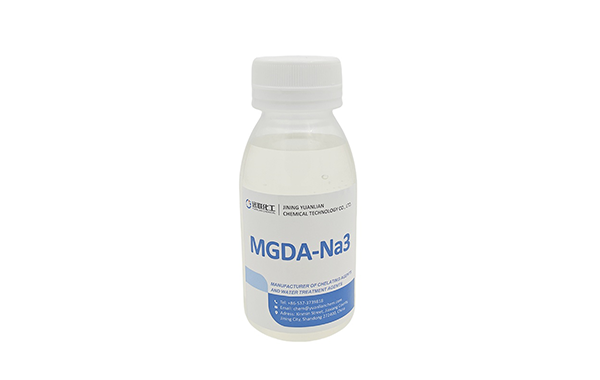
Performance Comparison: MGDA-Na3 vs. Citric Acid vs. EDTA
| Parameter | MGDA-Na3 | Citric Acid | EDTA |
|---|---|---|---|
| pH stability range | 2–14 | 5–8 | 4–10 |
| Performance at pH > 10 | Retains >90% chelation | Drops sharply | Retains ~80% |
| Biodegradability (OECD 301B) | Readily biodegradable (>80% in 28 days) | Readily biodegradable | Not readily biodegradable (<1%) |
| Calcium binding (mg CaCO₃/g) | 280–300 | ~150 | 300–320 |
| Thermal stability | Stable >100°C | Degrades above 70°C | Stable to 80°C |
| Surfactant compatibility | Excellent | Good (pKa issues at high pH) | Excellent |
Alkaline stability. Citrate is the first alternative many formulators test. It is readily biodegradable and widely available. But in high-pH liquid laundry detergents and dishwash tablets—typically pH 10–11—citrate's chelation efficiency drops dramatically. The carboxylic groups lose protonation, reducing metal-binding capacity. MGDA retains its calcium and magnesium binding capacity even at pH values above 11 . This stability is why MGDA has become the preferred builder in automatic dishwashing formulations, where alkalinity is essential for protein and starch removal.
Solubility and concentration. The shift toward concentrated detergents—pods, tablets, and high-density liquids—requires ingredients that remain soluble at high active levels. MGDA liquid grades (40% active content, pH 10–12, density 1.30 g/cm³) remain fluid down to -15°C and are fully miscible in concentrated surfactant systems . EDTA salts, by contrast, can precipitate in high-electrolyte systems, causing cloudiness and sediment.
Bleach stability. Oxygen bleach systems—sodium percarbonate, sodium perborate—are sensitive to metal ion catalysis. Iron, copper, and manganese ions accelerate peroxide decomposition, shortening shelf life and reducing bleaching efficacy. MGDA complexes these heavy metal ions effectively (copper chelation: 96 mg/g; iron: 84 mg/g) , stabilising the bleach system without the persistence concerns of EDTA.
Recommended Application Guidelines for Formulators
Automatic dishwashing detergents (ADWD). MGDA serves as the core builder in phosphate-free tablets, powders, and liquid formulations. It prevents spotting and filming, removes tea and starch stains, and enhances rinsing efficiency . For multifunctional products, MGDA can be combined with polymers and enzymes to address soil removal and scale prevention simultaneously .
Heavy-duty liquid laundry detergents. In low-temperature (20–30°C) and short-cycle wash modes, MGDA's small molecular size enables rapid chelation—critical when contact time is limited . It prevents surfactant deactivation in hard water, improving detergency across a range of soil types, including grease, blood, and protein stains . Colour care benefits are also documented: MGDA prevents metal-catalysed dye degradation and maintains whiteness across multiple wash cycles .
Personal care applications. In clear soaps, shampoos, and body washes, MGDA functions as a trace metal stabiliser. It prevents rancidity and colour change in formulations containing natural oils or botanical extracts . The low toxicity profile and skin compatibility make it suitable for products marketed to sensitive-skin consumers .
Sourcing and Supply Chain Considerations for Scale Production
Liquid vs. powder. For liquid detergent production, direct metering of liquid MGDA-Na3 (40% active content) eliminates dusting risks, simplifies pumping and blending, and reduces energy consumption compared to dissolving powders. For tablet compression or dry-blend applications, powder grades (≥85% active) are available .
Supply chain reliability. Technical performance alone does not guarantee a smooth scale-up. Formulators should verify supplier capabilities for consistent product quality: low free amino acid residuals, clear colour, and minimal NTA content (typically <0.2%) . European buyers should also confirm full REACH registration and compliance with Ecolabel criteria .
Cost-per-wash optimisation. While MGDA raw material costs are higher than EDTA, the dosage efficiency and multi-functional benefits often offset the difference. At typical inclusion rates of 2–5% in detergent formulations, the cost impact is modest relative to the performance gains and regulatory compliance achieved.
Technical Cooperation and Formulation Support
Moving to greener formulations no longer means compromising cleaning performance. MGDA-Na3 demonstrates that environmental compliance and high detergency can be achieved in the same package.
Our applications laboratory supports home care and personal care manufacturers in optimising formulations for specific water hardness conditions and surfactant systems. If you are reformulating to reduce EDTA dependency or need chelation data tailored to your raw material compatibility, contact our technical team for formulation reference guides and experimental samples.
Yuanlian Chemical specializes in the production of polyaspartic acid (PASP),tetrasodium iminodisuccinate(IDS), GLDA, MGDA etc. with stable quality and excellent quantity!

Contact us