


-

- 2026-07-13
Sustainable Chelation: Why MGDA-Zn is Replacing EDTA Zinc in European Formulations
European regulators are accelerating the phase-out of persistent chelating agents. The EU Ecolabel for detergents explicitly prohibits EDTA and NTA, with major retailers across Germany, France, and the Nordic countries now refusing to accept new EDTA-based products . For agricultural applications, the EU Fertilising Products Regulation (2019/1009) sets clear criteria for chelating agents, requiring stability at pH 7 and 8 for at least three days . While EDTA remains on the authorised list, the direction of travel is clear. Agricultural use of EDTA bypasses wastewater treatment systems, eliminating opportunities for capture and recycling .
Formulators are caught between two requirements: maintain metal stabilisation efficiency and meet environmental compliance. MGDA-Zn offers a viable path forward.
1. The Regulatory Shift in Europe's Chemical Landscape
The regulatory framework across Europe is reshaping the chelating agent market. The EU Green Deal and associated chemical regulations are driving demand for raw materials that meet stringent eco-label criteria.
Key regulatory drivers:
-
EU Detergents Regulation (EC 648/2004) amendments require phosphorus content limits and restrict persistent chelating agents
-
EU Fertilising Products Regulation (2019/1009) defines stability requirements for chelating agents in fertiliser formulations
-
REACH compliance is now a baseline requirement for import into the European Economic Area
-
Retailer procurement policies - major European supermarket chains increasingly demand proof of sustainability claims
The European chelated micronutrient market reflects this shift, projected to grow from USD 0.71 billion in 2025 to USD 1.00 billion by 2030, with high-value horticultural crops driving the most technically demanding segment .
2. Understanding MGDA-Zn: Molecular Structure and Stability
Core Parameters
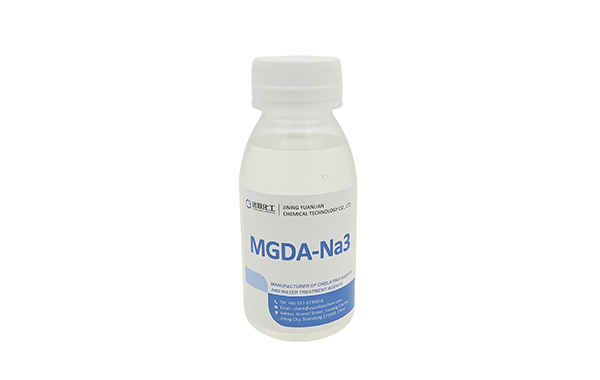
MGDA (methylglycinediacetic acid, trisodium salt) is an amino-acid-based chelating agent with a molecular weight of 271.1 g/mol . Its structure is built around alanine—a natural amino acid. The zinc chelate is formed by reacting MGDA-Na₃ with a zinc source, yielding a water-soluble complex that remains stable across a wide operating window.
Chelation Mechanism
As a multidentate ligand, MGDA binds zinc ions through its three carboxylate groups and one tertiary amine. The relative stability of MGDA-metal complexes follows the order: Sn²⁺ > Fe³⁺ > Cu²⁺ > Zn²⁺ . The formation of ML and MLOH species has been demonstrated through potentiometric measurements and isothermal titration calorimetry .
Thermodynamic data for Zn-MGDA complex:
-
Enthalpy change at infinite dilution: +8.7 kJ mol⁻¹ (endothermic)
-
Entropic contribution to stability is predominant for all MGDA-metal complexes
pH and Thermal Stability
MGDA maintains zinc chelation across a wide pH range from 2 to 13.5, with complexes remaining stable even at temperatures up to 100°C . This wide stability window is particularly relevant for:
-
Alkaline detergent systems - pH 10–11 automatic dishwashing formulations
-
Calcareous soil conditions - common across Southern Europe where pH often exceeds 7.5
-
Recirculating hydroponic systems - where pH drifts upward over time
3. Key Applications: Where MGDA-Zn Excels
Sustainable Agriculture & Biostimulants
MGDA-Zn addresses the core challenge of delivering zinc to crops in calcareous soils where phosphate and carbonate ions would otherwise precipitate conventional zinc sources .
Bioavailability advantages:
Studies have demonstrated that MGDA-Zn provides reliable zinc availability indices for maize in calcareous soils. Zinc uptake by maize showed correlations of r = 0.86 (P < 0.05) with Zn extracted by 0.05 M MGDA for 1 hour—stronger than the r = 0.77 correlation achieved with DTPA extraction . This suggests MGDA achieves better prediction of plant-available zinc.
Performance vs. EDTA-Zn:
Research on phytoextraction from contaminated calcareous soils showed that at 8 mmol kg⁻¹ application levels, Zn uptake by maize shoots increased from 100.9 mg plant⁻¹ in control to 798.9 mg plant⁻¹ with MGDA, compared to 530.4 mg plant⁻¹ with EDTA . Additionally, water-extractable—and thereby potentially leachable—Zn in post-harvest soil was considerably greater with EDTA than with MGDA, indicating lower environmental mobility risk with the biodegradable alternative .
Practical grower benefits:
-
15–20% reduction in total zinc input reported in recirculating systems
-
Cleaner irrigation lines and fewer clogged emitters
-
Iron remained fully soluble for entire crop cycles with MGDA-Fe
Eco-Labeled Detergents & Industrial Cleaning
MGDA-Zn serves dual functions in automatic dishwashing (ADW) and industrial cleaning formulations: zinc protection against glass corrosion and scale prevention through MGDA chelation.
Glass corrosion inhibition:
Machine dishwashing causes glass corrosion through multiple mechanisms: microscopic fine cracks, general hazing, and roughening that renders affected glass unattractive . Patent literature identifies that zinc salts combined with certain polymers provide effective glass corrosion inhibition .
Formulations containing:
-
(A) 1–50% by weight MGDA or GLDA salts
-
(B) 0.01–0.4% by weight zinc salt (as zinc)
-
(C) 0.001–0.045% by weight ethyleneimine homo- or copolymer
have been proposed as dishwashing compositions that effectively reduce glass corrosion .
4. Comparative Analysis: MGDA-Zn vs. Traditional Chelates
| Characterization | MGDA-Zn | EDTA-Zn | Zinc Citrate |
|---|---|---|---|
| Biodegradability (OECD 301B) | Readily biodegradable (>60% in 28 days) | Poor / Persistent (<1% degradation) | Biodegradable |
| pH stability range | Wide (pH 2–13.5) | Wide (pH 4–10) | Narrow (precipitates in alkaline) |
| Thermal stability | Stable >100°C | Stable to 80°C | Limited above 70°C |
| Regulatory risk in EU | Safe / Preferred | High risk / Restricted | Safe |
| Zinc leaching efficiency from sludge | 94.1% ± 4.5% | Lower than MGDA | Variable |
| Soil Zn bioavailability correlation (r value) | r = 0.86 | r = 0.77 (DTPA extractable) | Lower |
Zinc leaching efficiency:
Research comparing MGDA with EDTA for heavy metal extraction from sewage sludge showed that MGDA exhibited higher Zn leaching efficiency than EDTA under the same pH and dosage conditions. Maximum Zn leaching efficiency reached 94.1% ± 4.5%, with Zn distribution transformed from organically bound fraction to soluble fraction upon MGDA addition .
Soil phytoextraction comparison:
MGDA at 8 mmol kg⁻¹ achieved 798.9 mg plant⁻¹ zinc uptake in maize shoots, compared to 530.4 mg plant⁻¹ with EDTA at the same dosage . The biodegradable alternative enhanced zinc phytoextraction while leaving lower post-harvest water-extractable residues—a critical distinction for groundwater protection .
5. Aligning with Global Green Supply Chains
The shift from EDTA to MGDA-based chelates is not merely a technical decision—it requires supply chain reliability and documented compliance.
Supply chain considerations for European buyers:
-
REACH registration - MGDA is fully REACH-registered for import and use within the European Economic Area
-
OECD 301B documentation - readily biodegradable classification must be verified with certificate of analysis
-
Batch-to-batch consistency - colour clarity and low free amino acid residuals are essential for preserving end-product quality consistency
Manufacturing process maturity:
MGDA synthesis involves condensation of L-glutamic acid with monochloroacetic acid. Reaction temperature and residence time directly influence by-product formation—including cyclic GLMN impurity. Suppliers with automated continuous-flow synthesis and multi-stage purification deliver consistent purity, with free monomer residuals well below industry averages .
Product form considerations:
-
Liquid grade (40% active) - preferred for large-scale liquid detergent production; can be dosed directly without pre-dissolution; remains fluid down to -15°C
-
Granule grade (78–81% active) - suitable for solid fertiliser blends and tablet compression
6. Conclusion & Technical Consultation
MGDA-Zn addresses both the regulatory and performance requirements facing European formulators in agriculture, detergents, and industrial cleaning. It demonstrates that environmental compliance and technical performance can be achieved in the same package.
The case for MGDA-Zn:
-
Readily biodegradable under OECD 301B—meets EU Ecolabel criteria
-
Stable across pH 2–13.5—outperforms citrate and matches EDTA in alkaline conditions
-
Provides zinc bioavailability comparable to EDTA in calcareous soils
-
Demonstrates higher zinc leaching efficiency than EDTA in environmental remediation applications
-
Supports glass corrosion inhibition in automatic dishwashing formulations
For detailed technical data sheets (TDS), stability curves, or sampling for formulation trials, contact our technical team.
Yuanlian Chemical specializes in the production of polyaspartic acid (PASP),tetrasodium iminodisuccinate(IDS), GLDA, MGDA etc. with stable quality and excellent quantity!

Contact us