


-

- 2026-07-13
Advanced Chelation: Overcoming Hard Water Challenges with Biodegradable MGDA-Mg
European regulators have made their position clear. The EU Detergents Regulation (EC 648/2004) amendments require phosphorus limits in household cleaners, and persistent chelating agents like EDTA face increasing restrictions across multiple sectors . For formulators working in agriculture and industrial cleaning, the challenge is specific: maintain magnesium availability in high-pH or hard water conditions while meeting the EU's sustainability criteria.
Magnesium sits at the centre of the chlorophyll molecule. Without adequate plant-available magnesium, photosynthesis slows, yields drop, and crop quality suffers. In calcareous soils across Southern Europe—where pH often exceeds 7.5—conventional magnesium sources precipitate as insoluble carbonates or phosphates before roots can access them. In automatic dishwashing formulations, hard water calcium and magnesium ions deactivate surfactants, leaving spotting and filming on glassware .
MGDA-Mg offers a technical path through both problems.
1. The Critical Need for Sustainable Magnesium Vehicles in Europe
The regulatory trajectory in Europe is unambiguous. The EU Green Deal, the Circular Economy Action Plan, and REACH revisions are driving demand for raw materials that meet stringent eco-label criteria. France's PFAS ban, the updated Toy Safety Regulation, and the General Product Safety Regulation (GPSR) all reflect a broader trend toward restricted substances and mandatory biodegradability assessments .
EDTA-Mg faces particular scrutiny. It persists in the environment—OECD 301B degradation rates below 1% in 28 days—and bypasses wastewater treatment systems in agricultural applications. When applied to soil, EDTA-Mg does not break down; it accumulates, mobilising heavy metals and creating secondary environmental risks .
For European buyers, the compliance checklist now includes:
-
OECD 301B readiness - readily biodegradable classification (>60% degradation in 28 days)
-
REACH registration - full compliance for import and use within the EEA
-
Ecolabel compatibility - EU Ecolabel, Nordic Swan, and Blue Angel criteria
-
Traceability - documented supply chain from raw material to finished product
The European chelated micronutrient market reflects this shift, with biodegradable alternatives gaining share at the expense of persistent chelates .
2. Chemical Performance: Why MGDA-Mg Excels in Hostile Environments
Core Parameters
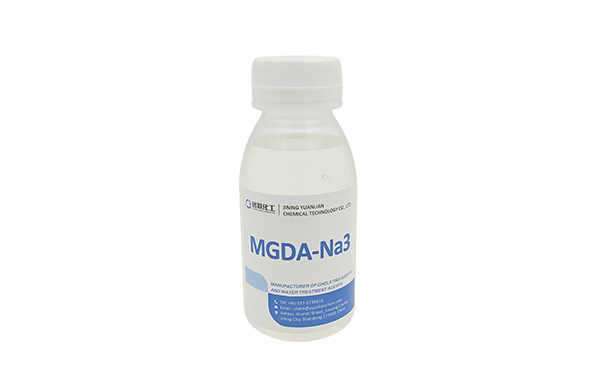
MGDA (methylglycinediacetic acid, trisodium salt) has a molecular weight of 271.17 g/mol and a molecular formula of C₇H₈NNa₃O₆ . The magnesium chelate is formed by reacting MGDA-Na₃ with a magnesium source, yielding a water-soluble complex that remains stable across a wide operating window.
Commercial liquid grades contain 40% active content, with density of 1.30 g/cm³ and pH (1% solution) of 10.0–12.0 .
Chelation Mechanism
As a multidentate ligand, MGDA binds magnesium ions through its three carboxylate groups and one tertiary amine. The conditional stability constant for Mg²⁺ is lower than for calcium or iron, but the key performance metric is not the absolute binding strength—it is the selectivity and availability in competitive environments.
MGDA's magnesium binding capacity reaches approximately 35 mg Mg²⁺/g on a dry basis . Citrate, by comparison, binds magnesium less effectively above pH 8 because the carboxylic acid groups lose protonation, reducing metal-binding capacity. EDTA maintains higher absolute binding but carries an environmental penalty that is increasingly unacceptable in European markets.
pH Stability and Temperature Tolerance
MGDA maintains chelation performance across pH 2–12, with no precipitation of the magnesium complex under alkaline conditions . This is critical for:
-
Calcareous soils - pH often exceeds 7.5; citrate precipitates, MGDA remains available
-
Alkaline detergent systems - pH 10–11 in automatic dishwashing; MGDA prevents calcium and magnesium from deactivating surfactants
-
High-temperature processes - stable >100°C; suitable for CIP cleaning and industrial water treatment
The distinction from magnesium citrate is worth noting. Citrate forms relatively weak complexes with magnesium, and in hard water or high-pH systems, magnesium citrate dissociates and precipitates as magnesium carbonate or phosphate. MGDA-Mg stays in solution, maintaining bioavailability and chelation activity.
3. Cross-Industry Applications: Tailored for European Compliance
Next-Generation Crop Nutrition & Biostimulants
Magnesium is the central atom of chlorophyll—without it, photosynthesis cannot proceed. European horticulture, particularly protected cropping in the Netherlands, Spain, and Italy, depends on consistent magnesium delivery to maintain crop quality and yield.
Why MGDA-Mg for foliar and fertigation:
-
Penetrates the leaf cuticle - small molecular size (271 g/mol) facilitates uptake through stomata and cuticular pathways
-
Avoids soil fixation - in calcareous soils, magnesium from sulphate or oxide sources precipitates as insoluble carbonate. MGDA-Mg remains plant-available
-
No soil microbial disruption - the biodegradable chelating agent breaks down without accumulating or altering soil microbiome composition
Leafy vegetables, fruit trees, and high-value ornamentals respond particularly well to MGDA-Mg applications. The improved bioavailability means lower application rates per hectare while maintaining or improving tissue magnesium concentrations.
pH stability relevance: In recirculating hydroponic systems, pH drifts upward over time. MGDA-Mg maintains stability across this drift, preventing the precipitation that occurs with citrate or sulphate forms.
Eco-Labeled Detergents & Industrial Water Treatment
In automatic dishwashing, hard water calcium and magnesium ions cause multiple problems: surfactant deactivation, glass filming and spotting, and scale deposition in the machine .
MGDA-Mg addresses these challenges through two mechanisms:
-
Calcium/magnesium binding - prevents hard water ions from interfering with surfactants and enzymes
-
Scale inhibition - keeps calcium and magnesium in solution throughout the wash cycle and rinse stages
Industrial water treatment presents similar challenges. In cooling towers and boiler feed water, scale formation reduces heat transfer efficiency and increases energy consumption. MGDA-Mg prevents scale by sequestering calcium and magnesium ions, maintaining system cleanliness without the environmental persistence of phosphonates or EDTA.
4. Comparative Assessment: Technical Specifications Overview
| Technical Parameter | MGDA-Mg | EDTA-Mg | Magnesium Citrate |
|---|---|---|---|
| Ultimate Biodegradability (OECD 301B) | Over 80% (Readily Biodegradable) | Persistent (<1% degradation) | Biodegradable |
| Stability in High pH (pH 8.0–11.0) | High - remains in solution | Medium-High | Low - prone to precipitation |
| Calcareous soil performance | High bioavailability | High bioavailability (persistent) | Limited - precipitates |
| Environmental Hazard Classification | Non-hazardous | Subject to review/restriction | Safe but limited performance |
| Temperature tolerance | Stable >100°C | Stable to 80°C | Degrades above 70°C |
| Regulatory risk in EU | Safe / Preferred | High Risk / Restrictive | Safe |
The key distinction: EDTA-Mg works. The environmental persistence that makes it effective in soil also makes it problematic. MGDA-Mg matches the performance in hard water and high-pH systems while eliminating the accumulation risk. Citrate, while biodegradable, cannot match the high-pH stability required for modern formulations.
5. Integrating Reliability into the Supply Chain
European buyers making the transition from EDTA to MGDA-based chelates face a practical concern: supply chain consistency. Batch-to-batch variation in chelation value, free amino acid residuals, or colour clarity can disrupt formulation performance and trigger costly rework.
Key quality parameters for MGDA-Mg procurement:
-
Active content - 40% liquid grade is the industry standard for direct dosing
-
Free monomer residuals - low and consistent; reaction temperature and residence time control during synthesis directly affect by-product formation
-
Colour clarity - ≤250 APHA for high-activity grades
-
NTA content - <0.10%
The liquid grade eliminates dusting hazards in compounding facilities and simplifies pumping and blending. No pre-dissolution step is required. For solid formulations—tablets, granules, or dry blends—powder grades (≥85% active) are available.
Traceability and compliance: Documented REACH registration and OECD 301B test results are baseline requirements. European procurement teams increasingly request full manufacturing chain transparency, from raw material sourcing through synthesis and purification.
6. Collaborative Development & Technical Consultation
MGDA-Mg addresses both the regulatory and performance requirements facing European formulators in agriculture and industrial cleaning. It demonstrates that environmental compliance and technical effectiveness can be achieved in the same package.
The case for MGDA-Mg:
-
Readily biodegradable under OECD 301B—meets EU Ecolabel criteria
-
Stable across pH 2–12—outperforms citrate and matches EDTA in alkaline conditions
-
Provides magnesium bioavailability in calcareous soils where other forms precipitate
-
Maintains chelation activity at temperatures exceeding 100°C
-
Supports scale prevention in water treatment and automatic dishwashing
To support your formulation trials, we provide standard laboratory samples alongside comprehensive Technical Data Sheets (TDS) and stability verification curves. Contact our technical engineering division for custom compatibility evaluations—including chelation data tailored to specific water hardness conditions, surfactant systems, or soil types.
Yuanlian Chemical specializes in the production of polyaspartic acid (PASP),tetrasodium iminodisuccinate(IDS), GLDA, MGDA etc. with stable quality and excellent quantity!

Contact us