


-

- 2026-07-14
MGDA-Na4: A High-Stability, Biodegradable Chelating Agent for Eco-Friendly Detergents
European regulations on phosphates in detergents have been progressively tightening. The EU Detergents Regulation amendments have restricted phosphorus content, and the environmental risk assessment of EDTA persistence has pushed formulators to seek viable alternatives . Among the various green replacement options, tetrasodium methylglycine diacetate (MGDA-Na4) has gained traction as a high-performance, biodegradable multidentate chelating agent.
Unlike certain bio-based alternatives that lose efficacy under demanding conditions, MGDA-Na4 maintains its chelation performance in high-alkalinity, high-temperature, and oxidising environments. This article reviews the coordination chemistry, environmental toxicology profile, and formulation adaptability of MGDA-Na4 across industrial cleaning applications.
1. Chemical Composition & Molecular Properties
Molecular Architecture and Chelation Mechanism
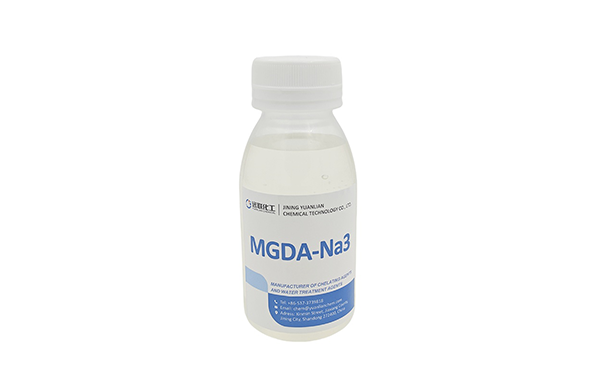
MGDA-Na4 is a small-molecule aminocarboxylate chelating agent with a molecular weight of 271 g/mol. Its structure contains one tertiary amine and three carboxylate groups, enabling the formation of highly stable five-membered chelate rings with di- and trivalent metal ions—including calcium, magnesium, copper, and iron—in aqueous solution .
Chelation stability constants (log K, 0.1M, 25°C):
| Metal ion | log K |
|---|---|
| Fe³⁺ | 16.5 |
| Cu²⁺ | 13.9 |
| Zn²⁺ | 10.9 |
| Ca²⁺ | 7.0 |
| Mg²⁺ | 5.8 |
Commercial Forms and Physical Specifications
40% Aqueous Solution:
-
Clear to light yellow liquid
-
pH (1% solution): 10.0–12.5
-
Density (20°C): 1.29–1.33 g/cm³
-
Pumpable and compatible with automated dosing systems
-
Remains fluid at low temperatures
High-Purity Granules/Powder:
-
White to off-white free-flowing particles
-
Highly water-soluble
-
Suitable for solid formulations where water content must be minimised
Calcium binding capacity: At pH 11, MGDA achieves a calcium binding value of approximately 406 mg CaCO₃/g of active substance, significantly higher than most biodegradable alternatives and comparable to NTA .
2. Performance Analysis: Stability Under Demanding Conditions
High Alkalinity Resistance
Many industrial cleaning formulations—CIP systems, bottle washing, and heavy-duty degreasers—operate at high pH. MGDA-Na4 remains stable in concentrated sodium hydroxide solutions without precipitation or decomposition. The chelation constants remain consistent across the pH range of 7 to 14 .
In industrial detergent formulations, MGDA effectively prevents the precipitation of calcium and magnesium salts even under strongly alkaline conditions, maintaining cleaning performance where citrate or other biodegradable alternatives would precipitate .
Thermal and Oxidative Stability
Automatic dishwashing and industrial laundering involve temperatures at or above 60–70°C, with drying cycles reaching higher temperatures. MGDA complexes remain stable at temperatures up to 100°C without dissociation .
In formulations containing peroxides (sodium percarbonate, hydrogen peroxide) or sodium hypochlorite, MGDA-Na4 does not undergo rapid oxidative degradation. This contrasts with certain organic acids that break down in the presence of oxidising agents. The stabilisation of bleach systems by MGDA is particularly relevant for European formulators targeting extended shelf-life requirements.
3. Core Application Scenarios in Europe
A. Automatic Dishwashing Detergents (ADW)
The phosphate-free challenge. Removing phosphates from automatic dishwashing formulations creates a technical difficulty: hard water calcium and magnesium ions deposit as calcium carbonate and silicate crystals on glassware and cutlery surfaces, causing spotting and filming.
MGDA addresses this through two mechanisms:
-
Sequestering hardness ions throughout the wash cycle, preventing precipitation on surfaces
-
Removing existing deposits by converting insoluble calcium salts into soluble complexes
MGDA has been demonstrated to provide efficient rinsing and starch stain removal in commercial phosphate-free dishwashing formulations, with particular effectiveness against tea stains .
Relevance for EU Ecolabel formulations: EU Ecolabel criteria permit NTA as an impurity in MGDA and GLDA only if the concentration in the final product remains below 0.10% . High-purity MGDA grades designed to meet this threshold are therefore essential for certified products.
B. Industrial, Institutional, and I&I Cleaning
Heavy-duty degreasing and vehicle care. In formulations for mechanical workshop cleaners and vehicle exterior washes, MGDA-Na4 removes the metal bridging bonds that anchor soil to substrate surfaces. The chelating action works synergistically with anionic and non-ionic surfactants—including APG and polyether types—to deliver rapid soil removal from hard surfaces.
CIP and bottle washing. In closed-loop industrial cleaning systems, MGDA prevents the formation of calcium phosphate and calcium carbonate scale on equipment surfaces and conveyor components . Its compatibility with alkaline cleaning chemistry makes it suitable for dairy processing equipment where phosphate scales are a persistent problem .
Milk processing equipment. Calcium phosphate deposits formed during milk processing are notoriously difficult to remove. MGDA has been shown to outperform other biodegradable chelating agents for this application, making it a suitable EDTA replacement in dairy CIP formulations .
C. Textile Dyeing & Pulp Bleaching
Preventing catalytic decomposition. In textile bleaching, trace heavy metals—iron and manganese in particular—catalyse the decomposition of hydrogen peroxide, reducing bleaching efficiency and damaging fibre strength. MGDA-Na4 stabilises peroxides by sequestering these catalytic transition metals .
The stabilisation effect protects fibre mechanical strength while improving whiteness, making MGDA suitable for bleaching applications in both textile processing and commercial laundry.
4. Sustainability & Compliance Framework (OECD 301B)
Rapid Biodegradation
MGDA is classified as readily biodegradable under OECD 301 test guidelines. Degradation exceeds 80% within 28 days under standard testing conditions . Multiple testing protocols confirm this profile:
| Biodegradability Test | Method | Result |
|---|---|---|
| CO₂ evolution (OECD 301B) | 28 days | 90–100% degradation |
| DOC reduction (OECD 301A) | 14 days | 90–100% degradation |
| MITI test (OECD 301C) | 37 days | 90–100% degradation |
| Anaerobic degradation (OECD 311) | 35–61 days | 82–87% degradation |
The degradation products are natural environmental components, presenting no accumulation risk. This profile meets the requirements of the EU Ecolabel and Nordic Swan certifications for raw material environmental performance.
Low Impurity Design: NTA Control
NTA (nitrilotriacetic acid) is classified by GHS as a suspected carcinogen (H351) . European formulators and procurement managers are attentive to NTA residuals in raw materials.
High-quality MGDA-Na4 production processes, through controlled synthesis conditions, maintain NTA content below 0.10%. This threshold aligns with EU Ecolabel requirements, enabling formulators to make non-carcinogenic hazard claims under CLP regulations .
Toxicological Profile
MGDA presents favourable toxicological data across multiple endpoints :
| Test | Result |
|---|---|
| Acute oral toxicity (rat) | LD50 > 2000 mg/kg |
| Skin irritation | Non-irritating |
| Eye irritation | Non-irritating |
| Skin sensitisation | Non-sensitising |
| Ames test (OECD 471/472) | Negative |
| Fish toxicity (OECD 203) | LC50 > 100 mg/L |
| Daphnia toxicity (OECD 202) | EC50 > 100 mg/L |
| Algae toxicity (OECD 201) | EC50 > 100 mg/L |
The low ecotoxicity profile makes MGDA suitable for products targeting sensitive environmental classifications.
5. Comparative Evaluation for Purchasing & Formulating
| Technical Attribute | Tetrasodium MGDA (MGDA-Na4) | Tetrasodium EDTA (EDTA-Na4) | STPP (Sodium Tripolyphosphate) |
|---|---|---|---|
| Environmental persistence | Readily biodegradable (>80%) | Persistent in aquatic environment | Causes eutrophication (restricted) |
| Calcium binding capacity (pH 11) | 406 mg CaCO₃/g | 274 mg CaCO₃/g | 287 mg CaCO₃/g |
| pH stability range | 2–13.5 | 4–10 | Narrow |
| Oxidiser compatibility | High | Medium-high | High |
| NTA impurity risk | <0.10% in high-purity grades | Not applicable | Not applicable |
| EU Ecolabel status | Fully approved | Restricted / Banned | Restricted in consumer detergents |
The technical distinction: EDTA works. The environmental persistence that makes it problematic in regulatory terms also makes it effective. MGDA matches or exceeds EDTA's chelation performance—particularly in alkaline and high-temperature systems—while eliminating the accumulation risk.
Formulation Guidelines & Dosage Recommendations
Typical use levels:
| Application | Dosage | Notes |
|---|---|---|
| Automatic dishwashing | 2–8% active | Often combined with polymers |
| Liquid laundry detergents | 0.5–3% active | Prevents calcium soap deposits |
| CIP cleaning systems | 0.5–2% active | Compatibility with alkaline cleaning agents |
| Textile bleaching | 0.1–0.5% active | Stabilises peroxide bleach systems |
| Hard surface cleaners | 0.2–1% active | Prevents filming and spotting |
Compatibility testing. Before scale-up, compatibility testing in the specific formulation matrix is recommended. MGDA-Na4 is compatible with most surfactants and oxidising systems, but acid conditions below pH 3 may affect complex stability. The chelating agent remains effective in solutions containing high electrolyte concentrations.
Product selection. The 40% liquid grade is suitable for large-scale liquid detergent production, as it can be dosed directly without pre-dissolution. The powder grade is preferred for tablet compression or dry blend formulations.
Technical Consultation & Documentation
The shift to readily biodegradable chelating agents is no longer a matter of choice. It is driven by regulatory constraints, retailer procurement policies, and consumer expectations across European markets. MGDA-Na4 demonstrates that environmental compliance and technical performance can be achieved in the same formulation.
For formulators evaluating MGDA-Na4 for specific applications—whether liquid detergents, dishwash tablets, or industrial cleaning formulations—standard evaluation samples, detailed Technical Data Sheets (TDS), and Safety Data Sheets (SDS) are available. Our technical team provides compatibility assessments tailored to specific surfactant systems, water hardness conditions, and application requirements. Contact our technical service group for dedicated support.
Yuanlian Chemical specializes in the production of polyaspartic acid (PASP),tetrasodium iminodisuccinate(IDS), GLDA, MGDA etc. with stable quality and excellent quantity!

Contact us