


-

- 2026-07-14
Zinc MGDA: A Sustainable, High-Stability Chelated Zinc for Eco-Friendly Formulations
The European Green Deal and the associated EU Chemicals Strategy for Sustainability have fundamentally altered the procurement criteria for chelating agents across home care, personal care, and agricultural formulations. Traditional EDTA-based chelates, effective as they are in binding metal ions, face increasing regulatory headwinds due to their environmental persistence—OECD 301B degradation rates consistently below 1% over 28 days .
Zinc methylglycine diacetic acid (Zinc MGDA / MGDA-Zn) represents a technical alternative that addresses both the performance and compliance requirements of modern formulations. Derived from a biodegradable amino-acid-based chelating framework, it offers the stability characteristics required for demanding applications while eliminating the environmental accumulation risks associated with persistent chelates.
1. Technical Profile: What is Zinc MGDA?
Molecular Structure and Coordination
MGDA is a multidentate ligand built around an alanine (methylglycine) backbone. The molecular structure incorporates three carboxylate groups and one tertiary amine, enabling the formation of highly stable five-membered chelate rings with divalent metal ions, including Zn²⁺. The MGDA-Zn complex is formed by reacting MGDA-Na₃ with a zinc source, yielding a water-soluble complex that remains stable across a wide pH operating window .
Key Parameters
| Parameter | Specification |
|---|---|
| Chemical Name | Methylglycine Diacetic Acid, Trisodium Salt, Chelated with Zinc |
| CAS Number | 164462-16-2 (MGDA-Na₃ base) |
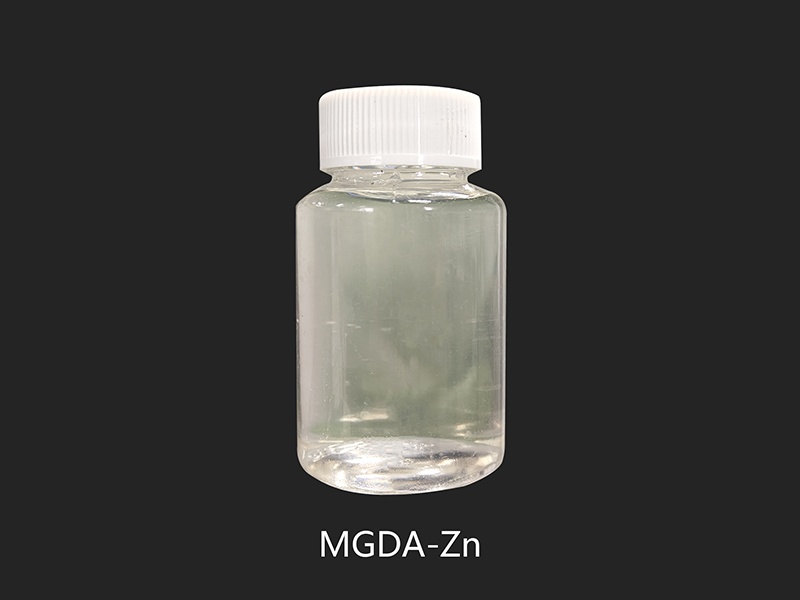
| Physical Form | White powder (≥81% active) or liquid solution (40% active) |
| pH Stability Range | 2–13.5 |
| Thermal Stability | Complexes remain stable at temperatures up to 100°C |
Chelation Mechanism
The conditional stability constants for MGDA-Zn vary with pH, reflecting the protonation state of the ligand under different conditions . The stability constant (log K) for the Zn-MGDA complex is approximately 11 at pH 7, providing sufficient binding strength to prevent zinc precipitation in complex formulations while remaining bioavailable in agricultural applications. At pH 9, the conditional stability constant reaches 9.1, indicating maintained chelation performance in alkaline detergent systems .
2. Environmental & Regulatory Advantages (EU Standards)
Rapid Biodegradability (OECD 301B)
MGDA is classified as readily biodegradable under OECD 301B, with degradation rates exceeding 80% within 28 days . This contrasts sharply with EDTA-Zn, which persists in the environment with degradation rates consistently below 1% over the same timeframe . In agricultural applications, where EDTA bypasses wastewater treatment systems, this persistence leads to long-term accumulation in soils and potential mobilisation of heavy metals into groundwater .
REACH Compliance
MGDA-Zn is fully REACH-registered for import and use within the European Economic Area . The transition from EDTA to MGDA-based chelates reduces the compliance burden for manufacturers, as the regulatory trajectory for persistent chelates continues to tighten. Major European retailers increasingly require "EDTA-free" claims on product packaging, making the sourcing of biodegradable alternatives a practical necessity for brand owners .
Ecotoxicological Profile
The ecotoxicological data for MGDA indicates favourable outcomes across multiple endpoints. The low aquatic toxicity profile is particularly relevant for products carrying EU Ecolabel or Nordic Swan certifications—both of which require raw materials to demonstrate acceptable environmental risk assessments .
3. Core Application Scenarios: Performance & Feasibility
A. Premium Liquid Detergents & Personal Care
In automatic dishwashing and liquid laundry formulations, Zinc MGDA serves two distinct functions: scale prevention through MGDA's calcium and magnesium binding, and glass corrosion inhibition through the zinc component . The chelation capacity of MGDA for zinc reaches 190 mg/g, with the complex remaining stable across pH 2–11 . This stability ensures that the zinc remains in solution throughout the wash cycle—unlike inorganic zinc sources, which would precipitate as zinc hydroxide or zinc carbonate under alkaline conditions.
Formulation synergy. MGDA demonstrates high compatibility with the surfactants common in European detergent formulations, including alkyl polyglycosides and amino-acid-based surfactants. In personal care, MGDA-Zn contributes to preservative synergy by sequestering metal ions required for microbial function, enabling reduced biocide loads in finished formulations .
B. High-Performance Foliar Fertilizers & Turf Nutrition
Bioavailability and absorption. The amino-acid-derived framework of MGDA confers a significant advantage in foliar nutrition. The relatively small molecular size of the MGDA-Zn complex enables penetration through the leaf cuticle, with plant tissues recognising the chelating ligand as a transportable amino-acid derivative . This mechanism differs substantially from inorganic zinc sources, which remain on the leaf surface and are subject to wash-off by rainfall.
Calcareous soil performance. In Southern European agriculture, calcareous soils present a specific challenge for micronutrient delivery. Phosphate and carbonate ions in these soils precipitate conventional zinc sources before roots can access them. MGDA-Zn remains soluble and plant-available in calcareous soil conditions, as demonstrated in a greenhouse study where zinc uptake by maize shoots reached 798.9 mg per plant at 8 mmol kg⁻¹ application—significantly higher than the 530.4 mg per plant achieved with EDTA-Zn at the same dosage .
Tank mix compatibility. In recirculating hydroponic and fertigation systems, MGDA-Zn prevents the reaction between Zn²⁺ and phosphate ions that would otherwise form insoluble zinc phosphate precipitates. This compatibility ensures that irrigation lines and emitters remain free of blockages, reducing maintenance requirements and improving system reliability.
4. Technical Comparison: Zinc MGDA vs. Traditional Zinc Chelates
| Parameter | Zinc MGDA (MGDA-Zn) | Zinc EDTA (EDTA-Zn) | Zinc Sulfate (Inorganic) |
|---|---|---|---|
| Biodegradability (OECD 301B) | Readily biodegradable (>80%) | Poorly biodegradable (<1%) | Not applicable |
| pH Stability Range | 2–13.5 | 4–10 | Narrow (precipitates above pH 7) |
| Plant Absorption Efficiency | High (organic complex) | Medium | Low (prone to soil fixation) |
| Regulatory Risk in EU | Safe / Preferred | High risk / Restricted | Safe but limited performance |
| Zinc Phytoextraction (mg/plant at 8 mmol/kg) | 798.9 | 530.4 | Not applicable |
| Thermal Stability | Stable >100°C | Stable to 80°C | Limited |
| EU Ecolabel Compliance | Yes | No | No |
The critical distinction: EDTA-Zn works. The environmental persistence that makes it problematic in regulatory terms also makes it effective in binding metals. MGDA-Zn matches the performance in hard water, high-pH, and calcareous soil applications while eliminating the accumulation risk and regulatory liability .
5. Guidance for Formulators & Dosage Recommendations
Compatibility Testing
Before scale-up, formulators should conduct small-scale compatibility testing in the specific formulation matrix. MGDA-Zn is compatible with most surfactants and oxidising systems, but strong acidic conditions (pH < 3) may affect complex stability. Product remains stable at temperatures up to 100°C and across pH 2–13.5 .
Dosage Guidelines
| Application | Typical Dosage | Notes |
|---|---|---|
| Liquid detergents & personal care | 0.1–0.5% active | Primarily for zinc function and scale prevention |
| Automatic dishwashing | 2–5% active | Combined with MGDA and polymers |
| Foliar fertilisers | Based on zinc element requirement | Target crop-specific zinc deficiency levels |
| Fertigation / hydroponics | 0.5–2% active | Maintains solubility in phosphate-containing systems |
Supply Chain Considerations for European Buyers
Procurement teams evaluating MGDA-Zn suppliers should verify:
-
OECD 301B biodegradability certification
-
REACH registration documentation
-
Batch-to-batch consistency records
-
NTA content (<0.10% specification for MGDA-Na₃ base)
-
Colour clarity (≤250 APHA for liquid grades)
The 40% liquid grade is the most widely used commercial form, preferred for large-scale liquid detergent production as it can be dosed directly without pre-dissolution and remains fluid down to -15°C . Powder grades (≥81% active) are available for solid formulations, including tablet compression and dry blends.
Technical Consultation & Documentation
The transition to biodegradable chelates is no longer a matter of choice—it is a requirement driven by regulatory constraints, retailer procurement policies, and consumer expectations across European markets. Zinc MGDA demonstrates that environmental compliance and technical performance can be achieved in the same formulation.
For formulators evaluating Zinc MGDA for specific applications, standard evaluation samples, detailed Technical Data Sheets (TDS), and Safety Data Sheets (SDS) are available through our technical division. The technical team provides compatibility assessments tailored to specific surfactant systems, water hardness conditions, or crop types. Contact the European technical service group for dedicated technical exchange.
Yuanlian Chemical specializes in the production of polyaspartic acid (PASP),tetrasodium iminodisuccinate(IDS), GLDA, MGDA etc. with stable quality and excellent quantity!

Contact us