


-

- 2026-07-15
Evaluating Polyaspartic Acid (PASP) as a Biodegradable Scale Inhibitor and Dispersant
Global regulations on phosphorus discharge and non-degradable polymers continue to tighten. The EU Water Framework Directive and national regulations across Asia are imposing stricter limits on phosphonate-based scale inhibitors—HEDP, ATMP—and persistent polymers like polyacrylic acid (PAA) due to their contribution to eutrophication and poor biodegradability. Wastewater treatment facilities increasingly screen for these compounds, and formulators in industrial water treatment, fertiliser production, and oilfield chemistry are under pressure to transition to alternatives that meet environmental compliance without sacrificing performance.
Polyaspartic acid (PASP)—an amino-acid-derived polymer synthesised from L-aspartic acid—has gained attention as a biodegradable scale inhibitor and dispersant that addresses both regulatory and performance requirements. Its polypeptide backbone offers a different approach to scale control: chelation, lattice distortion, and electrostatic dispersion, rather than the threshold inhibition mechanism of phosphonates.
1. Environmental Directives Driving Phosphorus-Free Industrial Chemistry
Regulatory drivers across major markets:
-
EU Water Framework Directive and Urban Wastewater Treatment Directive restrict phosphorus discharge from industrial sources, with member states imposing increasingly low phosphorus concentration limits (typically 0.1–0.2 mg/L) in sensitive areas
-
China's Water Pollution Prevention and Control Action Plan ("Ten Measures for Water") mandates total phosphorus control in industrial wastewater, pushing water treatment operators toward phosphorus-free formulations
-
Japan's Water Pollution Control Law sets strict effluent standards for phosphorus compounds, with enforcement increasingly stringent for industrial sectors
-
Korea's Act on Water Quality Improvement requires monitoring and reduction of phosphorus loading from industrial point sources
The problem with legacy chemistries:
-
Phosphonates (HEDP, ATMP) contribute to eutrophication by releasing orthophosphate upon degradation. In Europe, phosphonate use in detergents has been restricted under the EU Detergents Regulation; industrial applications face growing scrutiny
-
Polyacrylic acid (PAA) is persistent in the environment. OECD 301B degradation rates are typically below 10% over 28 days, leading to accumulation in water systems and concerns about its ecotoxicological profile
PASP offers an alternative consistent with the ecological transition in industrial chemistry. It is synthesised from a renewable amino-acid feedstock and meets readily biodegradable criteria, providing a pathway toward phosphorus-free formulations without the persistence penalty of synthetic acrylic polymers.
2. Synthesis Origin and Molecular Mechanisms of PASP
Synthesis route. PASP is produced by thermal polycondensation of L-aspartic acid—a naturally occurring amino acid—yielding a polypeptide chain with repeating aspartic acid units. The molecular weight is typically controlled in the 3,000–8,000 Da range to optimise scale inhibition performance, though applications requiring dispersant function often favour higher molecular weight grades (10,000–15,000 Da).
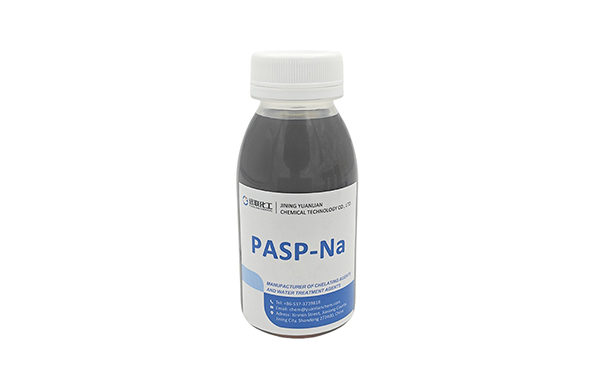
Chemical structure. The polypeptide backbone carries a high density of active carboxyl groups (−COOH) along the chain. In aqueous solution, these carboxyl groups deprotonate to carboxylate (−COO⁻) species, generating the polyanionic charge that underpins both chelation and dispersion mechanisms.
Dual mechanism of action:
-
Chelation and lattice distortion. The carboxylate groups along the polypeptide backbone coordinate with divalent cations—Ca²⁺, Mg²⁺, Ba²⁺, Sr²⁺—preventing the formation of insoluble salts. More importantly, when microcrystals of calcium carbonate or calcium sulfate begin to nucleate, PASP molecules adsorb onto specific crystal growth sites, causing lattice distortion. This prevents the crystal from growing into its normal morphology, resulting in soft, non-adherent scale particles that remain suspended in the bulk solution rather than depositing on surfaces.
-
Electrostatic dispersion. The polyanionic character of PASP provides strong electrostatic repulsion between suspended particles. This prevents agglomeration and settling, maintaining the dispersed state of scale-forming salts, clay particles, and corrosion products within the fluid system.
The distinction from threshold inhibitors: Phosphonates (HEDP, ATMP) function primarily through threshold inhibition—low concentrations maintain supersaturation by blocking crystal nucleation sites. PASP combines chelation, lattice distortion, and dispersion into a single mechanism, making it effective across a broader range of conditions, including systems where threshold inhibitors lose efficacy due to high ionic strength or elevated temperature.
3. Cross-Sector Application Performance Analysis
A. Industrial Water Treatment & Cooling Towers
In recirculating cooling water systems, high hardness, high alkalinity, and elevated pH create conditions favourable for calcium carbonate and calcium sulfate scale formation. PASP demonstrates effective scale inhibition at temperatures up to 120°C in stable operation, making it suitable for medium-temperature industrial systems.
Performance characteristics:
-
Effective calcium carbonate inhibition at dosages typical for water treatment polymers (2–5 ppm active in treated water)
-
Compatibility with oxidising biocides (chlorine, bromine, chlorine dioxide) commonly used in cooling tower microbial control
-
Calcium sulfate and barium sulfate scale inhibition—particularly relevant in oilfield water injection and boiler feed systems
-
Dispersant action extends to iron oxide and clay particles, reducing fouling on heat exchange surfaces
The calcium tolerance of PASP in high-hardness water is well documented in the technical literature, with performance comparable to—and in some conditions superior to—PAA in preventing precipitation from supersaturated carbonate solutions.
B. Fertiliser Synergist & Nutrient Upgrading
In crop nutrition, PASP functions through a different mechanism than its water treatment role. When incorporated into fertiliser formulations, it serves as a nutrient synergist:
Mechanism of action:
-
Phosphate fixation mitigation. In calcareous soils, phosphate reacts with calcium to form insoluble calcium phosphate precipitates that are unavailable to plant roots. PASP sequesters calcium ions in the rhizosphere, maintaining phosphate in soluble form and extending its availability to root uptake systems. Studies have indicated improved phosphorus use efficiency in field trials with PASP-amended fertilisers.
-
Trace metal enrichment. The carboxylate-rich polypeptide chain complexes micronutrients—zinc, manganese, copper, iron—preventing their precipitation in alkaline soils and enhancing root absorption through the formation of soluble, transportable chelates.
-
Root growth stimulation. Polyaspartic acid has been shown to promote root development through mechanisms distinct from its chelation chemistry. The resulting larger root surface area further improves nutrient uptake efficiency.
Applications are most developed in high-value horticulture, turf management, and premium fertigation systems where improved nutrient efficiency and reduced fertilizer runoff are commercially relevant.
C. Sustainable Crude Oil Production
In oilfield water injection systems and production pipelines, scale deposition is a major operational challenge. Barium sulfate and strontium sulfate scales are particularly difficult to remove, forming when injection water (typically seawater with high sulfate content) mixes with formation water containing barium and strontium.
PASP in oilfield applications:
-
Barium sulfate and strontium sulfate scale inhibition with effectiveness comparable to conventional phosphonates in field trials
-
High thermal stability (functional up to 120°C) supports the elevated temperatures in deeper production wells
-
Readily biodegradable profile reduces environmental risk in produced water discharge—relevant for offshore operations with stringent discharge permits
The compatibility with other production chemicals (corrosion inhibitors, demulsifiers, biocides) is generally good, though site-specific compatibility testing is recommended prior to field deployment.
4. Technical Benchmarks: PASP vs. Legacy Polymeric Dispersants
| Performance Vector | Polyaspartic Acid (PASP) | Polyacrylic Acid (PAA) | Phosphonates (e.g., HEDP) |
|---|---|---|---|
| Chemical Classification | Polypeptide / Amino acid derivative | Acrylic polymer | Organophosphorus compound |
| Ultimate Biodegradability | Readily biodegradable (OECD 301B) | Persistent in environment | Poor / contributes to eutrophication |
| Thermal Stability Limit | Up to 120°C stable operation | High stability | Decomposes at higher temperatures |
| Scale Inhibition Mechanism | Chelation + lattice distortion | Threshold inhibition | Threshold inhibition |
| Calcium Tolerance | Good | Very good | Variable by type |
| Dispersant Performance | Good for iron oxide, clay | Excellent | Limited |
| Regulatory Profile | Favorable under current directives | Persistent classification | Phosphorus restrictions |
What the comparison demonstrates: PAA offers excellent dispersant performance and PAA-based formulations are well-established. Phosphonates provide effective scale inhibition with straightforward chemistry. PASP matches these performance levels while offering a clear environmental advantage—readily biodegradable, derived from a renewable feedstock, and free of phosphorus and persistent polymer concerns.
The distinction for formulators: The transition is not about replacing an inferior product. It is about achieving equivalent technical outcomes while eliminating environmental liabilities that are increasingly difficult to sustain under evolving regulations.
5. Ensuring Consistency in the Industrial Supply Chain
For large-scale water treatment operators and fertiliser manufacturers transitioning to PASP-based formulations, the concern is not just technical performance but supply chain consistency. Molecular weight distribution directly affects scale inhibition and dispersion performance—variation outside the specified range can reduce efficacy even when the active matter content remains constant.
Quality parameters to verify:
| Parameter | Typical Specification |
|---|---|
| Appearance | Light yellow to amber liquid |
| Active content | 40–42% by weight |
| Molecular weight (Mw) | 3,000–15,000 Da (application-dependent) |
| Density (20°C) | 1.18–1.22 g/cm³ |
| pH (1% solution) | 8.0–10.0 |
| Free monomer (aspartic acid) | <1.0% |
Supply chain considerations:
-
Full process control from L-aspartic acid feedstock through thermal polycondensation and product finishing
-
Batch-to-batch consistency in molecular weight distribution—verified by GPC analytical records
-
REACH registration for European import and use
-
Packaging and labelling compliant with international transport and storage standards
The high-activity liquid grade is suitable for direct dosing in water treatment applications. The product remains stable during storage under ambient conditions and is compatible with typical water treatment chemical feed equipment.
6. Comprehensive Compatibility & Formulation Assistance
PASP offers formulators a pathway to phosphorus-free, biodegradable scale control without the performance compromises associated with earlier-generation alternatives. It achieves effective scale inhibition across moderate-to-high temperature and hardness conditions, meets OECD 301B readily biodegradable criteria, and maintains good compatibility with biocides and other treatment chemicals.
The technical case for PASP:
-
Readily biodegradable under OECD 301B—supports environmental compliance
-
Dual mechanism (chelation/lattice distortion + electrostatic dispersion) ensures scale control in hard water
-
Thermal stability to 120°C supports medium-temperature industrial applications
-
Renewable feedstock—derived from L-aspartic acid, a naturally occurring amino acid
-
No phosphorus content—addresses phosphorus discharge restrictions
-
Good compatibility with oxidising biocides in cooling water systems
To verify the scale inhibition thresholds or nutrient mobility profiles of PASP within your custom formulations, standard evaluation materials, technical data sheets (TDS), and product safety parameters (SDS) are available upon request through our engineering department. The technical team provides compatibility assessments tailored to specific water chemistry profiles, application conditions, and formulation systems.
Yuanlian Chemical specializes in the production of polyaspartic acid (PASP),tetrasodium iminodisuccinate(IDS), GLDA, MGDA etc. with stable quality and excellent quantity!

Contact us