



-

- 2026-07-15
Biodegradable Coordination Chemistry: Evaluating IDS-Na4 as an Environmentally Safe Chelating Agent
Regulatory pressure on persistent chelating agents has been building across multiple industrial sectors. The EU Detergents Regulation amendments restrict phosphates, and EDTA—effective as it is—faces persistent scrutiny due to its environmental recalcitrance. NTA carries a carcinogen classification under GHS, placing it under even tighter restrictions. Industrial cleaning formulations, agricultural micronutrient delivery, and textile processing are all navigating the same challenge: maintain metal sequestration performance while transitioning to readily biodegradable alternatives that meet Ecolabel criteria.
Tetrasodium iminodisuccinate (IDS-Na4) has emerged as a technically viable option. Its coordination chemistry offers effective metal binding across a broad pH window, and its biodegradability profile—exceeding 80% under OECD 302B conditions—distinguishes it from legacy chelates that persist in natural water systems.
1. The Ecological Imperative for Biodegradable Complexing Agents
Regulatory constraints across major markets:
-
The EU Ecolabel for detergents explicitly prohibits EDTA and NTA in certified products. Major retailers across Germany, France, and the Nordic countries now require proof of biodegradability for raw materials used in private-label formulations.
-
Water framework directives restrict phosphorus discharge from industrial sources, limiting the use of phosphonates and phosphates as chelating agents.
-
REACH authorisation processes continue to evaluate persistent substances, with EDTA and its salts under ongoing assessment for potential restriction.
-
Agricultural applications face additional scrutiny: EDTA used in fertilisers bypasses wastewater treatment, accumulating in soils and potentially remobilising heavy metals into groundwater.
The problem with legacy chemistries:
EDTA's environmental persistence—degradation rates consistently below 10% under OECD 301B testing—means that once released into water systems, it remains available to mobilise heavy metals from sediments. This remobilisation effect is a recognised ecotoxicological concern. NTA, while more biodegradable than EDTA, carries a Category 2 carcinogen classification under GHS, limiting its acceptability in consumer-facing products.
IDS-Na4 offers a different profile: readily biodegradable, derived from renewable feedstocks, and free of phosphorus and persistent polymer concerns.
2. Chemical Architecture and Sequestration Mechanism of IDS-Na4
Core Parameters
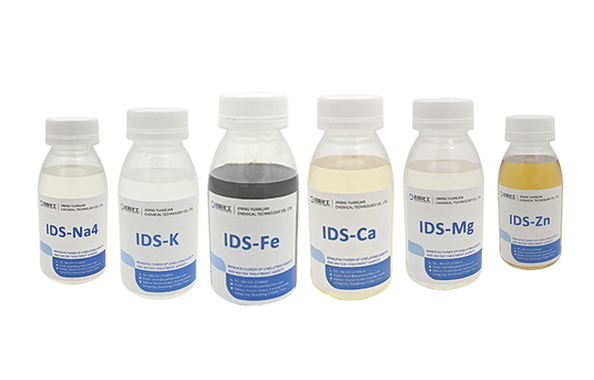
| Parameter | Specification |
|---|---|
| CAS number | 144538-83-0 |
| Molecular formula | C₈H₇NNa₄O₈ |
| Molecular weight | 337.1 g/mol |
| Commercial forms | 34–35% aqueous solution; solid grades >77% active |
| Appearance | Colourless to light yellow liquid or white powder |
Synthesis Route
IDS-Na4 is produced by the reaction of maleic anhydride with sodium hydroxide, followed by treatment with ammonia . The synthesis can achieve yields of up to 98% for the tetrasodium product in aqueous solution . The production process is based on renewable feedstocks—maleic anhydride derived from butane oxidation—positioning IDS as a bio-based chelate.
Chelation Mechanism
The molecular structure of IDS-Na4 contains one tertiary amine and four carboxylate groups arranged in a symmetric coordination geometry . As a multidentate ligand, it forms stable water-soluble complexes with divalent and trivalent metal ions through coordination bonds between the carboxylate groups and metal centres.
Sequestration performance: IDS-Na4 effectively binds calcium, magnesium, iron, copper, and manganese across a wide pH window. Its performance in alkaline systems (pH 10–11)—common in automatic dishwashing and industrial cleaning—is particularly relevant for applications where citrate loses efficacy.
The distinction from threshold inhibitors: Like EDTA, IDS functions through true chelation rather than threshold inhibition. This means metal ions are sequestered into soluble complexes rather than simply prevented from nucleating—a mechanism that remains effective across a broader range of conditions and concentrations.
3. Strategic Industrial and Agricultural Application Profiles
A. Sustainable Agriculture and Soil Micronutrient Delivery
In calcareous soils, phosphate and carbonate ions precipitate conventional micronutrient sources before roots can access them. IDS-Na4 maintains iron, manganese, zinc, and copper in soluble, plant-available form by chelating these metals and preventing their fixation .
Agricultural advantages:
-
Chelated micronutrient carrier – IDS-Na4 can be used as the chelating agent in liquid fertiliser formulations for foliar and fertigation applications.
-
Soil compatibility – The biodegradable profile ensures that residual chelate breaks down in the soil, avoiding the accumulation and heavy metal remobilisation risks associated with EDTA.
-
Phosphate fixation mitigation – IDS-Na4 sequesters calcium in the rhizosphere, maintaining phosphate in soluble form and improving phosphorus use efficiency in high-pH soils.
Applications are most developed in high-value horticulture, turf management, and premium water-soluble fertiliser formulations.
B. Industrial Cleaning & Ecolabeled Detergents
In automatic dishwashing, hard water calcium and magnesium ions cause spotting, filming, and scale deposition. IDS-Na4 prevents these effects by sequestering hardness ions throughout the wash and rinse cycles .
Peroxide stabilisation: In textile bleaching and pulp processing, trace transition metals (iron, copper, manganese) catalyse hydrogen peroxide decomposition, reducing bleaching efficiency and damaging fibre strength. IDS-Na4 stabilises peroxide systems by chelating these catalytic metals—a critical function for formulations containing sodium percarbonate or hydrogen peroxide .
Hard surface cleaning: IDS-Na4 is effective for removing calcium carbonate and calcium sulfate scale in industrial equipment cleaning, with compatibility across alkaline and neutral pH ranges .
C. Textile Dyeing and Auxiliary Agents
In textile processing, calcium, magnesium, and iron ions interfere with dye uptake, causing uneven colouration and reduced colour fastness. IDS-Na4 removes these metal ions from the dye bath, improving levelness and brightness. Its biodegradable profile supports compliance with OEKO-TEX and other textile ecological standards.
D. Photographic Processing and Metal Cleaning
IDS-Na4 has applications in photographic industry cleaning agents and metal surface treatment, where its metal sequestration capacity prevents unwanted precipitation and filming . In oil and gas pipeline cleaning, it is recommended for removal of iron oxide and iron sulfide deposits.
4. Comparative Evaluation: IDS-Na4 vs. Conventional Chelating Agents
| Technical Evaluation Vector | IDS-Na4 | EDTA-Na4 | NTA-Na3 |
|---|---|---|---|
| Chemical Formula | C₈H₇NNa₄O₈ | C₁₀H₁₂N₂O₈Na₄ | C₆H₆NO₆Na₃ |
| Biodegradability (OECD 302B) | >80% in 28 days (readily biodegradable) | <10% (persistent) | Biodegradable but toxicological concerns |
| Sequestration Capacity (Fe³⁺) | High | Very high | Moderate |
| Human Health Hazard Profile | Non-sensitising, non-hazardous | Category 2 Carcinogen Suspect | Category 2 Carcinogen |
| Phosphorus & Nitrogen Load | Zero phosphorus, low nitrogen | Zero phosphorus, higher nitrogen | Zero phosphorus |
| EU Ecolabel Compliance | Yes | No | No |
| Peroxide Compatibility | Good | Moderate | Limited |
What the comparison demonstrates: EDTA works. The environmental persistence that makes it problematic also makes it effective. IDS-Na4 matches EDTA's chelation performance—particularly for calcium and transition metals—while eliminating the accumulation risk and regulatory liability.
5. Enhancing Supply Chain Integrity: Quality Control Considerations
For formulators making the transition from EDTA to IDS-based chelates, batch-to-batch consistency is critical. Variation in chelation value, free impurities, or active content can disrupt formulation performance.
Quality parameters to verify:
| Parameter | Liquid Grade (34–35%) | Solid Grade (>77%) |
|---|---|---|
| Appearance | Colourless to light yellow liquid | White powder |
| Active content | 33–35% | >77% |
| pH (1% solution) | 10.3–11.4 | ~11 |
| Density (20°C) | ≥1.30 g/cm³ | N/A |
| Bulk density | N/A | 0.5–0.7 kg/L |
Impurity control: High-quality IDS-Na4 production controls residual by-products from the maleic anhydride-ammonia synthesis. The presence of fumarate, aspartate, malate, and maleate salts can vary significantly between grades . Formulators should verify that impurity profiles are within acceptable limits for their specific application.
Supply chain considerations:
-
The 34–35% liquid grade is suitable for large-scale liquid formulations, as it can be dosed directly without pre-dissolution.
-
The solid grade (≥77% active) is preferred for dry blend formulations and applications where water content must be minimised .
-
Full REACH registration and OECD biodegradability documentation are baseline requirements for European procurement.
6. Formulation Engineering & Technical Consultation
IDS-Na4 offers formulators a pathway to biodegradable, phosphorus-free chelation without the performance compromises associated with weaker alternatives. It achieves effective metal sequestration across moderate-to-high pH and temperature conditions, meets OECD readily biodegradable criteria, and maintains good compatibility with peroxides and surfactants.
The technical case for IDS-Na4:
-
Readily biodegradable under OECD 302B—supports EU Ecolabel compliance
-
Effective chelation for calcium, magnesium, iron, copper, and manganese
-
Peroxide compatibility stabilises bleaching systems
-
No phosphorus content—addresses discharge restrictions
-
Derived from renewable feedstocks
-
Non-hazardous human health profile
To confirm the specific coordination constants or compatibility profiles of IDS-Na4 within your custom formulations, standard laboratory evaluations, technical data sheets (TDS), and eco-toxicological data sheets (SDS) are accessible upon request through our application engineering department. The technical team provides compatibility assessments tailored to specific surfactant systems, water chemistry profiles, and application conditions.
Yuanlian Chemical specializes in the production of polyaspartic acid (PASP),tetrasodium iminodisuccinate(IDS), GLDA, MGDA etc. with stable quality and excellent quantity!

Contact us