



-

- 2026-07-17
Optimizing Nutrient Use Efficiency: The Technical Evaluation of Polyaspartic Acid (PASP) in Sustainable Agriculture
Global agricultural policy has shifted decisively toward input reduction. The European Farm to Fork strategy targets a 20% reduction in fertilizer use by 2030, while China's "dual carbon" goals and "fertilizer reduction and efficiency enhancement" policies mandate similar adjustments. The practical challenge for formulators and agronomists is maintaining crop productivity with diminished synthetic inputs. Traditional fertilizers suffer from low nutrient use efficiency—phosphate is readily fixed by calcium, iron, or aluminum ions in calcareous soils, and nitrogen is lost through volatilization and leaching .
Polyaspartic acid (PASP), a biodegradable amino acid-based polymer, has emerged as a functional additive that addresses these constraints. Research demonstrates its ability to chelate rhizosphere nutrients, stimulate microbial activity, and regulate plant metabolism through its degradation product, aspartic acid . This article evaluates the physicochemical mechanisms, agronomic performance data, and formulation considerations for PASP in sustainable crop nutrition.
1. Global Agronomic Challenges: Maximizing Yields with Reduced Inputs
The nutrient use efficiency (NUE) of conventional fertilizers is low. Phosphorus application efficiency rarely exceeds 20–30% in the year of application, with the remainder fixed as insoluble phosphates in the soil matrix. Nitrogen losses through volatilization, denitrification, and leaching range from 30% to 60% depending on soil type, climate, and management practice.
Regulatory drivers:
-
EU Farm to Fork Strategy —targets a 20% reduction in fertilizer use by 2030, with member states implementing national action plans
-
China's "Dual Carbon" goals —carbon peaking by 2030 and carbon neutrality by 2060 are driving green chemistry adoption in agriculture
-
China's Action Plan for Fertilizer Reduction and Efficiency —mandates reduced synthetic fertilizer application while maintaining grain output
-
Nitrate Directive (91/676/EEC) —limits nitrogen application in nitrate-vulnerable zones across Europe
-
Soil health initiatives —increasing focus on soil organic matter, microbial diversity, and reduced chemical inputs
PASP offers a functional pathway through these constraints. As an environmentally friendly fertilizer synergist, it enhances nutrient use efficiency through chelation and dispersion mechanisms, while its biodegradable profile (OECD 301B >60% in 28 days) eliminates accumulation risks in soil .
2. Biochemical Structure and Nutrient Mobility Mechanisms of PASP
Synthesis and Molecular Architecture
PASP is produced through thermal polycondensation of L-aspartic acid—a naturally occurring amino acid—yielding a polypeptide chain with repeating aspartic acid units. Molecular weight control is critical: low-molecular-weight PASP (<1 kDa), medium-molecular-weight (3–5 kDa), and high-molecular-weight (>10 kDa) grades exhibit distinct structural and functional properties .
Molecular weight influences both structural characteristics and agronomic performance. As molecular weight increases, peptide bond content increases, while carboxyl content initially increases then decreases. Medium-molecular-weight PASP (3–5 kDa) shows the highest carboxyl content and the strongest growth promotion effects in wheat trials, increasing total dry weight by 23.36% compared to controls at 25 mg/L application .
Mechanisms of Action
1. Phosphate Fixation Mitigation
The high density of carboxyl groups along the polypeptide chain competitively binds with soil cations—Ca²⁺, Mg²⁺, Al³⁺, Fe³⁺—that would otherwise precipitate phosphate ions as insoluble salts. This maintains phosphorus in plant-available forms within the rhizosphere, extending the nutrient uptake window.
2. Trace Metal Enrichment and Delivery
PASP forms weak chelates with micronutrients—zinc, manganese, copper, iron—preventing their precipitation in alkaline soils. The metal–PASP complexes are water-soluble and transportable, enhancing root absorption and translocation to plant tissues.
3. Root Growth Stimulation
PASP promotes root development through mechanisms distinct from its chelation chemistry. Medium-molecular-weight PASP has been shown to optimize root morphology, increase total absorption area, and enhance root activity. At 25 mg/L, medium-molecular-weight PASP increased root dry weight by 11.90–19.06% compared to controls, with total dry matter increases of 9.13–23.36% depending on dosage .
The resulting larger root surface area further improves nutrient uptake efficiency, creating a positive feedback loop between PASP application and nutrient acquisition capacity.
4. Rhizosphere Microbial Modulation
PASP degradation products—short-chain amino acids—serve as carbon and nitrogen sources for beneficial soil microorganisms. Recent research combining PASP with plant growth-promoting rhizobacteria (PGPR) demonstrated synergistic effects on nutrient availability and microbial community restructuring. Co-application significantly increased plant height (9.59%), stem diameter (28.39%), root length (38.61%), and root and shoot biomass (21.26% and 25.17%, respectively) compared to PASP alone .
The co-application also enriched beneficial taxa—Paucibacter and Massilia—while suppressing competitive genera, with available potassium and ammonium nitrogen identified as the key factors shaping the microbial community structure .
3. Targeted Application Matrix in Agrochemical Formulations
A. Premium Water-Soluble Fertilizers & Biostimulants
In water-soluble fertilizer (WSF) formulations, PASP serves as a functional additive at typical inclusion rates of 0.1–1.0% of total formulation weight . The polypeptide structure improves electrolyte compatibility, preventing salt precipitation in concentrated liquid fertilizers and maintaining system stability across storage temperature ranges.
PASP's compatibility with fertilizer components—urea, potassium dihydrogen phosphate, calcium phosphate, magnesium sulfate, and micronutrients—has been demonstrated in commercial formulations, with the PASP component functioning through chelation, dispersion, and adsorption to provide controlled nutrient release .
B. Coated Granular Fertilizers & Urea Modification
In granular fertilizer production, PASP can be applied as a surface coating or incorporated during granulation. The polyanionic character of PASP modifies nitrogen release kinetics:
-
Extended nutrient release —nutrient ions are maintained in chelated form, slowing fixation and leaching
-
Reduced volatilization —inhibition of NH₃ volatilization by 17.22% in PASP-treated rice compared to conventional urea
-
Enhanced nitrogen retention —PASP treatment shows a significant inhibitory effect on ammonia-oxidizing archaea (AOA), slowing nitrification and extending nitrogen availability
Field trials with PASP-containing urea reported a 25.29% reduction in N₂O emissions compared to conventional fertilizer, indicating both productivity and environmental benefits .
C. Rhizosphere Conditioning and Root Development
PASP degradation products provide a carbon-nitrogen source for beneficial microorganisms, indirectly improving rhizosphere microbial community structure. The combination of PASP with PGPR has demonstrated significant yield increases in potato through improved rhizosphere nutrient availability .
4. Technical Benchmarks: Quantitative Performance Metrics
| Characterisation Vector | Polyaspartic Acid (PASP) | Polyacrylic Acid (PAA) | EDTA-based Chelates |
|---|---|---|---|
| Chemical Classification | Polypeptide (amino acid linked) | Synthetic carbon-chain | Aminopolycarboxylic acid |
| Environmental Degradation (OECD 301B) | Readily biodegradable (>60% in 28 days) | Persistent in soil | Poor / accumulates heavy metals |
| Rhizosphere Compatibility | High (degrades to organic nutrients) | Low (inert polymer matrix) | Neutral |
| Primary Synergistic Focus | Multi-ion dispersion + weak chelation | Threshold dispersion only | Strong single-metal sequestration |
| Toxicity to Soil Flora | Non-toxic | Evaluated case-by-case | Long-term accumulation risks |
| Root Growth Promotion | 11.9–19.1% dry weight increase | Limited | Limited |
| Yield Effect | 6.2–16.7% increase across crops | Variable | Variable |
What the comparison demonstrates: PAA and EDTA-based chelates offer effective dispersion or sequestration—but they are either persistent in soil (PAA) or accumulate heavy metals (EDTA). PASP matches or exceeds their performance while offering a clear environmental advantage: readily biodegradable, derived from a renewable amino-acid feedstock, and proven to promote root development and nutrient uptake through mechanisms distinct from simple chelation.
5. Securing Supply Chain Integrity for Modern Agrochemical Manufacturers
For large-scale fertilizer producers incorporating PASP into formulations, supply chain consistency is a practical concern. Molecular weight distribution directly affects nutrient synergy and root stimulation—variation outside the specified range can reduce efficacy even when active content remains constant.
Quality Parameters to Verify
| Parameter | Specification |
|---|---|
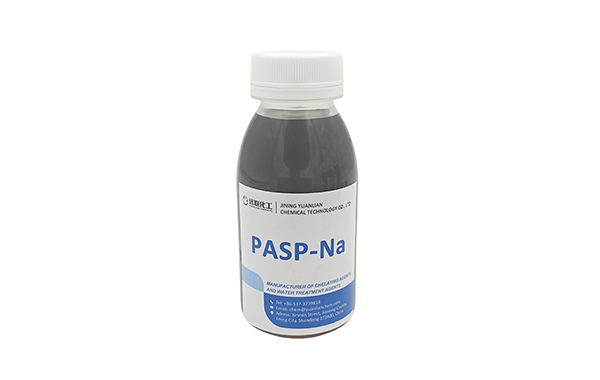
| Appearance | Yellow to reddish-brown liquid |
| Solid content | ≥40.0% by weight |
| Molecular weight (Mw) | 1,000–5,000 Da (liquid grade) |
| pH (1% solution) | 9.0–11.0 |
| Density (20°C) | ≥1.20 g/cm³ |
Supply Chain Considerations
-
Process control —thermal polycondensation parameters (temperature, residence time) directly influence molecular weight distribution and carboxyl content
-
Batch-to-batch consistency —GPC analytical records should be provided with each shipment
-
Application-specific grades —higher molecular weight grades (>10 kDa) for dispersant applications; medium molecular weight (3–5 kDa) for root growth promotion
-
Storage stability —store in cool, dark conditions; shelf life is typically ten months for liquid grades
6. Collaborative Formulation Engineering & Verification
PASP offers formulators a pathway to biodegradable, phosphorus-free nutrient enhancement without the performance compromises associated with earlier-generation alternatives. Field data confirms yield increases across crops:
-
Rice: 6.2% yield increase with PASP
-
Rice (modified PASP): 12.15% yield increase, net benefit increase exceeding 255 yuan/mu
-
Maize (modified PASP): 10.40% yield increase under 20% fertilizer reduction
-
Wheat (modified PASP): 16.65% yield increase, net benefit increase of 222 yuan/mu
The combination of PASP with PGPR shows further yield potential, with potato trials demonstrating synergistic effects on plant growth, root development, and nutrient availability .
The technical case for PASP in agriculture:
-
Readily biodegradable under OECD 301B—no soil accumulation
-
Proven yield increases across staple crops (rice, maize, wheat, potato)
-
Reduces N₂O emissions and NH₃ volatilization by 25% and 17%, respectively
-
Promotes root growth and nutrient uptake through multiple mechanisms
-
Compatible with PGPR for synergistic nutrient enhancement
To verify the scale-dispersion indices or nutrient mobility thresholds of PASP within your custom fertilizer configurations, standard laboratory evaluation materials, technical data sheets (TDS), and safety data sheets (SDS) are accessible through our engineering division. The technical team provides formulation compatibility assessments tailored to specific crop types, soil conditions, and application systems.
Yuanlian Chemical specializes in the production of polyaspartic acid (PASP),tetrasodium iminodisuccinate(IDS), GLDA, MGDA etc. with stable quality and excellent quantity!

Contact us